 English
 العربية
 Français
 Deutsch
 Italiano
 Polski
 Português
 Русский
 Español
 Українська


Température de couleur – Qu'est-ce que cela signifie?
Lorsque vous achetez une ampoule, vous rencontrerez souvent des termes comme température de couleur, blanc chaud, blanc froid, et lumière du jour. Si vous n'êtes pas sûr de ce qu'ils signifient, tu n'es certainement pas seul.
Dans le passé, choisir une ampoule était simple car la plupart des maisons utilisaient des ampoules à incandescence traditionnelles qui produisaient toutes une lueur chaleureuse similaire. Aujourd'hui, cependant, DIRIGÉ, halogène, et les ampoules CFL sont disponibles dans une large gamme de températures de couleur. Par conséquent, Choisir la bonne couleur de lumière est tout aussi important que choisir le bon culot d'ampoule ou la bonne luminosité..
Comprendre la température de couleur vous aide à créer la bonne atmosphère, améliorer la visibilité, et assurez-vous que les ampoules de remplacement correspondent à votre éclairage existant.
Qu'est-ce que la température de couleur?
En termes simples, température de couleur décrit l'apparence de la lumière blanche produite par une source lumineuse. Plutôt que de mesurer la luminosité, il indique si la lumière apparaît chaud (jaune), neutre, ou cool (bleu).
La température de couleur est mesurée en Kelvin (K).
- 2700K–3000K: Blanc chaud
- 3500K: Blanc neutre
- 4000K: Blanc froid
- 5000K–6 500K: Lumière du jour
Rappelez-vous simplement:
- Kelvin inférieur = lumière plus chaude
- Kelvin plus élevé = lumière plus froide
Il est important de noter que la température de couleur ne détermine pas la luminosité. La luminosité est mesurée séparément dans lumens (LM).
Pourquoi la température de couleur est-elle importante?
La température de couleur a un impact significatif sur l’apparence et l’atmosphère d’une pièce.
Par exemple, imaginez qu'une des trois ampoules de votre cuisine grille. Vous achetez un remplacement avec la même base, forme, puissance, et luminosité. Après l'avoir installé, cependant, la nouvelle ampoule est sensiblement différente des autres : l'une semble chaude et jaune, tandis que le nouveau semble d'un blanc éclatant.
La raison est simple: les ampoules ont des températures de couleur différentes.
Même si les ampoules produisent le même nombre de lumens, des valeurs Kelvin incompatibles peuvent rendre une pièce incohérente et moins attrayante visuellement. Donc, correspondant au Kelvin (K) L'évaluation est l'un des moyens les plus simples d'obtenir un éclairage uniforme dans toute votre maison..
Tableau des températures de couleur (Échelle Kelvin)
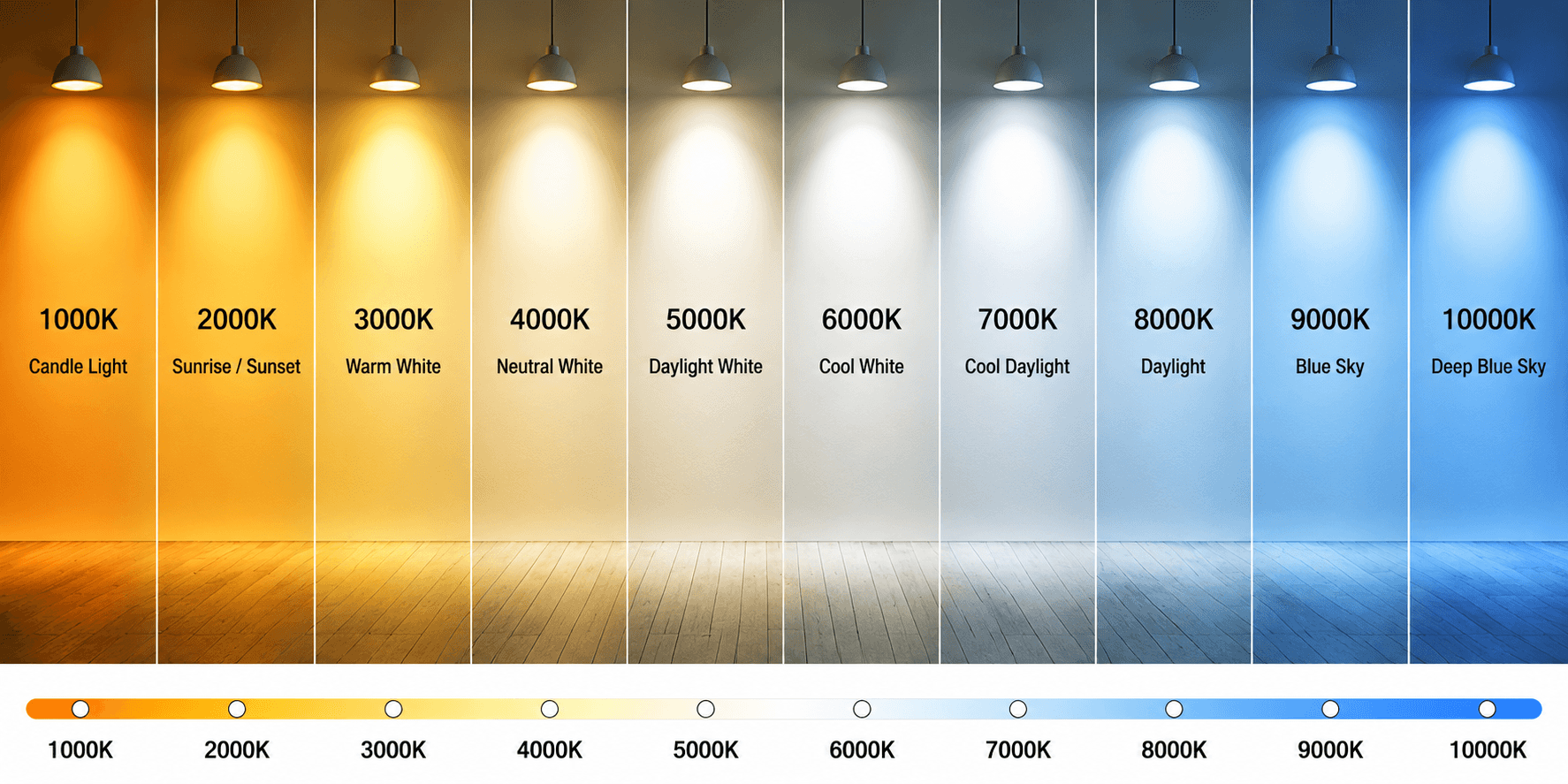
Heureusement, comparer les couleurs claires est facile. Le Kelvin (K) échelle montre à quel point une source de lumière apparaîtra chaude ou froide.
| Température de couleur | Apparence | Utilisation typique |
|---|---|---|
| 1000K | Aux chandelles | Ambiance déco |
| 2700K–3000K | Blanc chaud | Maisons, hôtels, restaurants |
| 3500K | Blanc neutre | Bureaux, écoles |
| 4000K | Blanc froid | Cuisines, salles de bains |
| 5000K–6 500K | Lumière du jour | Ateliers, vente au détail, bureaux |
| 9000K | Ciel bleu clair | Référence naturelle |
La plupart des fabricants impriment clairement le Cote Kelvin sur l'emballage et les spécifications du produit, ce qui facilite le choix de la bonne ampoule de remplacement.
Que faire si je ne connais pas la température de couleur de mes ampoules existantes?
Si votre ampoule actuelle n'affiche pas son indice Kelvin, Ne vous inquiétez pas.
La plupart des éclairages résidentiels se situent dans l'une de ces températures de couleur courantes:
- 2700K–3000K – Blanc chaud
- 3500K - Blanc
- 4000K – Blanc froid
- 6500K – Lumière du jour
En comparant votre éclairage existant avec ces gammes standards, vous pouvez généralement trouver la correspondance la plus proche.
Heureusement, lors de vos achats en ligne, la cote Kelvin est presque toujours indiquée dans les spécifications du produit, rendant le remplacement beaucoup plus facile.
2700K–3000K – Blanc chaud
Parmi toutes les températures de couleur, Blanc chaud est le choix le plus populaire pour l’éclairage résidentiel. Il ressemble beaucoup à la douce lueur des ampoules à incandescence traditionnelles et crée une ambiance accueillante., atmosphère relaxante.
Idéal pour
- Salons
- Chambres
- Salles à manger
- Hôtels
- Restaurants
- Éclairage décoratif
Avantages
- Crée une ambiance chaleureuse, ambiance chaleureuse
- Confortable pour une utilisation en soirée
- Idéal pour les ampoules à filament LED vintage et de style Edison
- Rehausse les meubles en bois et les couleurs intérieures chaleureuses
Dans l'ensemble, Warm White est le meilleur choix partout où le confort et la détente sont la priorité.
3500K – Blanc Neutre
Si vous recherchez un équilibre entre un éclairage chaud et froid, 3500K Blanc Neutre est un excellent choix. Il fournit propre, éclairage d'aspect naturel sans paraître trop jaune ou bleu.
Idéal pour
- Bureaux
- Écoles
- Espaces de réception
- Salles d'attente
- Espaces de vente au détail
- Couloirs
Avantages
- Confortable pour un usage quotidien
- Aspect couleur naturelle
- Convient aux espaces résidentiels et commerciaux
- Aide à réduire la fatigue oculaire lors d’une utilisation prolongée
Par conséquent, 3500K est une option populaire pour les espaces à usages multiples.
4000K – Blanc froid
Pour un éclairage quotidien plus lumineux, 4000K Blanc Froid est l’une des options les plus polyvalentes disponibles. Il produit du croustillant, éclairage propre avec très peu de teinte jaune, rendre les détails plus faciles à voir.
Idéal pour
- Cuisines
- Salles de bains
- Buanderies
- Ateliers
- Garage
- Éclairage de sécurité extérieur
Avantages
- Brillant, aspect propre
- Excellente précision des couleurs
- Idéal pour cuisiner, nettoyage, et toilettage
- Populaire dans les maisons et les bâtiments commerciaux
Par conséquent, 4000K est l'une des températures de couleur les plus couramment recommandées pour l'éclairage de travail..
6500K – Lumière du jour
Lorsqu’une luminosité et une visibilité maximales sont requises, 6500K Lumière du jour est souvent le choix préféré. Il ressemble beaucoup à la lumière naturelle du jour et produit une lumière blanche brillante avec une teinte bleue visible.
Idéal pour
- Bureaux
- Ateliers
- Présentoirs de vente au détail
- Ateliers de photographie
- Entrepôts
- Éclairage extérieur
Avantages
- Visibilité maximale
- Excellent rendu des couleurs
- Aide à améliorer la concentration
- Idéal là où une reconnaissance précise des couleurs est essentielle
Conseil: Évitez d'utiliser des ampoules 6500K dans les chambres ou les salons si vous préférez une atmosphère chaleureuse et relaxante.
Ampoules lumière du jour ou ampoules lumière du jour à spectre complet
Bien que ces termes soient souvent utilisés de manière interchangeable, Ampoules LED lumière du jour et Ampoules lumière du jour à spectre complet ne sont pas les mêmes.
UN 6500Ampoule lumière du jour K imite simplement la couleur de la lumière naturelle du jour.
UN Ampoule à spectre complet, cependant, est conçu pour produire une plus large gamme de longueurs d'onde visibles qui ressemblent davantage à la lumière naturelle du soleil. Ces lampes spécialisées sont couramment utilisées pour la photographie, croissance des plantes, et luminothérapie, y compris des applications qui peuvent aider les personnes touchées par Trouble affectif saisonnier (TRISTE).
Comment choisir la bonne température de couleur
La température de couleur idéale dépend de la façon dont la pièce est utilisée. Comme guide général, les recommandations suivantes fonctionnent bien pour la plupart des applications.
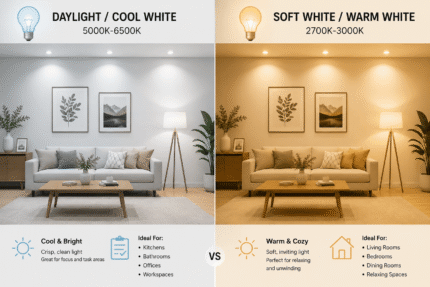
| Chambre | Température de couleur recommandée |
|---|---|
| Chambre à coucher | 2700K–3000K |
| Salon | 2700K–3000K |
| Salle à manger | 2700K–3000K |
| Cuisine | 4000K |
| Salle de bain | 4000K |
| Bureau à domicile | 4000K–5000K |
| Atelier | 5000K–6 500K |
| Affichage au détail | 5000K–6 500K |
| Sécurité extérieure | 4000K–6 500K |
Foire aux questions
Un Kelvin plus élevé signifie-t-il une ampoule plus lumineuse ??
Non. Kelvin mesure le couleur de la lumière, tandis que la luminosité est mesurée en lumens (LM). Deux ampoules ayant le même flux lumineux peuvent avoir des températures de couleur complètement différentes.
Est-ce que 3000K ou 4000K est mieux?
Ni l’un ni l’autre n’est universellement meilleur. 3000K crée une atmosphère chaleureuse et relaxante idéale pour les espaces de vie, alors que 4000K fournit plus de luminosité, un éclairage plus propre et mieux adapté aux cuisines, salles de bains, et zones de travail.
2 700 K est-il identique au blanc doux ??
Oui. La plupart des fabricants utilisent Blanc doux et Blanc chaud de manière interchangeable pour les ampoules autour 2700K. Bien que le libellé puisse varier légèrement selon les marques, ils produisent généralement la même chaleur, lumière confortable.
Quelle température de couleur est la meilleure pour les ampoules LED?
Il n’y a pas une seule meilleure option. La température de couleur idéale dépend de l'endroit où l'ampoule sera utilisée. Blanc chaud (2700K–3000K) fonctionne mieux pour les espaces de détente, tandis que Cool White (4000K) et la lumière du jour (5000K–6 500K) sont meilleurs pour l’éclairage de travail et les environnements de travail.
Quelle température de couleur est la meilleure pour une chambre?
La plupart des experts en éclairage recommandent 2700K–3000K, car la lumière chaude crée une atmosphère chaleureuse et favorise la détente.
Puis-je mélanger différentes températures de couleur?
Tu peux, mais il est généralement préférable de conserver la même température de couleur dans une même pièce. Un éclairage cohérent crée un environnement plus propre, apparence plus professionnelle.
Quelle température de couleur est la plus proche de la lumière naturelle du jour?
6500K ressemble le plus à la lumière naturelle du jour et est largement utilisé pour les ateliers, bureaux, présentoirs de vente au détail, et autres zones où une visibilité maximale est requise.
Pensées finales
Choisir le bon température de couleur est tout aussi important que de sélectionner le bon culot d'ampoule ou la bonne luminosité.. Que vous préfériez la lueur chaleureuse de 2700K, l'apparence équilibrée de 3500K, la clarté nette de 4000K, ou l'éclairage brillant de 6500K Lumière du jour, comprendre le Échelle Kelvin facilite la création de l'éclairage parfait pour chaque pièce.
Avant d'acheter des ampoules de remplacement, vérifiez toujours le Kelvin (K) note aux côtés du type de base et flux lumineux. La correspondance aux trois spécifications contribuera à garantir la cohérence, un éclairage confortable dans toute votre maison ou votre lieu de travail.
Huiyee Lighting est dans ce domaine depuis plus de 10 années. Cliquez ici pour plus d'options sur la température de couleur des ampoules LED.