 English
 العربية
 Français
 Deutsch
 Italiano
 Polski
 Português
 Русский
 Español
 Українська


Interdiction des ampoules CFL
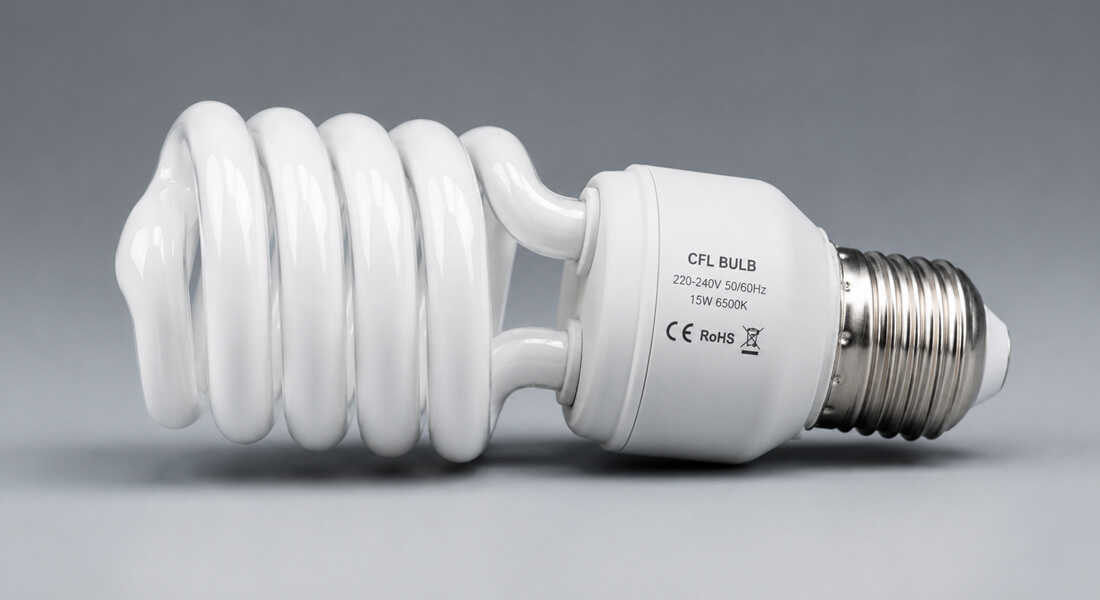
Depuis de nombreuses années, Ampoules CFL (Lampes fluorescentes compactes) étaient l'une des solutions d'éclairage à économie d'énergie les plus populaires pour les maisons et les entreprises. Cependant, la technologie d'éclairage a continué d'évoluer, et Ampoules CFL disparaissent progressivement du marché.
Bien que vous puissiez continuer à utiliser les Ampoules CFL, les fabricants ont arrêté leur production dans de nombreuses régions, ce qui signifie que les ampoules de remplacement deviendront de plus en plus difficiles à trouver. Donc, comprendre pourquoi Ampoules CFL sont progressivement éliminés – et quelles alternatives sont disponibles – est plus important que jamais.
Dans ce guide, tu apprendras pourquoi Ampoules CFL sont interdits, s'ils sont toujours disponibles, comment les recycler en toute sécurité, et pourquoi les ampoules LED sont devenues le remplacement préféré.
Qu’est-ce qu’une ampoule CFL exactement?
UN Lampe fluorescente compacte (Ampoule CFL) est une ampoule économe en énergie qui produit de la lumière en utilisant une petite quantité de vapeur de mercure.
Contrairement aux ampoules à incandescence traditionnelles, Ampoules CFL générer de la lumière par une réaction chimique plutôt que par un filament lumineux. À l'intérieur de chaque Ampoule CFL, l'électricité passe par le mercure et l'argon, créer des ultraviolets invisibles (UV) lumière. La lumière UV réagit ensuite avec la couche de phosphore à l'intérieur du tube de verre., produisant la lumière blanche visible que nous voyons.
Par conséquent, Ampoules CFL nécessitent une courte période de préchauffage avant d’atteindre la pleine luminosité. Leur conception distinctive en spirale ou en tube plié permet également Ampoules CFL pour s'adapter aux luminaires domestiques standards tout en occupant beaucoup moins d'espace que les tubes fluorescents traditionnels.
Les principales caractéristiques des ampoules CFL comprennent:
- Consomment beaucoup moins d'électricité que les ampoules à incandescence
- Dure beaucoup plus longtemps que les ampoules à filament traditionnelles
- Disponible en plusieurs puissances et températures de couleur
- Compatible avec les culots de lampes courants tels que E26, E27, E14, et B22
Pourquoi utilisons-nous des ampoules fluorescentes compactes?
Avant que la technologie LED ne devienne courante, Ampoules CFL représentait une percée dans l’éclairage économe en énergie.
Par rapport aux lampes à incandescence, Ampoules CFL typiquement:
- Consommer autour 70–80% d’électricité en moins
- Dernier 6–10 fois plus longtemps
- Produire moins de chaleur
- Offre une large gamme de niveaux de luminosité et de températures de couleur
En raison de ces avantages, Ampoules CFL est rapidement devenu le choix standard pour l'éclairage résidentiel et commercial.
Par exemple, Ampoules CFL ont été largement utilisés dans:
- Maisons
- Bureaux
- Hôtels
- Écoles
- Magasins de détail
- Plafonniers
- Lampes de table
- Couloirs
- Éclairage de salle de bain
- Éclairage décoratif pour étagères et miroirs
Cependant, les progrès de la technologie LED ont progressivement remplacé Ampoules CFL dans la plupart des applications. Aujourd'hui, Les ampoules LED offrent une efficacité encore plus grande tout en éliminant le besoin de mercure.
Pourquoi les ampoules CFL sont-elles interdites?
L'élimination progressive de Ampoules CFL est principalement motivée par la législation environnementale.
Spécifiquement, le Directive RoHS (Restriction des substances dangereuses) limite l’utilisation de matières dangereuses dans les produits électriques et électroniques. Depuis Ampoules CFL contenir du mercure, l'exemption permettant aux fabricants de produire de nombreuses lampes fluorescentes a expiré.
Par conséquent, la production de plusieurs produits d'éclairage fluorescents a été arrêtée.
Les principales dates d'élimination progressive comprennent:
- Lampes fluorescentes compactes (Ampoules CFL): 1 Février 2024
- Tubes fluorescents T5 et T8: 1 Février 2024
- Lampes fluorescentes circulaires T9: 24 Février 2025
Surtout, la législation ne concerne que la fabrication et la vente de produits neufs Ampoules CFL. Existant Ampoules CFL peuvent encore être utilisés jusqu’à la fin de leur durée de vie.
Entre-temps, plusieurs applications d’éclairage spécialisées restent exonérées, y compris:
- Éclairage de secours
- Matériel médical
- Éclairage alimenté par batterie
- Certains éclairages industriels
- Quelques applications artistiques et scientifiques
Finalement, l’objectif est de réduire la pollution au mercure tout en incitant les consommateurs à abandonner Ampoules CFL pour être plus sûr, éclairage LED plus économe en énergie.
Les ampoules CFL sont-elles toujours disponibles?
Oui, mais seulement tant que le stock actuel reste disponible.
Même si les fabricants ont cessé de produire de nombreux Ampoules CFL, les détaillants peuvent continuer à vendre leurs stocks existants jusqu'à ce que les stocks soient épuisés.
Donc, si vous utilisez actuellement Ampoules CFL, vous pouvez continuer à les utiliser sans restriction. Cependant, échec du remplacement Ampoules CFL deviendra de plus en plus difficile à mesure que le stock disparaîtra.
Pour cette raison, de nombreux propriétaires et entreprises sont déjà en train de passer de Ampoules CFL aux ampoules LED.
Les ampoules CFL sont-elles dangereuses?
Dans des conditions normales, Ampoules CFL sont considérés comme sûrs.
Chaque Ampoule CFL ne contient qu'une très petite quantité de mercure, qui reste scellé à l'intérieur du tube de verre lors d'une utilisation normale. Par conséquent, intact Ampoules CFL ne présentent pratiquement aucun risque pour la santé.
Cependant, si un Ampoule CFL pauses, une petite quantité de vapeur de mercure peut être libérée. Heureusement, la teneur en mercure est extrêmement faible, et suivre des procédures de nettoyage appropriées minimise tout risque potentiel.
Que dois-je faire si une LFC se brise?
Si un Ampoule CFL pauses, restez calme et suivez ces simples mesures de sécurité:
- D'abord, éloigner les personnes et les animaux de la zone.
- Suivant, ouvrez les fenêtres et aérez la pièce pendant au moins 10 à 15 minutes.
- Alors, éteignez tout système de chauffage ou de climatisation qui fait circuler l’air.
- Portez des gants jetables avant de manipuler des pièces cassées.
- Collectez soigneusement les gros fragments à l’aide de papier ou de carton rigide.
- Après, utilisez du ruban adhésif pour enlever les petits morceaux de verre et la poudre de phosphore.
- Évitez d'utiliser un aspirateur immédiatement, car cela pourrait propager des particules de mercure.
- Enfin, scellez tous les déchets dans un sac en plastique ou un contenant hermétique avant de les jeter conformément aux réglementations locales en matière de recyclage..
En suivant ces précautions, cassé Ampoules CFL peut être nettoyé en toute sécurité et de manière responsable.
Comment fonctionne le recyclage des ampoules CFL?
Parce que Ampoules CFL contenir du mercure, Les ampoules CFL ne doivent jamais être jetées dans les poubelles ménagères..
Plutôt, Ampoules CFL doit être apporté à des installations de recyclage agréées où le verre, métal, plastique, et le mercure peut être récupéré en toute sécurité.
Selon l'endroit où vous habitez, Recyclage des ampoules CFL peut être disponible via:
- Déchetteries domestiques
- Programmes de reprise au détail
- Sites de collecte de déchets dangereux
- Programmes de recyclage des DEEE
Un recyclage approprié aide à prévenir la pollution par le mercure tout en conservant les matériaux précieux pour la fabrication future.
Quelle est l’alternative aux CFL?
Aujourd'hui, Les ampoules LED sont largement reconnues comme le meilleur remplacement des ampoules CFL..
Par rapport à Ampoules CFL, les ampoules LED modernes offrent de meilleures performances dans presque toutes les catégories. En outre, Les ampoules LED consomment moins d'électricité, durer beaucoup plus longtemps, et ne contient pas de mercure.
| Fonctionnalité | Ampoules CFL | Ampoules LED |
|---|---|---|
| Efficacité énergétique | Haut | Très élevé |
| Durée de vie | 8,000–15 000 heures | 25,000–50 000 heures |
| Mercure | Oui | Non |
| Allumage instantané | Non | Oui |
| Commutation fréquente | Équitable | Excellent |
| Options à intensité variable | Limité | Largement disponible |
| Impact environnemental | Modéré | Faible |
Avant de remplacer Ampoules CFL, assurez-vous de choisir le bon:
- Pied de lampe (E26, E27, E14, B22, etc.)
- Forme de l'ampoule
- Luminosité (lumens)
- Température de couleur
- Version dimmable ou non
Par conséquent, passer de Ampoules CFL les ampoules LED peuvent réduire les coûts énergétiques, dépenses d'entretien réduites, et améliorer la qualité de l'éclairage. Sur notre site Internet, vous pouvez trouver des types d'ampoules LED pour différentes fonctions. Pour plus d'articles, s'il vous plaît vérifier Éclairage Huiyee.
Foire aux questions
Puis-je toujours utiliser mes ampoules CFL existantes?
Oui. Existant Ampoules CFL leur utilisation reste totalement légale jusqu'à ce qu'ils cessent de fonctionner naturellement.
Pourquoi les ampoules CFL sont-elles progressivement supprimées?
Parce que Ampoules CFL contenir du mercure, les réglementations environnementales telles que la directive RoHS ont mis fin aux exemptions qui permettaient auparavant leur fabrication.
Puis-je jeter les ampoules CFL à la poubelle?
Non. Parce que Ampoules CFL contenir du mercure, ils doivent toujours être recyclés par le biais de programmes approuvés de recyclage ou de collecte des déchets dangereux.
Les ampoules LED sont-elles plus lumineuses que les ampoules CFL?
Pas nécessairement. La luminosité dépend de lumens, pas de technologie d'ampoule. Cependant, Les ampoules LED produisent la même luminosité tout en consommant moins d'électricité que Ampoules CFL.
Les ampoules LED sont-elles meilleures que les ampoules CFL?
Oui. Dans l'ensemble, Les ampoules LED sont plus performantes Ampoules CFL en offrant des durées de vie plus longues, efficacité énergétique supérieure, éclairage instantané, entretien réduit, et fonctionnement sans mercure.
Conclusion
Dans l'ensemble, Ampoules CFL a joué un rôle important dans l’amélioration de l’efficacité énergétique et la réduction de la consommation d’électricité pendant de nombreuses années. Cependant, parce que Ampoules CFL contiennent du mercure et des technologies d'éclairage plus récentes sont maintenant disponibles, les gouvernements du monde entier les suppriment progressivement.
Heureusement, moderne Ampoules LED offrir un service plus sûr, plus efficace, et alternative plus durable. Si vous remplacez l'ancien Ampoules CFL, choisir des ampoules LED de haute qualité est le meilleur moyen de réduire les coûts énergétiques tout en bénéficiant de meilleures performances d'éclairage pour les années à venir.