 English
 العربية
 Français
 Deutsch
 Italiano
 Polski
 Português
 Русский
 Español
 Українська


Ampoule LED E26: Tout ce que vous devez savoir avant d'acheter
Acheter une ampoule LED devrait être simple. Cependant, une fois que vous commencez à comparer différents produits, les étiquettes peuvent vite devenir déroutantes. Une ampoule dit E26, un autre dit A19, tandis que d'autres affichent 800 lumens, 9 watts, 60W équivalent, ou 2700K. Bientôt, trouver la bonne ampoule de remplacement semble beaucoup plus compliqué qu'il ne le devrait.
Ampoule LED E26
Tout d'abord, il est important de comprendre que E26 se réfère uniquement à type de base à vis sur l'ampoule. C'est le cas pas décrire la forme de l'ampoule, luminosité, ou couleur.
Le Culot moyen E26 est la base à vis standard utilisée partout aux États-Unis, Canada, et autres pays fonctionnant sur des systèmes électriques 120 V. Par conséquent, il s'adapte à la grande majorité des luminaires résidentiels, y compris les plafonniers, lampes de table, lampadaires, lampes suspendues, appliques murales, lumières de vanité, et de nombreux aménagements extérieurs.
Pour mieux comprendre le nom, regardons son origine.
La désignation E26 vient du célèbre Vis Edison, inventé par Thomas Edison il y a plus d'un siècle. Malgré le développement rapide de la technologie LED, cette base filetée est restée la norme de l'industrie en raison de sa simplicité, fiabilité, et compatibilité.
Voici ce que signifie le code:
- E = Vis Edison
- 26 = La base à vis mesure 26 millimètres de diamètre
Parce que la norme de base est restée inchangée, les ampoules LED E26 modernes peuvent facilement remplacer les ampoules à incandescence traditionnelles, halogène, ou ampoules CFL sans changer vos luminaires existants.
Pourquoi choisir une ampoule LED E26?
Par rapport aux ampoules à incandescence traditionnelles, Les ampoules LED E26 offrent de nombreux avantages.
Ils:
- Consommer jusqu'à 80–90% d’électricité en moins
- Dernier entre 15,000 et 50,000 heures
- Génère beaucoup moins de chaleur
- Allumez instantanément sans temps de préchauffage
- Sont disponibles en différents niveaux de luminosité et températures de couleur
- Peut être dimmable lorsqu'il est associé à des gradateurs compatibles
En bref, ils permettent de réduire les factures d'énergie, durée de vie plus longue, et de meilleures performances d'éclairage globales, ce qui en fait le choix préféré pour les maisons modernes.
Dimensions de la base moyenne E26
Maintenant que vous savez ce qu'est un culot E26, regardons de plus près ses dimensions.
Bien que les ampoules LED se présentent sous de nombreuses formes et tailles différentes, chaque ampoule E26 partage le même culot à vis standardisé.
Les spécifications typiques incluent:
| Spécification | Dimension |
|---|---|
| Diamètre de base | 26 mm (1.02 pouces) |
| Type de filetage | Vis Edison |
| Tension standard | 120V et |
| Régions communes | États-Unis, Canada, Mexique |
Ces fils fournissent à la fois une connexion mécanique sécurisée et le contact électrique nécessaire pour alimenter l'ampoule en toute sécurité..
E26 contre. E27
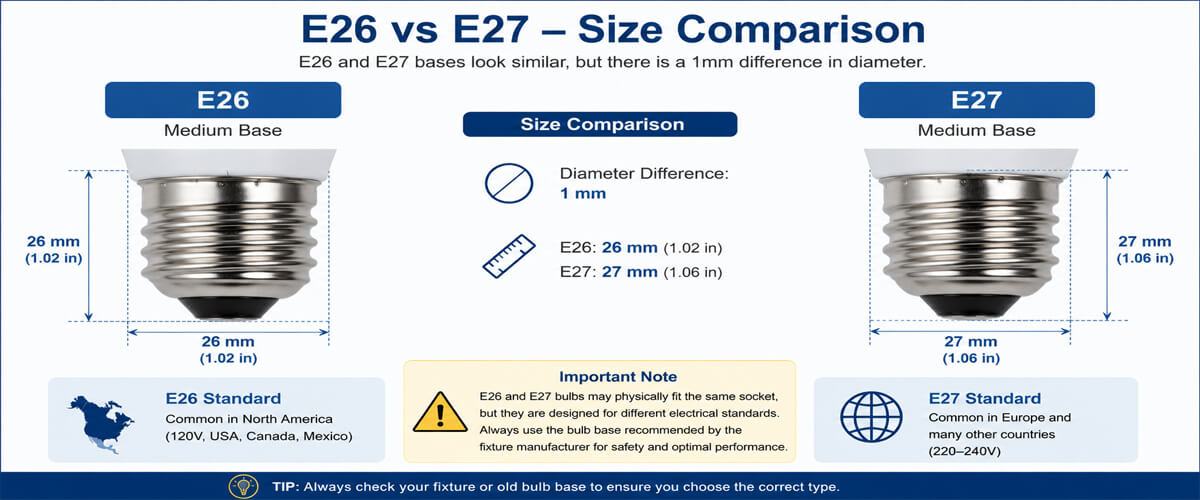
À première vue, E26 et E27 les ampoules semblent presque identiques. En fait, le diamètre de la base diffère seulement de 1 mm, ils peuvent donc souvent s'insérer dans la même prise.
Cependant, ils sont conçus pour différentes normes électriques.
- E26 — Norme nord-américaine (120V)
- E27 — Norme européenne (220–240V)
Bien qu'ils soient physiquement compatibles dans de nombreuses situations, il est toujours préférable d'utiliser le culot d'ampoule recommandé par le fabricant du luminaire pour garantir une sécurité et une performance optimales..
Codes de forme d'ampoule
Alors que E26 vous indique le type de base, ça ne vous dit pas à quoi ressemble réellement l'ampoule. C'est là codes de forme d'ampoule Entrez.
Les codes de forme d'ampoule sont un système standard de l'industrie utilisé pour identifier la forme et la taille d'une ampoule.. Ils facilitent grandement le remplacement d'une ampoule existante car vous pouvez rapidement en trouver une avec la même apparence et les mêmes dimensions..
Typiquement, chaque code est composé de:
- Une ou plusieurs lettres indiquant la forme de l'ampoule
- Un nombre représentant le diamètre maximum de l’ampoule en huitièmes de pouce
Certains des exemples les plus courants incluent:
| Code de l'ampoule | Forme | Applications typiques |
|---|---|---|
| A19 | Ampoule domestique standard | Éclairage général de la maison |
| ST19 / ST64 | Ampoule Edison vintage | Luminaires décoratifs |
| G25 | Ampoule globe | Éclairage de vanité de salle de bain |
| G40 | Grande ampoule globe | Lampes suspendues décoratives |
| B11 | Ampoule de bougie | Lustres et appliques murales |
| BR30 | Ampoule d'inondation | Éclairage encastré au plafond |
| PAR38 | Mettre en lumière | Éclairage de sécurité extérieur |
Par exemple, un A19 L'ampoule mesure environ 19/8 pouces (2.375 pouces) en diamètre.
Rappelez-vous simplement:
- E26 = Taille du socle
- A19, G25, ST19, B11 = Forme d'ampoule
Ensemble, ces spécifications décrivent entièrement la conception physique de l'ampoule.
Watts contre. Équivalent en watts
Après avoir identifié la bonne forme de base et d'ampoule, la prochaine spécification que vous remarquerez est la puissance.
De nombreuses personnes associent encore une puissance plus élevée à une lumière plus brillante. Même si cela était généralement vrai pour les ampoules à incandescence traditionnelles, cela ne s'applique plus aux LED modernes.
Puissance réelle
La puissance imprimée sur une ampoule LED indique combien d'électricité consomme l'ampoule, pas à quel point c'est brillant.
Les exemples incluent:
- 4LED W
- 6LED W
- 9LED W
- 12LED W
Puisque les LED sont très efficaces, ils nécessitent beaucoup moins d’énergie pour produire la même quantité de lumière. Pour une puissance plus élevée, nous pouvons personnaliser pour le client comme demandé. Si nécessaire, s'il vous plaît Contactez-nous directement.
Équivalent en watts
Pour faciliter la mise à niveau, les fabricants répertorient également un équivalent en watts.
Cela indique aux consommateurs quelle ampoule à incandescence la LED est conçue pour remplacer.
| Puissance des LED | Équivalent à incandescence |
|---|---|
| 4W | 40W |
| 6W | 60W |
| 9W | 75W |
| 12W | 100W |
| 15W | 150W |
Par exemple, un 9LED W peut produire à peu près la même luminosité qu'un 75Ampoule à incandescence W, tout en ne consommant qu'une fraction de l'électricité.
Donc, en comparant les ampoules LED, ne vous concentrez pas uniquement sur la puissance.
Lumens
Plutôt, prêter une attention particulière à indice de luminosité.
Lumens (LM) mesurer la quantité totale de lumière visible émise par une ampoule. En termes simples:
Plus la valeur du lumen est élevée, plus la lumière est brillante.
Contrairement aux watts, les lumens mesurent directement la luminosité, ce qui en fait le meilleur moyen de comparer les ampoules LED.
Voici quelques niveaux de luminosité courants:
| Luminosité | Lumens |
|---|---|
| Éclairage d'accentuation | 250–450 ml |
| Lampes de table | 450–800 ml |
| Éclairage général de la pièce | 800–1 100 ml |
| Éclairage de travail | 1,100–1 600 ml |
| Espaces très lumineux | 1,600+ LM |
Parce que différentes ampoules LED peuvent produire différents flux lumineux tout en consommant la même quantité d'électricité., les lumens sont l’indicateur de luminosité le plus fiable.
Température de couleur
Une fois que vous avez sélectionné la bonne luminosité, il est temps de considérer l’apparence de la lumière elle-même.
La température de couleur décrit si la lumière semble chaude, neutre, ou cool. Il est mesuré en Kelvin (K).
En général:
- Des valeurs Kelvin inférieures créent plus de chaleur, lumière aux tons jaunes.
- Des valeurs Kelvin plus élevées produisent une température plus fraîche, lumière plus blanche.
Les températures de couleur résidentielles les plus courantes comprennent:
| Température de couleur | Apparence | Idéal pour |
|---|---|---|
| 2200K | Aux chandelles | Éclairage vintage, restaurants |
| 2700K | Blanc chaud | Chambres, salons |
| 3000K | Blanc doux | Salles à manger, couloirs |
| 4000K | Blanc neutre | Cuisines, salles de bains |
| 5000K | Lumière du jour | Bureaux, garages, ateliers |
| 6500K | Lumière du jour fraîche | Espaces commerciaux et industriels |
Quelle température de couleur est la meilleure?
Finalement, la bonne température de couleur dépend de l'ambiance que vous souhaitez créer.
- 2700K–3000K crée un environnement confortable et relaxant.
- 4000K fournit un éclairage équilibré pour les activités quotidiennes.
- 5000K donne du croustillant, éclairage haute visibilité pour les zones de travail et les tâches détaillées.
Par conséquent, Choisir la température de couleur appropriée peut améliorer considérablement à la fois le confort et la fonctionnalité de votre espace..
Comment choisir la bonne ampoule LED E26
Maintenant que vous comprenez les spécifications de base, choisir la bonne ampoule devient beaucoup plus facile.
Avant de faire votre achat, considérez ces cinq facteurs:
- Confirmez que votre appareil utilise un Culot moyen E26.
- Choisissez la bonne forme d'ampoule, tel que A19, ST19, G25, ou B11.
- Comparer lumens pour déterminer la luminosité dont vous avez besoin.
- Sélectionnez un température de couleur qui correspond à votre chambre et à vos préférences personnelles.
- Recherchez des fonctionnalités supplémentaires telles que compatibilité de gradation, IRC élevé, ou fonctions d'éclairage intelligentes.
En suivant ces étapes simples, vous n'aurez aucun mal à sélectionner l'ampoule LED idéale pour votre application.
Conclusion
En résumé, choisir la bonne ampoule LED ne doit pas être une tâche difficile.
Une fois que tu as compris ce que E26, codes de forme d'ampoule, watts, équivalent en watts, lumens, et température de couleur signifie en fait, comparer les produits devient beaucoup plus simple.
Souviens-toi, un Ampoule LED E26 fait simplement référence à la norme 26 mm culot à vis Edison utilisé dans la plupart des foyers nord-américains. Les spécifications restantes vous indiquent le fonctionnement de l'ampoule : sa luminosité, combien d'énergie il utilise, et quel type de lumière il produit.
Enfin, ne jugez pas une ampoule LED uniquement par sa puissance. Pour la meilleure expérience d'éclairage, choisissez une ampoule avec le approprié flux lumineux, le droit température de couleur, et un Indice de rendu des couleurs (Cri) de 90 ou supérieur. Une ampoule LED à IRC élevé affiche les couleurs avec plus de précision, crée un environnement d'apparence plus naturelle, et améliore le confort visuel dans toute votre maison.
Avec une compréhension de base de ces spécifications, vous pourrez choisir en toute confiance l'ampoule LED E26 parfaite pour n'importe quelle pièce tout en bénéficiant d'une économie d'énergie, longue durée, et un éclairage de haute qualité pour les années à venir. Cliquez ici pour plus d'ampoules LED E26.