 English
 العربية
 Français
 Deutsch
 Italiano
 Polski
 Português
 Русский
 Español
 Українська


Temperatura de cor – o que significa?
Ao comprar uma lâmpada, você frequentemente encontrará termos como temperatura de cor, branco quente, branco legal, e luz do dia. Se você não tem certeza do que eles significam, você certamente não está sozinho.
No passado, escolher uma lâmpada foi simples porque a maioria das casas usava lâmpadas incandescentes tradicionais que produziam um brilho quente semelhante. Hoje, no entanto, LIDERADO, halogênio, e lâmpadas CFL estão disponíveis em uma ampla gama de temperaturas de cor. Como resultado, selecionar a cor de luz certa é tão importante quanto escolher a base da lâmpada ou o brilho correto.
Compreender a temperatura da cor ajuda a criar a atmosfera certa, melhorar a visibilidade, e garantir que as lâmpadas de reposição correspondam à iluminação existente.
O que é temperatura de cor?
Em termos simples, temperatura de cor descreve a aparência da luz branca produzida por uma fonte de luz. Em vez de medir o brilho, indica se a luz aparece esquentar (amarelo), neutro, ou legal (azul).
A temperatura da cor é medida em Kelvin (K).
- 2700K–3000K: Branco Quente
- 3500K: Branco Neutro
- 4000K: Branco frio
- 5000K–6500K: Luz do dia
Simplesmente lembre-se:
- Kelvin inferior = luz mais quente
- Kelvin mais alto = luz mais fria
É importante notar que a temperatura da cor não determina o brilho. O brilho é medido separadamente em lúmens (LM).
Por que a temperatura da cor é importante?
A temperatura da cor tem um impacto significativo na aparência e na atmosfera de uma sala.
Por exemplo, imagine que uma das três lâmpadas da sua cozinha queime. Você compra um substituto com a mesma base, forma, potência, e brilho. Depois de instalá-lo, no entanto, a nova lâmpada parece visivelmente diferente das outras – uma parece quente e amarela, enquanto o novo parece branco brilhante.
A razão é simples: as lâmpadas têm temperaturas de cor diferentes.
Mesmo que as lâmpadas produzam o mesmo número de lúmens, Classificações Kelvin incompatíveis podem fazer com que uma sala pareça inconsistente e menos atraente visualmente. Portanto, combinando com o Kelvin (K) a classificação é uma das maneiras mais fáceis de obter iluminação uniforme em toda a sua casa.
Gráfico de temperatura de cor (Escala Kelvin)
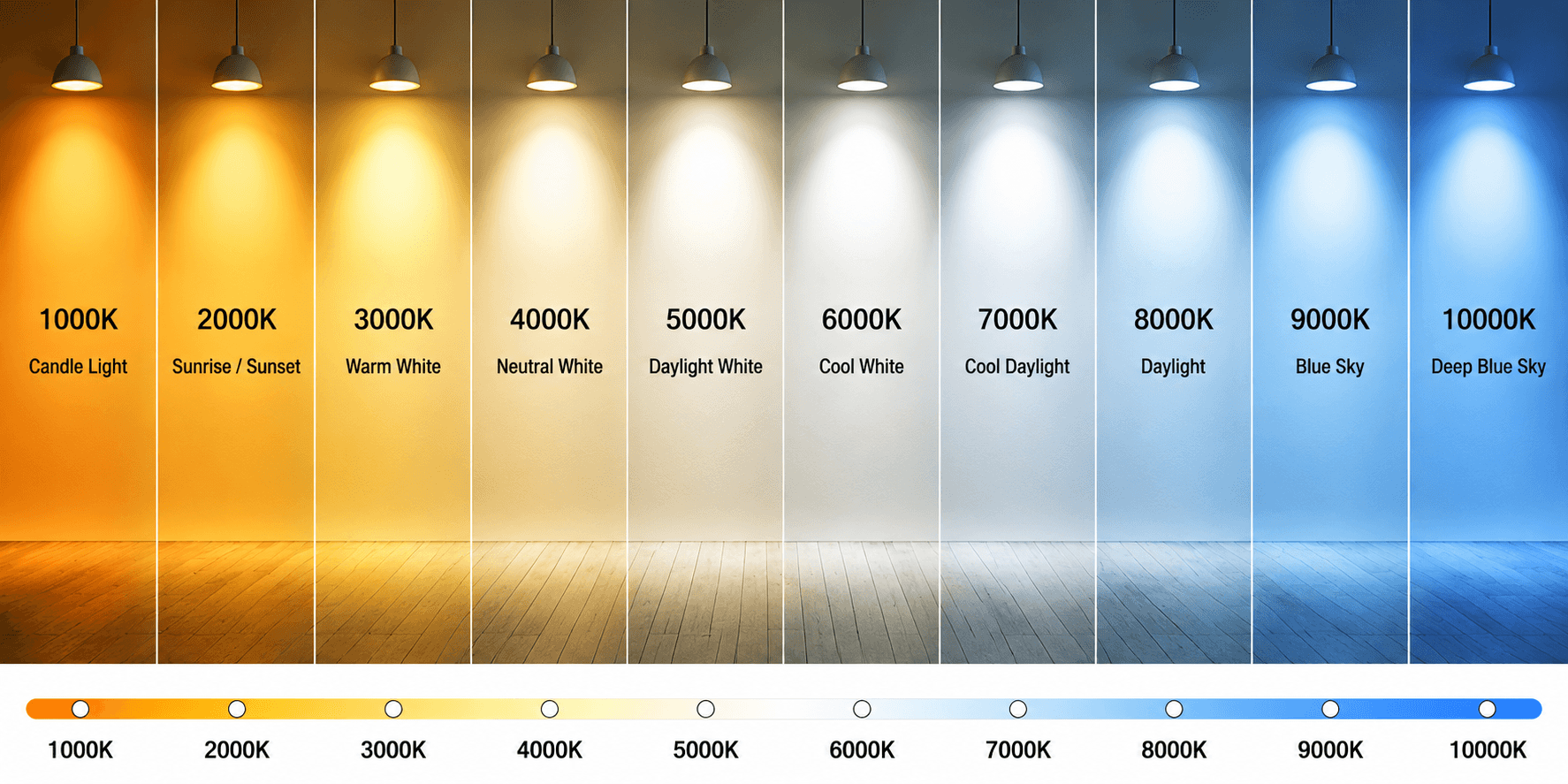
Felizmente, comparar cores claras é fácil. O Kelvin (K) escala mostra quão quente ou fria uma fonte de luz aparecerá.
| Temperatura de cor | Aparência | Uso típico |
|---|---|---|
| 1000K | Luz de velas | Ambiente decorativo |
| 2700K–3000K | Branco Quente | Casas, hotéis, restaurantes |
| 3500K | Branco Neutro | Escritórios, escolas |
| 4000K | Branco frio | Cozinhas, banheiros |
| 5000K–6500K | Luz do dia | Oficinas, varejo, escritórios |
| 9000K | Céu azul claro | Referência natural |
A maioria dos fabricantes imprime claramente o Classificação Kelvin tanto na embalagem quanto nas especificações do produto, facilitando a escolha da lâmpada de substituição correta.
E se eu não souber a temperatura da cor das minhas lâmpadas existentes?
Se a sua lâmpada atual não exibir a classificação Kelvin, não se preocupe.
A maior parte da iluminação residencial se enquadra em uma dessas temperaturas de cor comuns:
- 2700K–3000K – Branco Quente
- 3500K - Branco
- 4000K – Branco Frio
- 6500K – Luz do dia
Ao comparar a sua iluminação existente com estas gamas padrão, geralmente você pode encontrar a correspondência mais próxima.
Felizmente, ao fazer compras on-line, a classificação Kelvin quase sempre está listada nas especificações do produto, tornando a substituição muito mais fácil.
2700K–3000K – Branco Quente
Entre todas as temperaturas de cor, Branco Quente é a escolha mais popular para iluminação residencial. Assemelha-se muito ao brilho suave das lâmpadas incandescentes tradicionais e cria um ambiente acolhedor., atmosfera relaxante.
Melhor para
- Salas de estar
- Quartos
- Salas de jantar
- Hotéis
- Restaurantes
- Iluminação decorativa
Vantagens
- Cria um calor, atmosfera acolhedora
- Confortável para uso noturno
- Ideal para lâmpadas de filamento LED vintage e estilo Edison
- Melhora os móveis de madeira e as cores quentes do interior
Geral, Warm White é a melhor escolha onde o conforto e o relaxamento são a prioridade.
3500K – Branco Neutro
Se você está procurando um equilíbrio entre iluminação quente e fria, 3500K Branco Neutro é uma excelente escolha. Ele fornece limpeza, iluminação de aparência natural sem parecer excessivamente amarela ou azul.
Melhor para
- Escritórios
- Escolas
- Áreas de recepção
- Salas de espera
- Espaços de varejo
- Corredores
Vantagens
- Confortável para uso diário
- Aparência de cor natural
- Adequado para espaços residenciais e comerciais
- Ajuda a reduzir o cansaço visual durante o uso prolongado
Como resultado, 3500K é uma opção popular para espaços que atendem a múltiplos propósitos.
4000K – Branco Frio
Para uma iluminação diária mais brilhante, 4000K Branco Fresco é uma das opções mais versáteis disponíveis. Produz crocante, iluminação limpa com muito pouca tonalidade amarela, tornando os detalhes mais fáceis de ver.
Melhor para
- Cozinhas
- Banheiros
- Lavanderias
- Oficinas
- Garagens
- Iluminação de segurança externa
Vantagens
- Brilhante, aparência limpa
- Excelente precisão de cores
- Ideal para cozinhar, limpeza, e preparação
- Popular em residências e edifícios comerciais
Consequentemente, 4000K é uma das temperaturas de cor mais comumente recomendadas para iluminação de tarefas.
6500K – Luz do dia
Quando o brilho e a visibilidade máximos são necessários, 6500Luz do dia é muitas vezes a escolha preferida. Assemelha-se muito à luz natural do dia e produz uma luz branca brilhante com um tom azul perceptível..
Melhor para
- Escritórios
- Oficinas
- Expositores de varejo
- Estúdios de fotografia
- Armazéns
- Iluminação externa
Vantagens
- Visibilidade máxima
- Excelente renderização de cores
- Ajuda a melhorar a concentração
- Ideal onde o reconhecimento preciso das cores é essencial
Dica: Evite usar lâmpadas de 6500K em quartos ou salas se preferir um ambiente acolhedor e relaxante.
Luz diurna versus lâmpadas diurnas de espectro total
Embora esses termos sejam frequentemente usados de forma intercambiável, Lâmpadas LED diurnas e Lâmpadas de luz diurna de espectro total não são iguais.
UM 6500Lâmpada K de luz diurna simplesmente imita a cor da luz natural.
UM Lâmpada de espectro total, no entanto, é projetado para produzir uma gama mais ampla de comprimentos de onda visíveis que se assemelham mais à luz solar natural. Essas lâmpadas especializadas são comumente usadas para fotografia, crescimento das plantas, e terapia de luz, incluindo aplicativos que podem ajudar as pessoas afetadas por Transtorno Afetivo Sazonal (TRISTE).
Como escolher a temperatura de cor certa
A temperatura de cor ideal depende de como o ambiente é utilizado. Como guia geral, as recomendações a seguir funcionam bem para a maioria das aplicações.
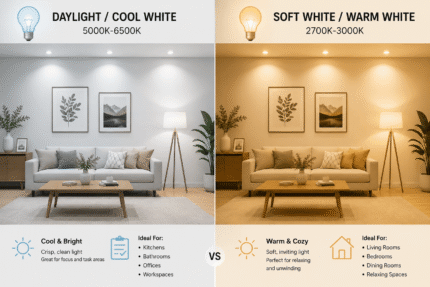
| Sala | Temperatura de cor recomendada |
|---|---|
| Quarto | 2700K–3000K |
| Sala de estar | 2700K–3000K |
| Sala de jantar | 2700K–3000K |
| Cozinha | 4000K |
| Banheiro | 4000K |
| Escritório em casa | 4000K–5000K |
| Oficina | 5000K–6500K |
| Exibição de varejo | 5000K–6500K |
| Segurança Externa | 4000K–6500K |
Perguntas frequentes
Um Kelvin mais alto significa uma lâmpada mais brilhante?
Não. Kelvin mede a cor da luz, enquanto o brilho é medido em lúmens (LM). Duas lâmpadas com a mesma saída luminosa podem ter temperaturas de cor completamente diferentes.
3.000K ou 4.000K é melhor?
Nenhum dos dois é universalmente melhor. 3000K cria uma atmosfera calorosa e relaxante, ideal para espaços residenciais, enquanto 4000K fornece mais brilho, iluminação mais limpa que é mais adequada para cozinhas, banheiros, e áreas de trabalho.
2700K é o mesmo que Soft White?
Sim. A maioria dos fabricantes usa Branco Suave e Branco Quente de forma intercambiável para lâmpadas ao redor 2700K. Embora o texto possa variar ligeiramente entre marcas, eles geralmente produzem o mesmo calor, luz confortável.
Qual temperatura de cor é melhor para lâmpadas LED?
Não existe uma única melhor opção. A temperatura de cor ideal depende de onde a lâmpada será usada. Branco Quente (2700K–3000K) funciona melhor para espaços relaxantes, enquanto Branco Fresco (4000K) e luz do dia (5000K–6500K) são melhores para iluminação de tarefas e ambientes de trabalho.
Qual temperatura de cor é melhor para um quarto?
A maioria dos especialistas em iluminação recomenda 2700K–3000K, pois a luz quente cria uma atmosfera acolhedora e ajuda a promover o relaxamento.
Posso misturar diferentes temperaturas de cores?
Você pode, mas geralmente é melhor manter a mesma temperatura de cor em um único ambiente. A iluminação consistente cria um ambiente mais limpo, aparência mais profissional.
Qual temperatura de cor está mais próxima da luz natural?
6500K se assemelha mais à luz natural do dia e é amplamente utilizado em oficinas, escritórios, displays de varejo, e outras áreas onde é necessária visibilidade máxima.
Considerações Finais
Escolhendo o certo temperatura de cor é tão importante quanto selecionar a base ou o brilho correto da lâmpada. Se você prefere o brilho quente de 2700K, a aparência equilibrada 3500K, a nítida clareza de 4000K, ou a iluminação brilhante de 6500Luz do dia, entendendo o Escala Kelvin torna mais fácil criar a iluminação perfeita para cada ambiente.
Antes de comprar lâmpadas de reposição, verifique sempre o Kelvin (K) classificação ao lado do tipo base e saída de lúmen. Corresponder todas as três especificações ajudará a garantir consistência, iluminação confortável em toda a sua casa ou local de trabalho.
A Huiyee Lighting está neste campo há mais de 10 anos. Clique aqui para mais opções sobre a temperatura de cor das lâmpadas LED.