 English
 العربية
 Français
 Deutsch
 Italiano
 Polski
 Português
 Русский
 Español
 Українська


Lâmpada LED E26: Tudo o que você precisa saber antes de comprar
Comprar uma lâmpada LED deve ser simples. No entanto, quando você começar a comparar produtos diferentes, os rótulos podem rapidamente se tornar confusos. Uma lâmpada diz E26, outro diz A19, enquanto outros exibem 800 lúmens, 9 Watts, 60Equivalente a W, ou 2700K. Em pouco tempo, encontrar a lâmpada de substituição certa parece muito mais complicado do que deveria.
Lâmpada LED E26
Em primeiro lugar, é importante entender isso E26 refere-se apenas ao tipo de base de parafuso na lâmpada. Isso acontece não descreva a forma da lâmpada, brilho, ou cor.
O Base média E26 é a base de parafuso padrão usada nos Estados Unidos, Canadá, e outros países que operam em sistemas elétricos de 120 V. Como resultado, cabe na grande maioria das luminárias residenciais, incluindo luzes de teto, candeeiros de mesa, luminárias de chão, luzes pendentes, arandelas de parede, luzes de vaidade, e muitas luminárias ao ar livre.
Para entender melhor o nome, vamos ver sua origem.
A designação E26 vem do famoso Parafuso Edison, inventado por Tomás Edison há mais de um século. Apesar do rápido desenvolvimento da tecnologia LED, esta base roscada permaneceu o padrão da indústria devido à sua simplicidade, confiabilidade, e compatibilidade.
Aqui está o que o código significa:
- E = Parafuso Edison
- 26 = A base do parafuso mede 26 milímetros de diâmetro
Porque o padrão básico permaneceu inalterado, as modernas lâmpadas LED E26 podem facilmente substituir as incandescentes tradicionais, halogênio, ou lâmpadas CFL sem alterar suas luminárias existentes.
Por que escolher uma lâmpada LED E26?
Comparado com lâmpadas incandescentes tradicionais, As lâmpadas LED E26 oferecem uma ampla gama de vantagens.
Eles:
- Consumir até 80–90% menos eletricidade
- Último entre 15,000 e 50,000 horas
- Gere significativamente menos calor
- Ligue instantaneamente sem tempo de aquecimento
- Estão disponíveis em vários níveis de brilho e temperaturas de cor
- Pode ser regulável quando emparelhado com interruptores dimmer compatíveis
Resumidamente, eles fornecem contas de energia mais baixas, vida útil mais longa, e melhor desempenho geral de iluminação, tornando-os a escolha preferida para casas modernas.
Dimensões básicas médias E26
Agora que você sabe o que é uma base E26, vamos dar uma olhada mais de perto em suas dimensões.
Embora as lâmpadas LED tenham muitos formatos e tamanhos diferentes, cada lâmpada E26 compartilha a mesma base de parafuso padronizada.
As especificações típicas incluem:
| Especificação | Dimensão |
|---|---|
| Diâmetro da base | 26 mm (1.02 polegadas) |
| Tipo de linha | Parafuso Edison |
| Tensão Padrão | 120V e |
| Regiões Comuns | Estados Unidos, Canadá, México |
Essas roscas fornecem uma conexão mecânica segura e o contato elétrico necessário para alimentar a lâmpada com segurança.
E26 versus. E27
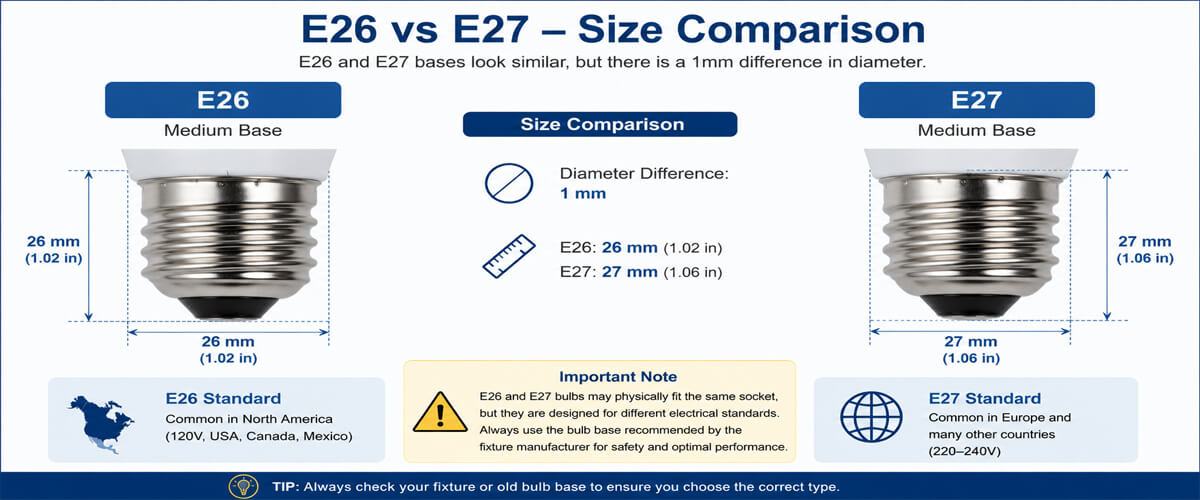
À primeira vista, E26 e E27 lâmpadas parecem quase idênticas. Na verdade, o diâmetro da base difere apenas em 1 mm, para que muitas vezes possam caber no mesmo soquete.
No entanto, eles são projetados para diferentes padrões elétricos.
- E26 — Padrão norte-americano (120V)
- E27 — padrão europeu (220–240 V)
Embora sejam fisicamente compatíveis em muitas situações, é sempre melhor usar a base da lâmpada recomendada pelo fabricante do aparelho para garantir segurança e desempenho ideais.
Códigos de formato de bulbo
Enquanto E26 informa o tipo de base, não diz como a lâmpada realmente se parece. É onde códigos de formato de bulbo entre.
Os códigos de formato de lâmpada são um sistema padrão da indústria usado para identificar a forma e o tamanho de uma lâmpada.. Eles tornam a substituição de uma lâmpada existente muito mais fácil porque você pode encontrar rapidamente uma com a mesma aparência e dimensões.
Tipicamente, cada código consiste em:
- Uma ou mais letras indicando o formato do bulbo
- Um número que representa o diâmetro máximo do bulbo em oitavos de polegada
Alguns dos exemplos mais comuns incluem:
| Código da lâmpada | Forma | Aplicações Típicas |
|---|---|---|
| A19 | Lâmpada doméstica padrão | Iluminação geral da casa |
| ST19 / ST64 | Lâmpada Edison vintage | Luminárias decorativas |
| G25 | Lâmpada globo | Iluminação de toucador de banheiro |
| G40 | Bulbo globo grande | Luzes pendentes decorativas |
| B11 | Lâmpada de vela | Lustres e arandelas de parede |
| BR30 | Bulbo de inundação | Iluminação embutida no teto |
| PAR38 | Destaque | Iluminação de segurança externa |
Por exemplo, um A19 a lâmpada mede aproximadamente 19/8 polegadas (2.375 polegadas) de diâmetro.
Simplesmente lembre-se:
- E26 = Tamanho base
- A19, G25, ST19, B11 = Formato do bulbo
Junto, estas especificações descrevem completamente o design físico da lâmpada.
Watts versus. Equivalente em Watts
Depois de identificar a base correta e o formato do bulbo, a próxima especificação que você notará é a potência.
Muitas pessoas ainda associam maior potência com luz mais brilhante. Embora isso geralmente fosse verdade para lâmpadas incandescentes tradicionais, não se aplica mais aos LEDs modernos.
Potência real
A potência impressa em uma lâmpada LED indica quanta eletricidade a lâmpada consome, não quão brilhante é.
Exemplos incluem:
- 4LED
- 6LED
- 9LED
- 12LED
Como os LEDs são altamente eficientes, eles exigem muito menos energia para produzir a mesma quantidade de luz. Para maior potência, podemos personalizar para o cliente conforme solicitado. Se necessário, por favor Contate-nos diretamente.
Equivalente em Watts
Para facilitar a atualização, os fabricantes também listam um equivalente em watts.
Isso informa aos consumidores qual lâmpada incandescente o LED foi projetado para substituir.
| Potência LED | Equivalente incandescente |
|---|---|
| 4C | 40C |
| 6C | 60C |
| 9C | 75C |
| 12C | 100C |
| 15C | 150C |
Por exemplo, um 9LED pode produzir aproximadamente o mesmo brilho que um tradicional 75Lâmpada incandescente W, enquanto consome apenas uma fração da eletricidade.
Portanto, ao comparar lâmpadas LED, não se concentre apenas na potência.
Lúmens
Em vez de, preste muita atenção ao classificação de lúmen.
Lúmens (LM) medir a quantidade total de luz visível emitida por uma lâmpada. Em termos simples:
Quanto maior o valor do lúmen, quanto mais brilhante a luz.
Ao contrário dos watts, lúmens medem diretamente o brilho, tornando-os a melhor maneira de comparar lâmpadas LED.
Aqui estão alguns níveis de brilho comuns:
| Brilho | Lúmens |
|---|---|
| Iluminação de destaque | 250–450lm |
| Candeeiros de mesa | 450–800lm |
| Iluminação geral da sala | 800–1.100lm |
| Iluminação de tarefas | 1,100–1.600lm |
| Espaços muito luminosos | 1,600+ LM |
Porque diferentes lâmpadas LED podem produzir diferentes saídas de lúmen enquanto consomem a mesma quantidade de eletricidade, os lúmens são o indicador de brilho mais confiável.
Temperatura de cor
Depois de selecionar o brilho certo, é hora de considerar a aparência da própria luz.
A temperatura da cor descreve se a luz parece quente, neutro, ou legal. É medido em Kelvin (K).
De um modo geral:
- Valores mais baixos de Kelvin criam mais calor, luz em tom amarelo.
- Valores Kelvin mais altos produzem mais frio, luz mais branca.
As temperaturas de cor residenciais mais comuns incluem:
| Temperatura de cor | Aparência | Melhor para |
|---|---|---|
| 2200K | Luz de velas | Iluminação vintage, restaurantes |
| 2700K | Branco Quente | Quartos, salas de estar |
| 3000K | Branco Suave | Salas de jantar, corredores |
| 4000K | Branco Neutro | Cozinhas, banheiros |
| 5000K | Luz do dia | Escritórios, garagens, oficinas |
| 6500K | Luz do dia fresca | Espaços comerciais e industriais |
Qual temperatura de cor é melhor?
Em última análise, a temperatura de cor certa depende da atmosfera que você deseja criar.
- 2700K–3000K cria um ambiente aconchegante e relaxante.
- 4000K fornece iluminação equilibrada para atividades diárias.
- 5000K oferece nítido, iluminação de alta visibilidade para áreas de trabalho e tarefas detalhadas.
Como resultado, escolher a temperatura de cor apropriada pode melhorar drasticamente o conforto e a funcionalidade do seu espaço.
Como escolher a lâmpada LED E26 certa
Agora que você entende as especificações básicas, escolher a lâmpada certa fica muito mais fácil.
Antes de fazer sua compra, considere estes cinco fatores:
- Confirme se seu aparelho usa um Base média E26.
- Escolha o formato correto da lâmpada, como A19, ST19, G25, ou B11.
- Comparar lúmens para determinar o brilho que você precisa.
- Selecione um temperatura de cor que corresponda ao seu quarto e preferência pessoal.
- Verifique se há recursos adicionais como compatibilidade de escurecimento, IRC alto, ou funções de iluminação inteligente.
Seguindo estes passos simples, você não terá problemas para selecionar a lâmpada LED ideal para sua aplicação.
Conclusão
Resumindo, escolher a lâmpada LED certa não precisa ser uma tarefa difícil.
Depois de entender o que E26, códigos de formato de bulbo, Watts, equivalente em watts, lúmens, e temperatura de cor realmente significa, comparar produtos fica muito mais simples.
Lembrar, um Lâmpada LED E26 refere-se simplesmente ao padrão 26 base de parafuso Edison mm usado na maioria dos lares norte-americanos. As especificações restantes informam o desempenho da lâmpada – quão brilhante ela é, quanta energia ele usa, e que tipo de luz ela produz.
Finalmente, não julgue uma lâmpada LED apenas pela potência. Para a melhor experiência de iluminação, escolha uma lâmpada com o apropriado saída de lúmen, a direita temperatura de cor, e um Índice de reprodução de cores (Cri) de 90 ou superior. Uma lâmpada LED de alto CRI exibe as cores com mais precisão, cria um ambiente de aparência mais natural, e melhora o conforto visual em toda a sua casa.
Com uma compreensão básica dessas especificações, você poderá escolher com segurança a lâmpada LED E26 perfeita para qualquer ambiente enquanto desfruta de economia de energia, duradouro, e iluminação de alta qualidade nos próximos anos. Clique aqui para mais lâmpadas LED E26.