 English
 العربية
 Français
 Deutsch
 Italiano
 Polski
 Português
 Русский
 Español
 Українська


Colour Temperature – What Does It Mean?
When shopping for a light bulb, you’ll often come across terms like colour temperature, warm white, cool white, and daylight. If you’re not sure what they mean, you’re certainly not alone.
In the past, choosing a light bulb was simple because most homes used traditional incandescent bulbs that all produced a similar warm glow. Today, however, LED, halogen, and CFL bulbs are available in a wide range of colour temperatures. As a result, selecting the right light colour is just as important as choosing the correct bulb base or brightness.
Understanding colour temperature helps you create the right atmosphere, improve visibility, and ensure replacement bulbs match your existing lighting.
What Is Colour Temperature?
In simple terms, colour temperature describes the appearance of white light produced by a light source. Rather than measuring brightness, it indicates whether the light appears warm (yellow), neutral, or cool (blue).
Colour temperature is measured in Kelvin (K).
- 2700K–3000K: Warm White
- 3500K: Neutral White
- 4000K: Cool White
- 5000K–6500K: Daylight
Simply remember:
- Lower Kelvin = Warmer light
- Higher Kelvin = Cooler light
It’s important to note that colour temperature does not determine brightness. Brightness is measured separately in lumens (lm).
Why Does Colour Temperature Matter?
Colour temperature has a significant impact on the appearance and atmosphere of a room.
For example, imagine one of the three light bulbs in your kitchen burns out. You buy a replacement with the same base, shape, wattage, and brightness. After installing it, however, the new bulb looks noticeably different from the others—one appears warm and yellow, while the new one looks bright white.
The reason is simple: the bulbs have different colour temperatures.
Even if bulbs produce the same number of lumens, mismatched Kelvin ratings can make a room feel inconsistent and less visually appealing. Therefore, matching the Kelvin (K) rating is one of the easiest ways to achieve uniform lighting throughout your home.
Colour Temperature Chart (Kelvin Scale)
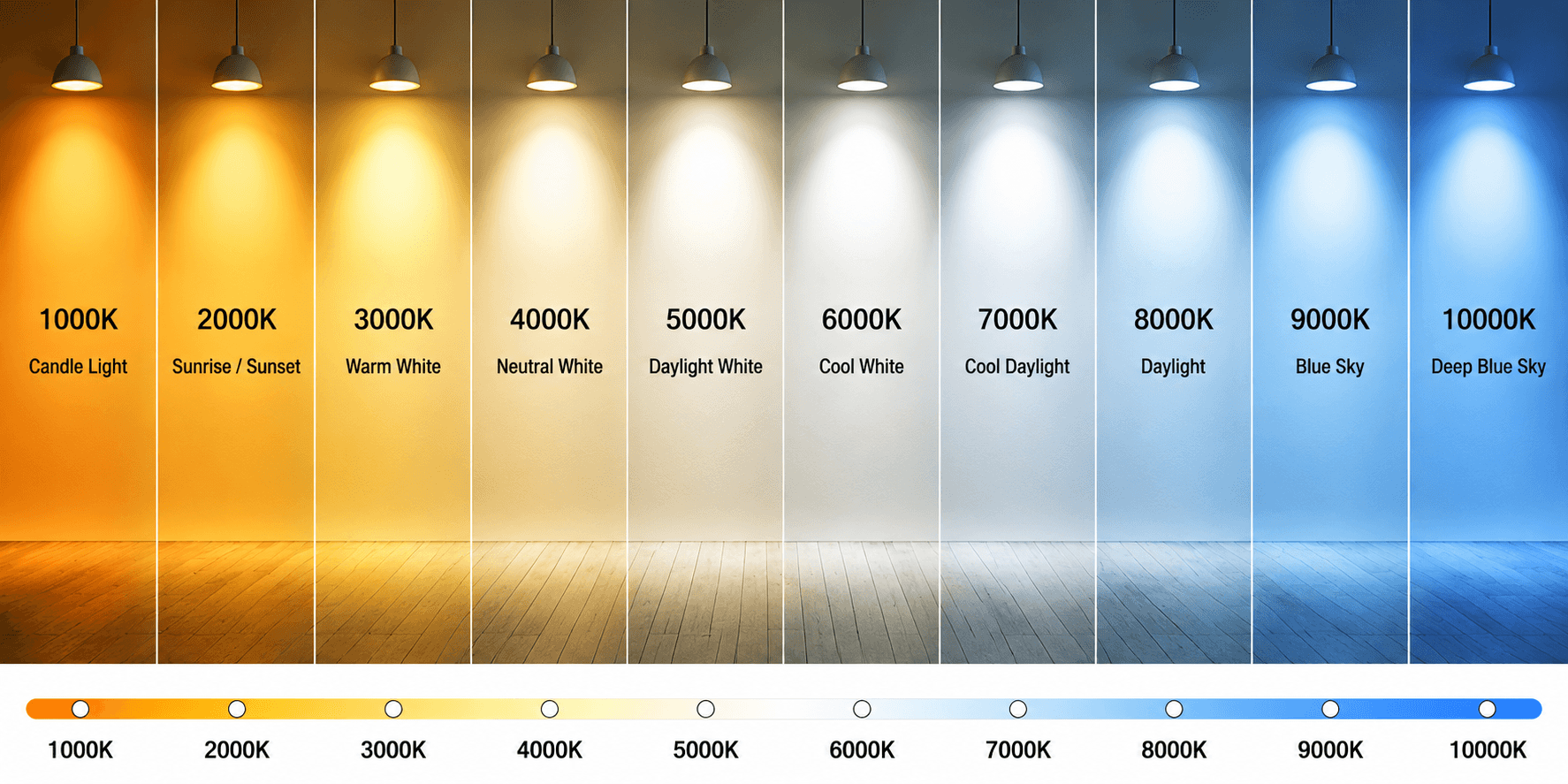
Fortunately, comparing light colours is easy. The Kelvin (K) scale shows how warm or cool a light source will appear.
| Colour Temperature | Appearance | Typical Use |
|---|---|---|
| 1000K | Candlelight | Decorative ambience |
| 2700K–3000K | Warm White | Homes, hotels, restaurants |
| 3500K | Neutral White | Offices, schools |
| 4000K | Cool White | Kitchens, bathrooms |
| 5000K–6500K | Daylight | Workshops, retail, offices |
| 9000K | Clear blue sky | Natural reference |
Most manufacturers clearly print the Kelvin rating on both the packaging and product specifications, making it easy to choose the correct replacement bulb.
What If I Don’t Know the Colour Temperature of My Existing Bulbs?
If your current bulb doesn’t display its Kelvin rating, don’t worry.
Most residential lighting falls into one of these common colour temperatures:
- 2700K–3000K – Warm White
- 3500K – White
- 4000K – Cool White
- 6500K – Daylight
By comparing your existing lighting with these standard ranges, you can usually find the closest match.
Fortunately, when shopping online, the Kelvin rating is almost always listed in the product specifications, making replacement much easier.
2700K–3000K – Warm White
Among all colour temperatures, Warm White is the most popular choice for residential lighting. It closely resembles the soft glow of traditional incandescent bulbs and creates a welcoming, relaxing atmosphere.
Best for
- Living rooms
- Bedrooms
- Dining rooms
- Hotels
- Restaurants
- Decorative lighting
Advantages
- Creates a warm, cosy atmosphere
- Comfortable for evening use
- Ideal for vintage and Edison-style LED filament bulbs
- Enhances wood furniture and warm interior colours
Overall, Warm White is the best choice wherever comfort and relaxation are the priority.
3500K – Neutral White
If you’re looking for a balance between warm and cool lighting, 3500K Neutral White is an excellent choice. It provides clean, natural-looking illumination without appearing overly yellow or blue.
Best for
- Offices
- Schools
- Reception areas
- Waiting rooms
- Retail spaces
- Hallways
Advantages
- Comfortable for everyday use
- Natural colour appearance
- Suitable for both residential and commercial spaces
- Helps reduce eye strain during extended use
As a result, 3500K is a popular option for spaces that serve multiple purposes.
4000K – Cool White
For brighter everyday lighting, 4000K Cool White is one of the most versatile options available. It produces crisp, clean illumination with very little yellow tint, making details easier to see.
Best for
- Kitchens
- Bathrooms
- Laundry rooms
- Workshops
- Garages
- Outdoor security lighting
Advantages
- Bright, clean appearance
- Excellent colour accuracy
- Ideal for cooking, cleaning, and grooming
- Popular in both homes and commercial buildings
Consequently, 4000K is one of the most commonly recommended colour temperatures for task lighting.
6500K – Daylight
When maximum brightness and visibility are required, 6500K Daylight is often the preferred choice. It closely resembles natural daylight and produces a bright white light with a noticeable blue tint.
Best for
- Offices
- Workshops
- Retail displays
- Photography studios
- Warehouses
- Outdoor lighting
Advantages
- Maximum visibility
- Excellent colour rendering
- Helps improve concentration
- Ideal where accurate colour recognition is essential
Tip: Avoid using 6500K bulbs in bedrooms or living rooms if you prefer a warm and relaxing atmosphere.
Daylight vs Full-Spectrum Daylight Bulbs
Although these terms are often used interchangeably, Daylight LED bulbs and Full-Spectrum Daylight bulbs are not the same.
A 6500K Daylight bulb simply mimics the colour of natural daylight.
A Full-Spectrum bulb, however, is engineered to produce a wider range of visible wavelengths that more closely resemble natural sunlight. These specialised lamps are commonly used for photography, plant growth, and light therapy, including applications that may help people affected by Seasonal Affective Disorder (SAD).
How to Choose the Right Colour Temperature
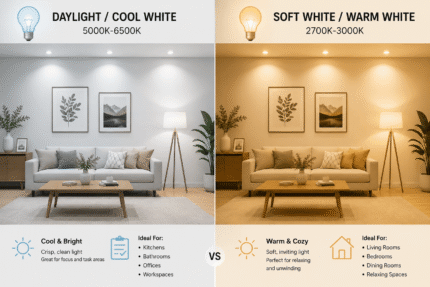
The ideal colour temperature depends on how the room is used. As a general guide, the following recommendations work well for most applications.
| Room | Recommended Colour Temperature |
|---|---|
| Bedroom | 2700K–3000K |
| Living Room | 2700K–3000K |
| Dining Room | 2700K–3000K |
| Kitchen | 4000K |
| Bathroom | 4000K |
| Home Office | 4000K–5000K |
| Workshop | 5000K–6500K |
| Retail Display | 5000K–6500K |
| Outdoor Security | 4000K–6500K |
Frequently Asked Questions
Does a higher Kelvin mean a brighter bulb?
No. Kelvin measures the colour of the light, while brightness is measured in lumens (lm). Two bulbs with the same lumen output can have completely different colour temperatures.
Is 3000K or 4000K better?
Neither is universally better. 3000K creates a warm and relaxing atmosphere that’s ideal for living spaces, while 4000K provides brighter, cleaner illumination that’s better suited to kitchens, bathrooms, and work areas.
Is 2700K the same as Soft White?
Yes. Most manufacturers use Soft White and Warm White interchangeably for bulbs around 2700K. Although the wording may vary slightly between brands, they generally produce the same warm, comfortable light.
Which colour temperature is best for LED bulbs?
There isn’t a single best option. The ideal colour temperature depends on where the bulb will be used. Warm White (2700K–3000K) works best for relaxing spaces, while Cool White (4000K) and Daylight (5000K–6500K) are better for task lighting and work environments.
What colour temperature is best for a bedroom?
Most lighting experts recommend 2700K–3000K, as the warm light creates a cosy atmosphere and helps promote relaxation.
Can I mix different colour temperatures?
You can, but it’s generally best to keep the same colour temperature within a single room. Consistent lighting creates a cleaner, more professional appearance.
What colour temperature is closest to natural daylight?
6500K most closely resembles natural daylight and is widely used for workshops, offices, retail displays, and other areas where maximum visibility is required.
Final Thoughts
Choosing the right colour temperature is just as important as selecting the correct bulb base or brightness. Whether you prefer the warm glow of 2700K, the balanced appearance of 3500K, the crisp clarity of 4000K, or the bright illumination of 6500K Daylight, understanding the Kelvin scale makes it easier to create the perfect lighting for every room.
Before purchasing replacement bulbs, always check the Kelvin (K) rating alongside the base type and lumen output. Matching all three specifications will help ensure consistent, comfortable lighting throughout your home or workplace.
Huiyee Lighting has been in this field for more than 10 years. Click here for more options on the color temperature for the LED bulbs.