 English
 العربية
 Français
 Deutsch
 Italiano
 Polski
 Português
 Русский
 Español
 Українська


CFL Light Bulb Ban
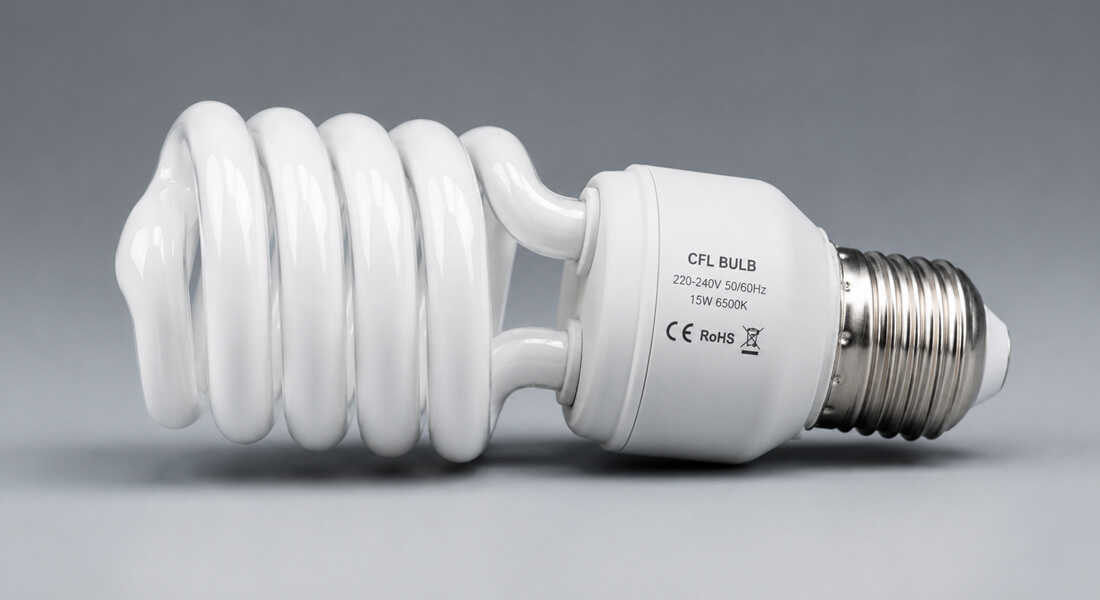
For many years, CFL bulbs (Compact Fluorescent Lamps) were one of the most popular energy-saving lighting solutions for homes and businesses. However, lighting technology has continued to evolve, and CFL bulbs are now gradually disappearing from the market.
Although you can continue using existing CFL bulbs, manufacturers have ended production in many regions, meaning replacement bulbs will become increasingly difficult to find. Therefore, understanding why CFL light bulbs are being phased out—and what alternatives are available—is more important than ever.
In this guide, you’ll learn why CFL bulbs are being banned, whether they’re still available, how to recycle them safely, and why LED bulbs have become the preferred replacement.
What Exactly Is a CFL Bulb?
A Compact Fluorescent Lamp (CFL bulb) is an energy-efficient light bulb that produces light using a small amount of mercury vapor.
Unlike traditional incandescent bulbs, CFL bulbs generate light through a chemical reaction rather than a glowing filament. Inside every CFL bulb, electricity passes through mercury and argon gas, creating invisible ultraviolet (UV) light. The UV light then reacts with the phosphor coating inside the glass tube, producing the visible white light we see.
As a result, CFL bulbs require a short warm-up period before reaching full brightness. Their distinctive spiral or folded tube design also allows CFL bulbs to fit standard household light fittings while occupying much less space than traditional fluorescent tubes.
Key features of CFL bulbs include:
- Use significantly less electricity than incandescent bulbs
- Last much longer than traditional filament bulbs
- Available in multiple wattages and colour temperatures
- Compatible with common lamp bases such as E26, E27, E14, and B22
Why Do We Use Compact Fluorescent Bulbs?
Before LED technology became mainstream, CFL bulbs represented a breakthrough in energy-efficient lighting.
Compared with incandescent lamps, CFL bulbs typically:
- Consume around 70–80% less electricity
- Last 6–10 times longer
- Produce less heat
- Offer a wide range of brightness levels and colour temperatures
Because of these advantages, CFL bulbs quickly became the standard choice for residential and commercial lighting.
For example, CFL bulbs have been widely used in:
- Homes
- Offices
- Hotels
- Schools
- Retail stores
- Ceiling fixtures
- Table lamps
- Hallways
- Bathroom lighting
- Decorative shelf and mirror lighting
However, advances in LED technology have gradually replaced CFL bulbs in most applications. Today, LED bulbs provide even greater efficiency while eliminating the need for mercury.
Why Are CFL Bulbs Being Banned?
The phase-out of CFL bulbs is primarily driven by environmental legislation.
Specifically, the RoHS Directive (Restriction of Hazardous Substances) limits the use of hazardous materials in electrical and electronic products. Since CFL bulbs contain mercury, the exemption allowing manufacturers to produce many fluorescent lamps has expired.
Consequently, production of several fluorescent lighting products has stopped.
Key phase-out dates include:
- Compact Fluorescent Lamps (CFL bulbs): 1 February 2024
- T5 and T8 fluorescent tubes: 1 February 2024
- T9 circular fluorescent lamps: 24 February 2025
Importantly, the legislation only affects the manufacture and sale of new CFL bulbs. Existing CFL bulbs can still be used until they reach the end of their lifespan.
Meanwhile, several specialist lighting applications remain exempt, including:
- Emergency lighting
- Medical equipment
- Battery-powered lighting
- Certain industrial lighting
- Some artistic and scientific applications
Ultimately, the goal is to reduce mercury pollution while encouraging consumers to switch from CFL bulbs to safer, more energy-efficient LED lighting.
Are CFL Light Bulbs Still Available?
Yes—but only while current stock remains available.
Although manufacturers have stopped producing many CFL bulbs, retailers may continue selling existing inventory until supplies are exhausted.
Therefore, if you currently use CFL light bulbs, you can continue using them without restriction. However, replacing failed CFL bulbs will become increasingly difficult as stock disappears.
For this reason, many homeowners and businesses are already upgrading from CFL bulbs to LED bulbs.
Are CFL Light Bulbs Dangerous?
Under normal conditions, CFL bulbs are considered safe.
Each CFL bulb contains only a very small amount of mercury, which remains sealed inside the glass tube during normal use. Consequently, intact CFL bulbs pose virtually no health risk.
However, if a CFL bulb breaks, a small amount of mercury vapor may be released. Fortunately, the mercury content is extremely low, and following proper cleanup procedures minimizes any potential risk.
What Should I Do If a CFL Breaks?
If a CFL bulb breaks, remain calm and follow these simple safety steps:
- First, keep people and pets away from the area.
- Next, open windows and ventilate the room for at least 10–15 minutes.
- Then, turn off any heating or air-conditioning systems that circulate air.
- Wear disposable gloves before handling broken pieces.
- Carefully collect large fragments using stiff paper or cardboard.
- Afterwards, use sticky tape to remove smaller glass pieces and phosphor powder.
- Avoid using a vacuum cleaner immediately, as this may spread mercury particles.
- Finally, seal all waste inside a plastic bag or airtight container before disposing of it according to local recycling regulations.
By following these precautions, broken CFL bulbs can be cleaned up safely and responsibly.
How Does CFL Bulb Recycling Work?
Because CFL bulbs contain mercury, CFL bulbs should never be placed in household rubbish bins.
Instead, CFL bulbs should be taken to approved recycling facilities where the glass, metal, plastic, and mercury can all be safely recovered.
Depending on where you live, CFL bulb recycling may be available through:
- Household recycling centres
- Retail take-back programs
- Hazardous waste collection sites
- WEEE recycling schemes
Proper recycling helps prevent mercury pollution while conserving valuable materials for future manufacturing.
What’s the Alternative to CFL?
Today, LED bulbs are widely recognised as the best replacement for CFL bulbs.
Compared with CFL bulbs, modern LED bulbs provide better performance in almost every category. In addition, LED bulbs consume less electricity, last significantly longer, and contain no mercury.
| Feature | CFL Bulbs | LED Bulbs |
|---|---|---|
| Energy Efficiency | High | Very High |
| Lifespan | 8,000–15,000 hours | 25,000–50,000 hours |
| Mercury | Yes | No |
| Instant On | No | Yes |
| Frequent Switching | Fair | Excellent |
| Dimmable Options | Limited | Widely Available |
| Environmental Impact | Moderate | Low |
Before replacing CFL bulbs, make sure you choose the correct:
- Lamp base (E26, E27, E14, B22, etc.)
- Bulb shape
- Brightness (lumens)
- Colour temperature
- Dimmable or non-dimmable version
As a result, switching from CFL bulbs to LED bulbs can reduce energy costs, lower maintenance expenses, and improve lighting quality. On our website, you can find kinds of LED bulbs for different functions. For more items, pls check Huiyee Lighting.
Frequently Asked Questions
Can I still use my existing CFL bulbs?
Yes. Existing CFL bulbs remain completely legal to use until they stop working naturally.
Why are CFL bulbs being phased out?
Because CFL bulbs contain mercury, environmental regulations such as the RoHS Directive have ended exemptions that previously allowed their manufacture.
Can I throw CFL bulbs in the trash?
No. Because CFL bulbs contain mercury, they should always be recycled through approved recycling or hazardous waste collection programs.
Are LED bulbs brighter than CFL bulbs?
Not necessarily. Brightness depends on lumens, not bulb technology. However, LED bulbs produce the same brightness while using less electricity than CFL bulbs.
Are LED bulbs better than CFL bulbs?
Yes. Overall, LED bulbs outperform CFL bulbs by offering longer lifespans, higher energy efficiency, instant illumination, lower maintenance, and mercury-free operation.
Conclusion
Overall, CFL bulbs played an important role in improving energy efficiency and reducing electricity consumption for many years. However, because CFL bulbs contain mercury and newer lighting technologies are now available, governments around the world are gradually phasing them out.
Fortunately, modern LED bulbs offer a safer, more efficient, and longer-lasting alternative. If you’re replacing old CFL bulbs, choosing high-quality LED bulbs is the best way to reduce energy costs while enjoying better lighting performance for years to come.