 English
 العربية
 Français
 Deutsch
 Italiano
 Polski
 Português
 Русский
 Español
 Українська


E26 LED Bulb: Everything You Need to Know Before Buying
Shopping for an LED bulb should be simple. However, once you start comparing different products, the labels can quickly become confusing. One bulb says E26, another says A19, while others display 800 lumens, 9 watts, 60W equivalent, or 2700K. Before long, finding the right replacement bulb feels much more complicated than it should.
E26 LED Bulb
First of all, it’s important to understand that E26 refers only to the type of screw base on the light bulb. It does not describe the bulb’s shape, brightness, or color.
The E26 medium base is the standard screw base used throughout the United States, Canada, and other countries operating on 120V electrical systems. As a result, it fits the vast majority of residential lighting fixtures, including ceiling lights, table lamps, floor lamps, pendant lights, wall sconces, vanity lights, and many outdoor fixtures.
To better understand the name, let’s look at its origin.
The designation E26 comes from the famous Edison Screw, invented by Thomas Edison more than a century ago. Despite the rapid development of LED technology, this threaded base has remained the industry standard because of its simplicity, reliability, and compatibility.
Here’s what the code means:
- E = Edison Screw
- 26 = The screw base measures 26 millimeters in diameter
Because the base standard has remained unchanged, modern E26 LED bulbs can easily replace traditional incandescent, halogen, or CFL bulbs without changing your existing fixtures.
Why Choose an E26 LED Bulb?
Compared with traditional incandescent bulbs, E26 LED bulbs offer a wide range of advantages.
They:
- Consume up to 80–90% less electricity
- Last between 15,000 and 50,000 hours
- Generate significantly less heat
- Turn on instantly with no warm-up time
- Are available in various brightness levels and color temperatures
- Can be dimmable when paired with compatible dimmer switches
In short, they provide lower energy bills, longer service life, and better overall lighting performance, making them the preferred choice for modern homes.
E26 Medium Base Dimensions
Now that you know what an E26 base is, let’s take a closer look at its dimensions.
Although LED bulbs come in many different shapes and sizes, every E26 bulb shares the same standardized screw base.
Typical specifications include:
| Specification | Dimension |
|---|---|
| Base Diameter | 26 mm (1.02 inches) |
| Thread Type | Edison Screw |
| Standard Voltage | 120V AC |
| Common Regions | United States, Canada, Mexico |
These threads provide both a secure mechanical connection and the electrical contact needed to power the bulb safely.
E26 vs. E27
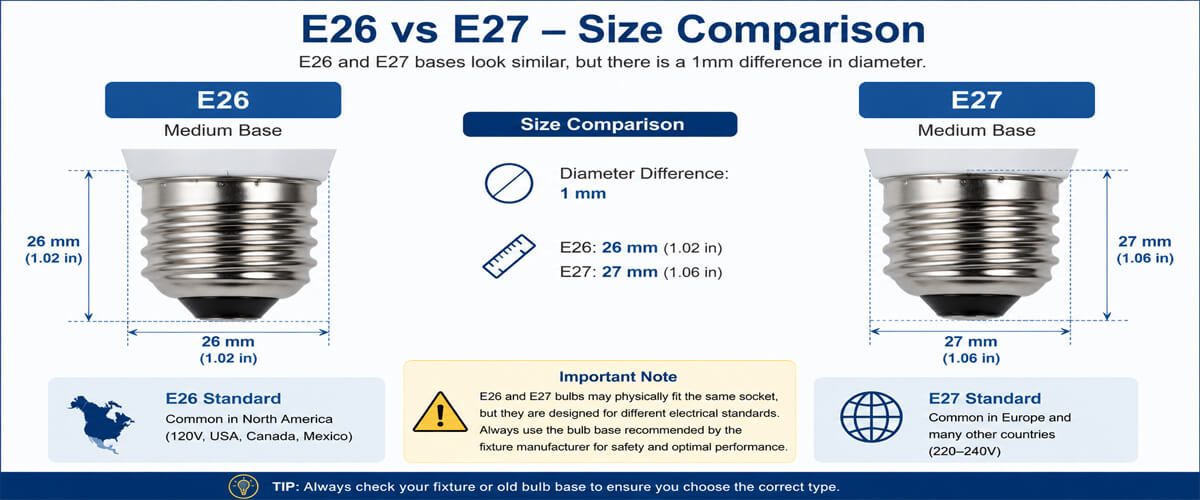
At first glance, E26 and E27 bulbs appear almost identical. In fact, the base diameter differs by only 1 mm, so they can often fit into the same socket.
However, they are designed for different electrical standards.
- E26 — North American standard (120V)
- E27 — European standard (220–240V)
Although they are physically compatible in many situations, it’s always best to use the bulb base recommended by the fixture manufacturer to ensure optimal safety and performance.
Bulb Shape Codes
While E26 tells you the base type, it doesn’t tell you what the bulb actually looks like. That’s where bulb shape codes come in.
Bulb shape codes are an industry-standard system used to identify a bulb’s shape and size. They make replacing an existing bulb much easier because you can quickly find one with the same appearance and dimensions.
Typically, each code consists of:
- One or more letters indicating the bulb shape
- A number representing the bulb’s maximum diameter in eighths of an inch
Some of the most common examples include:
| Bulb Code | Shape | Typical Applications |
|---|---|---|
| A19 | Standard household bulb | General home lighting |
| ST19 / ST64 | Vintage Edison bulb | Decorative fixtures |
| G25 | Globe bulb | Bathroom vanity lighting |
| G40 | Large globe bulb | Decorative pendant lights |
| B11 | Candle bulb | Chandeliers and wall sconces |
| BR30 | Flood bulb | Recessed ceiling lighting |
| PAR38 | Spotlight | Outdoor security lighting |
For example, an A19 bulb measures approximately 19/8 inches (2.375 inches) in diameter.
Simply remember:
- E26 = Base size
- A19, G25, ST19, B11 = Bulb shape
Together, these specifications fully describe the physical design of the bulb.
Watts vs. Watt Equivalent
After identifying the correct base and bulb shape, the next specification you’ll notice is wattage.
Many people still associate higher wattage with brighter light. While this was generally true for traditional incandescent bulbs, it no longer applies to modern LEDs.
Actual Wattage
The wattage printed on an LED bulb indicates how much electricity the bulb consumes, not how bright it is.
Examples include:
- 4W LED
- 6W LED
- 9W LED
- 12W LED
Since LEDs are highly efficient, they require much less power to produce the same amount of light. For higher wattage, we can customize for the customer as requested. If needed, pls contact us directly.
Watt Equivalent
To make upgrading easier, manufacturers also list a watt equivalent.
This tells consumers which incandescent bulb the LED is designed to replace.
| LED Wattage | Incandescent Equivalent |
|---|---|
| 4W | 40W |
| 6W | 60W |
| 9W | 75W |
| 12W | 100W |
| 15W | 150W |
For example, a 9W LED can produce roughly the same brightness as a traditional 75W incandescent bulb, while consuming only a fraction of the electricity.
Therefore, when comparing LED bulbs, don’t focus on wattage alone.
Lumens
Instead, pay close attention to the lumen rating.
Lumens (lm) measure the total amount of visible light emitted by a bulb. In simple terms:
The higher the lumen value, the brighter the light.
Unlike watts, lumens directly measure brightness, making them the best way to compare LED bulbs.
Here are some common brightness levels:
| Brightness | Lumens |
|---|---|
| Accent Lighting | 250–450 lm |
| Table Lamps | 450–800 lm |
| General Room Lighting | 800–1,100 lm |
| Task Lighting | 1,100–1,600 lm |
| Very Bright Spaces | 1,600+ lm |
Because different LED bulbs can produce different lumen outputs while consuming the same amount of electricity, lumens are the most reliable indicator of brightness.
Color Temperature
Once you’ve selected the right brightness, it’s time to consider the appearance of the light itself.
Color temperature describes whether light appears warm, neutral, or cool. It is measured in Kelvin (K).
Generally speaking:
- Lower Kelvin values create warmer, yellow-toned light.
- Higher Kelvin values produce cooler, whiter light.
The most common residential color temperatures include:
| Color Temperature | Appearance | Best For |
|---|---|---|
| 2200K | Candlelight | Vintage lighting, restaurants |
| 2700K | Warm White | Bedrooms, living rooms |
| 3000K | Soft White | Dining rooms, hallways |
| 4000K | Neutral White | Kitchens, bathrooms |
| 5000K | Daylight | Offices, garages, workshops |
| 6500K | Cool Daylight | Commercial and industrial spaces |
Which Color Temperature Is Best?
Ultimately, the right color temperature depends on the atmosphere you want to create.
- 2700K–3000K creates a cozy and relaxing environment.
- 4000K provides balanced lighting for everyday activities.
- 5000K delivers crisp, high-visibility illumination for work areas and detailed tasks.
As a result, choosing the appropriate color temperature can dramatically improve both the comfort and functionality of your space.
How to Choose the Right E26 LED Bulb
Now that you understand the basic specifications, choosing the right bulb becomes much easier.
Before making your purchase, consider these five factors:
- Confirm your fixture uses an E26 medium base.
- Choose the correct bulb shape, such as A19, ST19, G25, or B11.
- Compare lumens to determine the brightness you need.
- Select a color temperature that matches your room and personal preference.
- Check for additional features like dimming compatibility, high CRI, or smart lighting functions.
By following these simple steps, you’ll have no trouble selecting the ideal LED bulb for your application.
Conclusion
In summary, choosing the right LED bulb doesn’t have to be overwhelming.
Once you understand what E26, bulb shape codes, watts, watt equivalent, lumens, and color temperature actually mean, comparing products becomes much simpler.
Remember, an E26 LED bulb simply refers to the standard 26 mm Edison screw base used in most North American homes. The remaining specifications tell you how the bulb will perform—how bright it is, how much energy it uses, and what type of light it produces.
Finally, don’t judge an LED bulb by wattage alone. For the best lighting experience, choose a bulb with the appropriate lumen output, the right color temperature, and a Color Rendering Index (CRI) of 90 or higher. A high-CRI LED bulb displays colors more accurately, creates a more natural-looking environment, and improves visual comfort throughout your home.
With a basic understanding of these specifications, you’ll be able to confidently choose the perfect E26 LED bulb for any room while enjoying energy-efficient, long-lasting, and high-quality lighting for years to come. Click here for more E26 LED bulbs.