 English
 العربية
 Français
 Deutsch
 Italiano
 Polski
 Português
 Русский
 Español
 Українська


Comprendre la puissance d'une puce LED
Introduction
Alors que l'éclairage LED continue de remplacer les ampoules à incandescence et CFL traditionnelles, de plus en plus d'acheteurs prêtent attention à un élément petit mais essentiel : le Puce LED. Que vous achetiez des ampoules LED, ampoules à filament, éclairage commercial, ou luminaires décoratifs, la qualité de la puce LED détermine directement la luminosité, efficacité, durée de vie, et les performances globales du produit.
Pour commencer, comprendre le fonctionnement d'une puce LED peut vous aider à comparer plus efficacement les produits d'éclairage. Au lieu de se concentrer uniquement sur le prix, vous pourrez évaluer l’efficacité énergétique, fiabilité, et valeur à long terme.
Donc, qu'est-ce qu'une puce LED exactement? Plus important encore, pourquoi les acheteurs devraient-ils se soucier du type de puce LED utilisé dans une ampoule?
Explorons tout ce que vous devez savoir du point de vue d'un acheteur.
Le cœur de l’éclairage LED
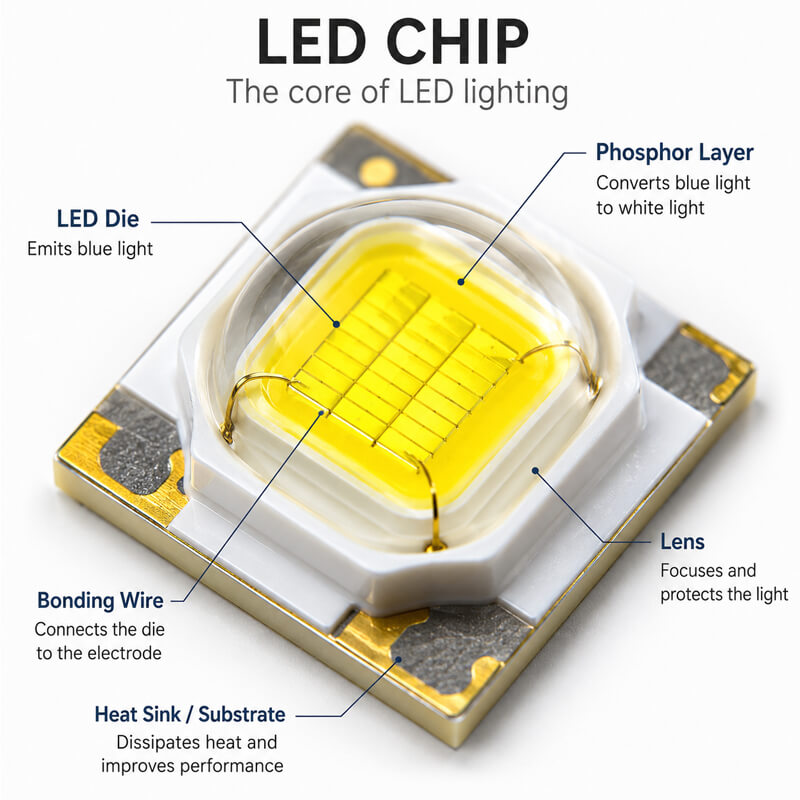
À la base, un Puce LED (Puce de diode électroluminescente) est le composant produisant de la lumière à l'intérieur de chaque lampe LED. Il s'agit d'un minuscule semi-conducteur qui convertit l'énergie électrique directement en lumière visible grâce à un processus appelé électroluminescence.
Contrairement à ampoules à incandescence traditionnelles, qui génèrent de la lumière en chauffant un filament de tungstène, Les puces LED produisent de la lumière beaucoup plus efficacement tout en générant très peu de chaleur.
Par conséquent, L'éclairage LED offre plusieurs avantages significatifs, y compris:
- Consommation d’énergie réduite
- Luminosité plus élevée
- Durée de vie plus longue
- Moins de génération de chaleur
- Coûts de maintenance réduits
- Des performances respectueuses de l'environnement
En raison de ces avantages, Les puces LED sont devenues la base de la technologie d'éclairage moderne. Que vous achetiez des ampoules domestiques ou des luminaires commerciaux, la qualité de la puce LED influencera directement les performances globales.
Un aperçu de la composition
Même si une puce LED est incroyablement petite, il se compose de plusieurs couches conçues avec précision qui fonctionnent ensemble pour offrir des performances d'éclairage fiables.
Typiquement, une puce LED comprend:
- Matériau semi-conducteur (généralement du nitrure de gallium ou de l'arséniure de gallium)
- Électrodes conductrices
- Substrat conducteur de chaleur
- Encapsulation protectrice
- Lentille optique ou revêtement phosphore
Parmi ces composants, le substrat conducteur de chaleur joue un rôle particulièrement important. Étant donné qu'une chaleur excessive peut réduire à la fois la luminosité et la durée de vie, une gestion thermique efficace est essentielle.
En outre, de nombreux fabricants de LED haut de gamme utilisent des matériaux de haute qualité tels que:
- Substrats céramiques
- Cartes de circuits imprimés en cuivre
- Dissipateurs thermiques en aluminium
- Lentilles en silicone à haute transmission
Par conséquent, ces matériaux améliorent la dissipation thermique, permettant aux puces LED de maintenir une luminosité stable et de fonctionner efficacement pendant des dizaines de milliers d'heures.
Pour les acheteurs, poser des questions sur la conception thermique est tout aussi important que vérifier la puissance ou le flux lumineux.
La merveille de la miniaturisation
L'une des caractéristiques les plus remarquables de la technologie LED est sa taille compacte..
En fait, Les puces LED modernes ne mesurent que quelques millimètres de diamètre. Malgré leurs petites dimensions, ils peuvent générer une quantité impressionnante de lumière.
En fonction de l'application d'éclairage, un produit peut contenir:
- Une puce LED haute puissance
- Plusieurs puces LED SMD
- Modules LED COB
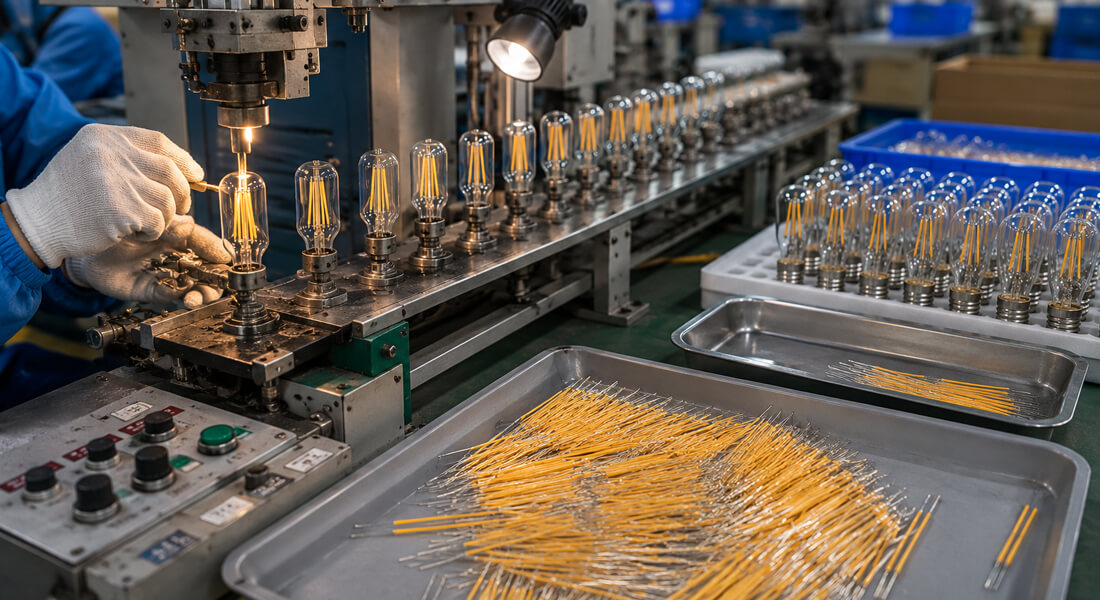
- Des centaines de puces de filament LED
Grâce à cette miniaturisation, les fabricants peuvent concevoir des modèles plus minces, plus léger, et des luminaires plus attrayants sans compromettre la luminosité.
Aujourd'hui, Les puces LED sont largement utilisées dans:
- Ampoules LED
- Bulbes de filament LED
- Lampes suspendues
- Lustres
- Appliques murales
- Projecteurs
- Éclairage de jardin
- Éclairage public
- Éclairage automobile
- Éclairage commercial
Donc, La technologie LED offre aux concepteurs une plus grande flexibilité tout en répondant à la demande croissante de solutions d'éclairage modernes.
Plus lumineux, Plus petit, Plus durable
Au cours de la dernière décennie, La technologie des puces LED a évolué rapidement.
Alors que la technologie continue de progresser, les fabricants produisent des puces LED qui sont:
- Plus lumineux
- Plus petit
- Plus économe en énergie
- Meilleure dissipation de la chaleur
- Plus durable
Aujourd'hui, de nombreuses puces LED haut de gamme offrent des efficacités dépassant 150 lumens par watt, tandis que les produits commerciaux avancés peuvent réaliser plus de 200 lumens par watt dans des conditions idéales.
Pour les acheteurs, cela signifie des coûts d'exploitation inférieurs et de meilleures performances d'éclairage.
Luminosité plus élevée
Les puces LED modernes produisent beaucoup plus de lumens tout en consommant moins d'électricité.
Par exemple:
- Ampoule à incandescence traditionnelle 60W → environ 800 lumens
- Ampoule LED moderne 8W → environ 800 lumens
Par conséquent, les utilisateurs bénéficient de la même luminosité tout en réduisant la consommation électrique jusqu'à 85%.
Durée de vie plus longue
Un autre avantage majeur est la durabilité.
Les puces LED de haute qualité durent généralement:
- 25,000 heures
- 35,000 heures
- 50,000 heures ou plus
Par conséquent, les entreprises et les propriétaires dépensent moins en ampoules de remplacement et en entretien.
Meilleure qualité des couleurs
En outre, Les puces LED haut de gamme offrent un excellent rendu des couleurs.
Pour la plupart des applications, les acheteurs devraient considérer:
- Cri 80+ pour l'éclairage résidentiel
- Cri 90+ pour le commerce de détail, hospitalité, galeries, et intérieurs haut de gamme
Cela signifie les couleurs semblent plus naturelles, vibrant, et confortable à l'œil humain.
Fiabilité améliorée
Tout aussi important, la technologie de fabrication avancée minimise:
- Décroissance de la lumière
- Changement de couleur
- Vacillant
- Défaillance précoce de la puce
Donc, l'éclairage reste stable et cohérent tout au long de sa durée de vie.
L'avenir est radieux
La technologie des puces LED continue d'évoluer chaque année.
Regarder vers l'avenir, plusieurs tendances importantes façonnent l’avenir de l’industrie de l’éclairage.
Efficacité énergétique supérieure
Les fabricants développent des puces LED qui produisent plus de lumière tout en consommant encore moins d'électricité..
Par conséquent, les entreprises peuvent réduire considérablement leurs coûts d’exploitation et réduire leurs émissions de carbone.
Intégration d'éclairage intelligent
Entre-temps, Les puces LED sont de plus en plus compatibles avec les systèmes d'éclairage intelligents.
Les solutions d’éclairage intelligentes d’aujourd’hui prennent en charge:
- Contrôle Wi-Fi
- Connectivité Bluetooth
- Assistants vocaux
- Capteurs de mouvement
- Gradation automatique
- Températures de couleur réglables
Par conséquent, les utilisateurs bénéficient d'un plus grand confort, confort, et économies d'énergie.
Éclairage centré sur l'humain
En outre, Les puces LED blanches réglables permettent à l'éclairage d'imiter la lumière naturelle tout au long de la journée..
Cela contribue à améliorer le confort, concentration, et le bien-être général dans les foyers, bureaux, écoles, et environnements de soins de santé.
Fabrication durable
En même temps, les fabricants adoptent des méthodes de production plus écologiques en réduisant les matières dangereuses, améliorer le recyclage, et accroître l'efficacité de la fabrication.
Donc, La technologie des puces LED continue de soutenir les objectifs mondiaux de développement durable.
Adoptez la révolution LED
Bien que la puce LED soit l'un des plus petits composants d'un produit d'éclairage, c'est lui qui a le plus grand impact sur les performances globales.
Finalement, la qualité de la puce LED détermine la luminosité, efficace, fiable, et durable, une lumière LED sera.
Lorsque l'on compare les produits d'éclairage LED, les acheteurs devraient évaluer plus que le prix.
Plutôt, faites attention à des facteurs tels que:
- Qualité et marque des puces
- Sortie lumineuse
- Efficacité lumineuse (lm/W)
- Indice de rendu des couleurs (Cri)
- Température de couleur (CCT)
- Conception de dissipation thermique
- Durée de vie nominale
- Garantie constructeur
En considérant ces facteurs, les acheteurs peuvent sélectionner des produits d'éclairage offrant de meilleures performances, coûts d'entretien réduits, et une plus grande valeur à long terme.
En résumé, investir dans une technologie de puces LED de haute qualité signifie investir dans un éclairage plus lumineux, factures d'énergie réduites, et un avenir plus durable. Que vous recherchiez de l'éclairage pour la maison, hôtels, bureaux, espaces de vente au détail, ou projets commerciaux, Choisir des produits construits avec des puces LED fiables est une décision judicieuse qui continuera à porter ses fruits pendant des années..