 English
 العربية
 Français
 Deutsch
 Italiano
 Polski
 Português
 Русский
 Español
 Українська


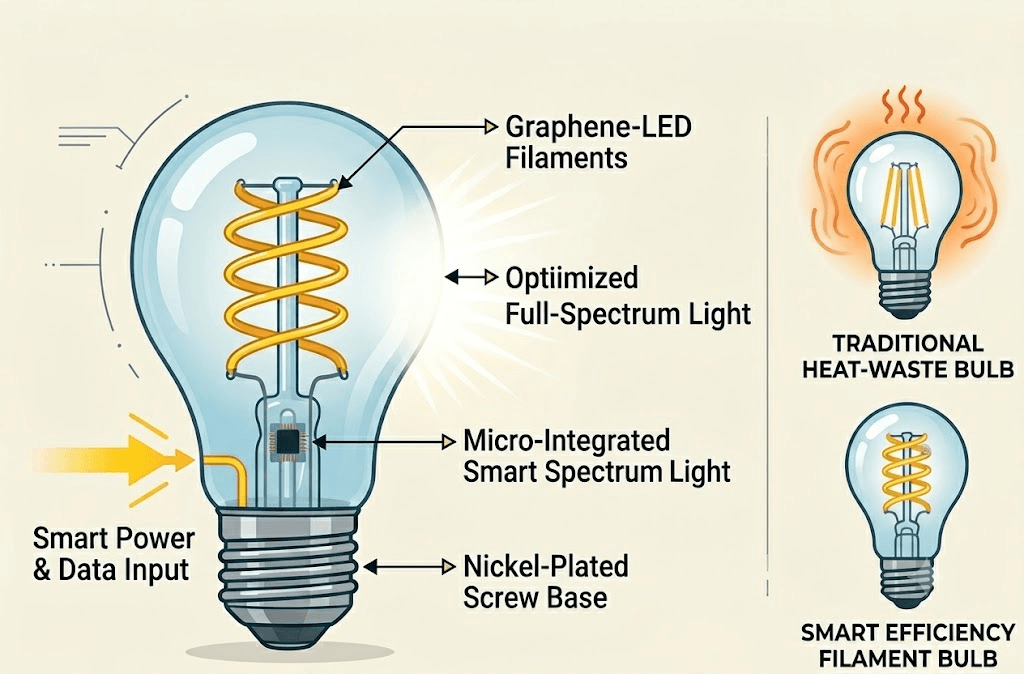
Comment fonctionne l'éclairage LED: La science derrière les ampoules modernes économes en énergie
L'éclairage LED a complètement transformé la façon dont nous éclairons nos maisons, bureaux, hôtels, restaurants, et espaces commerciaux. Par rapport aux ampoules à incandescence traditionnelles et aux ampoules CFL, Les lumières LED offrent une meilleure efficacité énergétique, durée de vie plus longue, qualité d'éclairage améliorée, et des coûts de maintenance réduits.
Cependant, de nombreuses personnes utilisent des ampoules LED tous les jours sans savoir ce qui se passe réellement à l'intérieur. Quand vous allumez une lumière LED, comment l'électricité devient brillante, éclairage confortable?
La réponse réside dans un composant minuscule mais puissant à l'intérieur de l'ampoule.: la puce semi-conductrice.
Lorsque le courant électrique traverse cette puce, il produit de la lumière visible grâce à un processus appelé électroluminescence. Contrairement aux ampoules à incandescence, qui chauffe un filament jusqu'à ce qu'il brille, La technologie LED convertit l'électricité directement en lumière. Par conséquent, beaucoup moins d'énergie est gaspillée sous forme de chaleur.
Grâce à cette conversion d'énergie efficace, Les ampoules LED peuvent réduire la consommation d'électricité jusqu'à 80% par rapport à l'éclairage traditionnel. En outre, leur longue durée de vie permet de réduire la fréquence de remplacement et les coûts de maintenance.
Aujourd'hui, La technologie LED est utilisée partout, des ampoules Edison décoratives aux ampoules bougies des lustres en passant par les downlights encastrés., systèmes d'éclairage intelligents, et solutions d'éclairage commerciales.
Dans ce guide complet, nous allons expliquer comment fonctionne l'éclairage LED, quels composants se trouvent à l'intérieur d'une ampoule LED, pourquoi les LED sont plus économes en énergie que les ampoules traditionnelles, et comment des facteurs tels que la luminosité, température de couleur, et CRI affectent votre expérience d'éclairage. L'image ci-dessous peut vous aider à mieux comprendre le fonctionnement de l'ampoule..
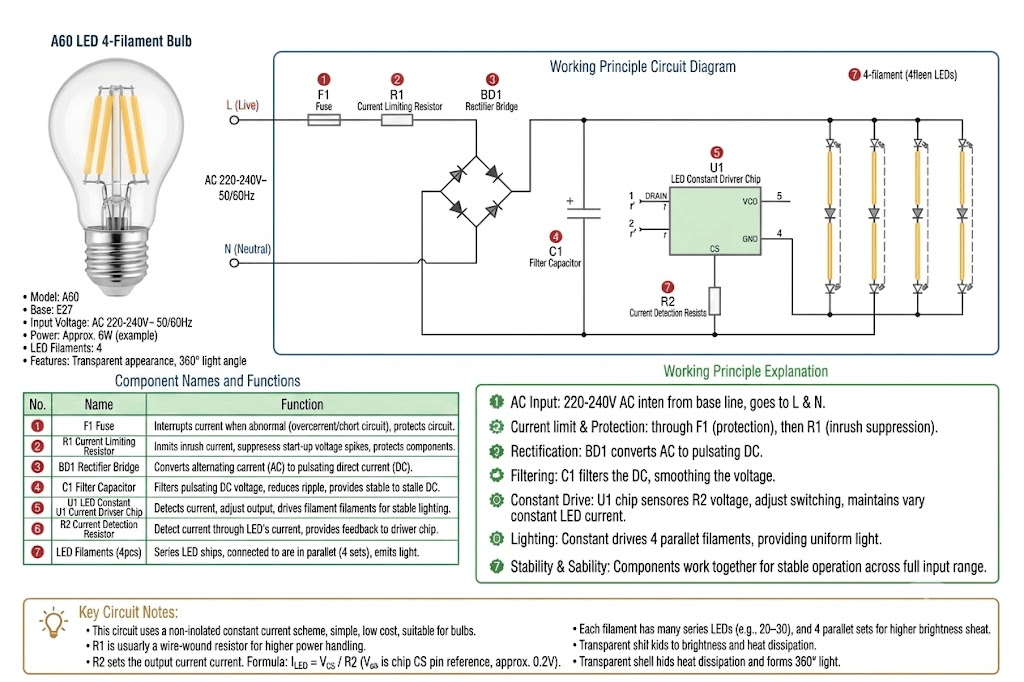
Que vous remplaciez une seule ampoule, améliorer l'éclairage de votre maison, ou planifier un projet d'éclairage commercial, comprendre la technologie LED vous aidera à choisir la bonne solution d'éclairage.
Qu'est-ce qu'une LED?
Avant d’explorer le fonctionnement de l’éclairage LED, il est important de comprendre ce que signifie le terme « LED ».
LED signifie Diode électroluminescente. C'est un dispositif semi-conducteur qui convertit l'énergie électrique en lumière visible.
Contrairement aux ampoules à incandescence, qui créent de la lumière en chauffant un filament de tungstène, Les LED produisent de la lumière grâce à un processus appelé électroluminescence.
Expliqué simplement:
L'électricité entre → Les électrons se déplacent à l'intérieur du semi-conducteur → L'énergie est libérée sous forme de lumière
Parce que les LED n'ont pas besoin de chauffer un filament, ils utilisent l'énergie beaucoup plus efficacement et génèrent beaucoup moins de chaleur.
Cette technologie simple mais avancée est la raison pour laquelle les ampoules LED sont:
- Plus économe en énergie
- Plus durable
- Refroidisseur pendant le fonctionnement
- Conception plus flexible
- Disponible dans de nombreuses couleurs et styles d'éclairage
Alors que la technologie LED continue de s'améliorer, les fabricants peuvent désormais créer des ampoules avec une meilleure luminosité, une plus grande précision des couleurs, et des fonctionnalités de contrôle plus intelligentes.
Une brève histoire de la technologie LED
Bien que l'éclairage LED soit considéré comme une technologie moderne, son développement a pris de nombreuses années.
Les premières LED n'étaient pas conçues pour l'éclairage domestique. Plutôt, ils étaient principalement utilisés comme petits voyants lumineux dans les appareils électroniques.
Au fil du temps, les améliorations apportées aux matériaux semi-conducteurs ont transformé les LED en solutions d’éclairage avancées d’aujourd’hui.
1962 – La première LED pratique
Nick Holonyak Jr.. développé la première LED rouge visible pratique, créer les bases de la future technologie LED.
1970Années 1980 – Davantage de couleurs de LED ont été développées
Pendant cette période, les fabricants ont introduit le jaune, orange, et LED vertes, étendre les applications LED au-delà des simples indicateurs.
1990s – La LED bleue a changé l’industrie de l’éclairage
Le développement de LED bleues à haute luminosité a constitué une avancée majeure. En combinant des puces LED bleues avec des matériaux phosphorescents, les fabricants pourraient enfin créer un éclairage LED blanc efficace.
2000s – Ampoules LED entrées dans les maisons
À mesure que les coûts de production diminuaient et que les performances s'amélioraient, Les ampoules LED sont devenues un remplacement pratique des ampoules à incandescence et CFL.
Aujourd'hui, l'éclairage LED domine le marché
Les LED modernes sont désormais largement utilisées dans:
- Éclairage résidentiel
- Bâtiments commerciaux
- Hôtels et restaurants
- Éclairage extérieur
- Systèmes d'éclairage intelligents
- Applications industrielles
Le plus important, l'invention de la technologie LED bleue a rendu possible l'éclairage LED blanc moderne et a complètement changé l'industrie mondiale de l'éclairage..
Ampoules LED, à incandescence ou CFL: Lequel est le meilleur?
Pour mieux comprendre pourquoi les LED sont devenues si populaires, cela aide à les comparer avec les anciennes technologies d'éclairage.
| Fonctionnalité | Incandescent | LCF | DIRIGÉ |
|---|---|---|---|
| Source de lumière | Filament chauffant | Gaz mercure | Puce semi-conductrice |
| Efficacité énergétique | Faible | Moyen | Haut |
| Efficacité typique | Autour 15 lm/W | Autour 60 lm/W | 80–120 lm/W |
| Durée de vie | À propos 1,000 heures | À propos 8,000 heures | 25,000–50 000+ heures |
| Production de chaleur | Très élevé | Modéré | Faible |
| Teneur en mercure | Non | Oui | Non |
| Consommation d'énergie | Le plus haut | Moyen | Le plus bas |
Comme le montre la comparaison, Les ampoules LED offrent des avantages dans presque toutes les catégories.
Par exemple, le remplacement d'une ampoule à incandescence traditionnelle de 60 W par une ampoule LED de 9 W peut fournir une luminosité similaire tout en consommant beaucoup moins d'électricité..
Donc, Les LED sont désormais le choix préféré des propriétaires, entreprises, et les professionnels de l'éclairage du monde entier.
Anatomie d'une ampoule LED moderne
Bien qu'une ampoule LED puisse ressembler à une ampoule traditionnelle de l'extérieur, sa structure interne est beaucoup plus avancée.
À l'intérieur de chaque ampoule LED, plusieurs composants clés travaillent ensemble pour créer une stabilité, efficace, et un éclairage de haute qualité.
Comprendre ces éléments explique également pourquoi certaines ampoules LED fonctionnent bien mieux que d'autres., même s'ils ont la même puissance.
Puce LED: Le coeur de l'ampoule
La puce LED est la partie la plus importante de l'ensemble du système d'éclairage.
C'est le composant qui produit de la lumière lorsque l'électricité le traverse.
Les puces LED modernes sont généralement fabriquées à partir de matériaux semi-conducteurs tels que:
- Nitrure de Gallium (GaN)
- Nitrure d'Indium et de Gallium (InGaN)
Ces matériaux convertissent efficacement l'énergie électrique en lumière visible.
Aujourd'hui, Les puces LED sont généralement disponibles en trois types principaux:
LED CMS (Appareil monté en surface)
Les LED SMD sont largement utilisées dans les produits d'éclairage domestique.
Avantages:
- Haute efficacité
- Répartition uniforme de la lumière
- Performances fiables
- Production rentable
On les trouve couramment dans les ampoules LED, panneaux, et spots.
LED COB (Puce à bord)
Les LED COB combinent plusieurs puces LED sur une seule carte.
Les avantages incluent:
- Luminosité plus élevée
- Meilleure gestion thermique
- Rendement lumineux plus fort
Ils sont souvent utilisés dans l'éclairage commercial et les applications haute puissance..
Puce à filament LED
La technologie des filaments LED est conçue pour imiter l'apparence des filaments incandescents traditionnels.
Ces ampoules sont particulièrement populaires pour:
- Ampoules Edison
- Éclairage vintage
- Lustres décoratifs
- Lampes suspendues
Alors que la technologie des puces LED continue de s'améliorer, les fabricants peuvent produire des solutions d'éclairage plus lumineuses avec une consommation d'énergie inférieure.
Pilote LED: Le cerveau d'une ampoule LED
Alors que la puce LED est la pièce qui crée la lumière, il ne peut pas fonctionner directement avec l'électricité de votre maison.
C'est là que le Pilote LED devient indispensable.
Le driver LED fonctionne comme un petit système de gestion de l'énergie à l'intérieur de l'ampoule. Sa tâche principale est de convertir le courant alternatif haute tension (CA) de votre système électrique vers le courant continu basse tension (CC) dont la puce LED a besoin.
En termes simples:
Électricité domestique → Pilote LED → Puissance stable → La puce LED produit de la lumière
Outre la conversion de puissance, un driver LED de haute qualité contrôle également le flux de courant et protège l'ampoule des fluctuations électriques.
Un bon pilote de LED fournit plusieurs fonctions importantes:
- Conversion de puissance AC en DC
- Régulation à courant constant
- Protection contre la tension
- Protection contre les surtensions
- Réduction du scintillement
- Compatibilité de gradation
Donc, la qualité du driver LED a un impact direct sur les performances de l'ampoule, stabilité de la luminosité, et durée de vie.
D'autre part, des pilotes de LED de mauvaise qualité peuvent causer des problèmes courants tels que:
- Scintillement visible
- Des bourdonnements
- Luminosité réduite
- Durée de vie plus courte
- Mauvaises performances de gradation
Pour cette raison, Il est important de choisir des ampoules LED auprès de fabricants fiables, spécialement pour les applications où la qualité de l'éclairage est importante, comme les maisons, hôtels, restaurants, et magasins de détail.
Dissipateur de chaleur: Garder les ampoules LED froides et fiables
Bien que les ampoules LED produisent beaucoup moins de chaleur que les ampoules à incandescence, ils ne sont pas complètement exempts de chaleur.
Pendant le fonctionnement, la puce LED génère encore une petite quantité de chaleur. Si cette chaleur ne peut pas s'échapper correctement, cela pourrait endommager les composants internes et réduire la durée de vie de l’ampoule.
Pour résoudre ce problème, les fabricants ajoutent un dissipateur de chaleur aux modèles d'ampoules LED.
Le dissipateur thermique fonctionne en absorbant la chaleur de la puce LED et en la transférant dans l'environnement..
Les matériaux courants des dissipateurs de chaleur comprennent:
- Aluminium
- Céramique
- Matériaux composites graphites
Parmi ces matériaux, l'aluminium est largement utilisé car il offre une excellente dissipation thermique tout en restant léger et abordable.
Par conséquent, une gestion thermique efficace aide les ampoules LED:
- Maintenir une luminosité stable
- Prévenir la surchauffe
- Améliorer la fiabilité
- Atteindre leur durée de vie nominale
C'est aussi pourquoi deux ampoules LED de même puissance peuvent avoir des durées de vie très différentes.. La conception interne et le système de gestion de la chaleur font une différence significative.
Revêtement et diffuseur de phosphore: Créer une lumière blanche confortable
Un fait intéressant à propos de la technologie LED est que la plupart des puces LED ne produisent pas naturellement de lumière blanche..
Plutôt, de nombreuses puces LED produisent de la lumière bleue.
Alors, comment les fabricants créent-ils l'éclairage blanc chaud ou blanc froid que nous voyons tous les jours ??
La réponse est un matériau spécial appelé revêtement de phosphore.
Une couche de phosphore est appliquée sur la puce LED. Lorsque la lumière bleue traverse ce revêtement, une partie de l'énergie est convertie en d'autres longueurs d'onde, y compris le jaune, orange, et feu rouge.
La combinaison de ces couleurs crée l’apparence d’une lumière blanche à l’œil humain..
Cette technologie permet aux fabricants de produire différentes couleurs d'éclairage, y compris:
| Température de couleur | Apparence | Applications courantes |
|---|---|---|
| 2700K | Blanc chaud | Chambres, salons |
| 3000K | Blanc chaud et doux. | Hôtels, restaurants, salles à manger |
| 4000K | Blanc neutre | Cuisines, salles de bains, bureaux |
| 5000K | Blanc froid | Espaces de travail, zones commerciales |
| 6500K | Blanc lumière du jour | Garage, ateliers |
En outre, Les ampoules LED comprennent généralement un diffuseur ou un cache optique.
Le diffuseur aide:
- Répartir la lumière uniformément
- Réduire l'éblouissement
- Éliminez les points chauds difficiles
- Créez une expérience visuelle plus confortable
Donc, les ampoules LED de haute qualité ne sont pas seulement une question de luminosité, elles visent également à produire un éclairage confortable et équilibré.
Base et boîtier de la lampe: Rendre les ampoules LED faciles à installer
Une fois les composants internes assemblés, ils sont protégés à l'intérieur du boîtier de l'ampoule et reliés à un culot de lampe.
La base est la pièce qui relie l'ampoule au luminaire et fournit l'énergie électrique..
Les types courants de culots d’ampoules LED comprennent:
- E26
- E27
- E12
- E14
- GU10
- MR16
- B22
Choisir le bon culot d'ampoule est essentiel car un culot incompatible peut empêcher l'installation ou affecter la sécurité..
Par exemple:
- E26 et E27 sont largement utilisés dans les douilles à vis domestiques
- E12 est couramment utilisé pour les ampoules de bougies décoratives et les lustres.
- Le GU10 se retrouve souvent dans les spots et les éclairages encastrés
En comprenant les bases des ampoules, vous pouvez rapidement sélectionner l'ampoule LED de remplacement appropriée pour votre luminaire.
La science derrière l'éclairage LED: Comment l'électricité devient lumière
Maintenant que nous comprenons les principaux éléments d’une ampoule LED, Examinons de plus près la science actuelle derrière la façon dont les LED créent de la lumière.
Bien que le processus se déroule à un niveau microscopique, l'idée de base est étonnamment simple.
La jonction P-N: Où la lumière est générée
À l'intérieur de chaque puce LED se trouve une structure spéciale appelée Jonction P-N.
Il contient deux couches semi-conductrices:
Semi-conducteur de type N
Cette couche contient des électrons supplémentaires.
Semi-conducteur de type P
Cette couche contient des zones appelées « trous," qui sont des espaces où les électrons peuvent se déplacer.
Quand l'électricité circule à travers la LED, les électrons se déplacent de la couche de type N vers la couche de type P.
Quand les électrons se combinent avec les trous, l'énergie est libérée.
Ce processus est appelé recombinaison électron-trou.
L'énergie libérée apparaît sous forme de minuscules particules de lumière appelées photons.
En termes simples:
Électricité → Mouvement des électrons → Libération de photons → Lumière visible
Contrairement aux ampoules à incandescence, Les LED n'ont pas besoin de chauffer quoi que ce soit pour créer de la lumière.
À cause de ça, beaucoup plus d'énergie électrique devient un éclairage utile au lieu de chaleur gaspillée.
Pourquoi les LED produisent des couleurs différentes
La couleur d'une LED dépend des matériaux semi-conducteurs utilisés à l'intérieur de la puce.
Différents matériaux ont différents niveaux d'énergie, également connu sous le nom bandes interdites.
La différence d'énergie détermine la longueur d'onde de la lumière produite.
Par exemple:
| Couleur | Longueur d'onde approximative |
|---|---|
| Rouge | 620–750 nm |
| Vert | 520–560 nm |
| Bleu | 460–495 nm |
| Violet | 400–420 nm |
En ajustant les matériaux semi-conducteurs, les fabricants peuvent créer différentes couleurs de LED pour diverses applications.
Cette technologie est utilisée dans:
- Éclairage décoratif
- Ampoules RVB intelligentes
- Écrans d'affichage
- Éclairage architectural
Comment les LED blanches créent une lumière blanche
Fait intéressant, la plupart des ampoules LED blanches ne créent pas directement de lumière blanche.
Plutôt, ils utilisent une combinaison de:
- Puce LED bleue
- Revêtement de phosphore
La LED bleue produit de la lumière bleue, tandis que le revêtement phosphore convertit une partie de cette lumière en d'autres couleurs.
Quand ces couleurs se mélangent, nos yeux perçoivent le résultat comme une lumière blanche.
Cette méthode fournit:
- Haute efficacité
- Meilleure cohérence des couleurs
- Longue durée de vie
- Coût de production inférieur
En raison de ces avantages, les LED converties au phosphore sont devenues la technologie standard pour l'éclairage LED blanc moderne.
Pourquoi l'éclairage LED est si économe en énergie
L’une des principales raisons pour lesquelles les gens optent pour l’éclairage LED est l’économie d’énergie..
Cependant, le véritable avantage de la technologie LED n'est pas simplement qu'elle consomme moins de watts. La principale différence est l'efficacité avec laquelle les LED convertissent l'électricité en lumière utilisable.
Les ampoules à incandescence traditionnelles fonctionnent en chauffant un filament métallique jusqu'à ce qu'il devienne suffisamment chaud pour briller.. Par conséquent, la majeure partie de l'électricité est libérée sous forme de chaleur au lieu de lumière.
En comparaison, Les ampoules LED utilisent la technologie des semi-conducteurs pour convertir l'électricité directement en lumière.
Cela signifie:
Moins d'énergie gaspillée → Plus d'énergie convertie en lumière → Réduction des coûts d'électricité
Grâce à cette conception efficace, Les ampoules LED peuvent fournir la même luminosité que les ampoules traditionnelles tout en consommant beaucoup moins d'énergie..
Pour les propriétaires, cela signifie des factures d'électricité mensuelles inférieures.
Pour les entreprises, comme les hôtels, restaurants, bureaux, et magasins de détail, L'éclairage LED peut réduire considérablement les coûts d'exploitation à long terme.
Lumens contre watts: Comprendre la luminosité des LED
Lors de l'achat d'ampoules traditionnelles, de nombreuses personnes utilisaient les watts pour estimer la luminosité.
Cependant, avec technologie LED, cette méthode n'est plus précise.
La raison est simple:
Les watts mesurent la consommation d'énergie, pas de luminosité.
Les lumens mesurent la puissance lumineuse réelle.
Par exemple:
| Ampoule traditionnelle | Luminosité | Équivalent LED |
|---|---|---|
| 25W À incandescence | Autour 250 lumens | 2–LED 3W |
| 40W À incandescence | Autour 450 lumens | 4–LED 6W |
| 60W À incandescence | Autour 800 lumens | 7–LED 10W |
| 75W À incandescence | Autour 1,100 lumens | 10–LED 13W |
| 100W À incandescence | Autour 1,600 lumens | 14–LED 18W |
Donc, lors du choix d'une ampoule LED, il vaut mieux se concentrer sur les lumens plutôt que sur les watts.
Par exemple, si vous voulez la même luminosité qu'une vieille ampoule à incandescence de 60W, cherchez une ampoule LED avec environ 800 lumens.
Ce simple changement dans vos habitudes d'achat peut vous aider à sélectionner plus facilement la bonne ampoule LED..
Moins de chaleur signifie plus d'avantages
Un autre avantage important de l’éclairage LED est la réduction de la production de chaleur.
Les ampoules à incandescence traditionnelles libèrent une grande quantité d'énergie sous forme de chaleur. En fait, environ 90% une partie de leur énergie peut être perdue sous forme de chaleur plutôt que de lumière utile.
Les ampoules LED fonctionnent différemment.
Parce qu'ils convertissent l'électricité plus efficacement, ils produisent beaucoup moins de chaleur.
Par conséquent:
- Les pièces restent plus fraîches
- Les systèmes de climatisation fonctionnent moins
- Les luminaires restent plus sûrs
- Les ampoules durent plus longtemps
- Le gaspillage d’énergie est réduit
Ceci est particulièrement utile dans les climats chauds, bâtiments commerciaux, et luminaires fermés où une chaleur excessive peut affecter les performances.
En outre, une consommation d’énergie réduite contribue à réduire les émissions de carbone, faire de l’éclairage LED un choix plus respectueux de l’environnement.
Qualité des couleurs: Pourquoi un bon éclairage est plus que la luminosité
Même si la luminosité est importante, ce n'est pas le seul facteur qui détermine la qualité de l'éclairage.
Un environnement lumineux confortable dépend également de:
- Température de couleur
- Indice de rendu des couleurs (Cri)
- Performances de gradation
- Contrôle du scintillement
Ces facteurs influencent l'apparence et la sensation d'un espace.
Par exemple, un restaurant peut avoir besoin de chaleur, lumière invitante, alors qu'un bureau peut nécessiter plus de luminosité, éclairage plus frais pour améliorer la concentration.
Comprendre ces détails vous aide à choisir des ampoules LED qui correspondent à l'objectif de chaque espace.
Comprendre la température de couleur (CCT)
La température de couleur décrit la façon dont la lumière apparaît à l'œil humain.
Il est mesuré en Kelvin (K).
Des valeurs Kelvin inférieures créent plus de chaleur, plus de lumière jaune, tandis que des valeurs Kelvin plus élevées créent une température plus fraîche, lumière plus bleue.
| Température de couleur | Apparence | Utilisation recommandée |
|---|---|---|
| 2700K | Blanc chaud | Chambres, salons |
| 3000K | Blanc doux | Salles à manger, hôtels, restaurants |
| 4000K | Blanc neutre | Cuisines, salles de bains, bureaux |
| 5000K | Blanc froid | Espaces de travail, zones commerciales |
| 6500K | Lumière du jour | Garage, ateliers |
Par exemple:
Une ampoule LED 2700K crée une ambiance cosy, ce qui le rend idéal pour les zones de détente.
Entre-temps, une ampoule 4000K ou 5000K offre un éclairage plus clair et plus énergique, ce qui fonctionne mieux pour les environnements de travail.
Donc, sélectionner la bonne température de couleur est tout aussi important que choisir la bonne luminosité.
Pourquoi le CRI est important dans l'éclairage LED
Un autre facteur important affectant la qualité de l'éclairage est Cri, ou Indice de Rendu des Couleurs.
Le CRI mesure la précision avec laquelle une source de lumière montre les vraies couleurs des objets par rapport à la lumière naturelle du soleil..
Plus la valeur CRI est élevée, plus les couleurs apparaissent naturelles. Vous pouvez voir la différence entre les différentes notes CRI selon l'image ci-dessous.
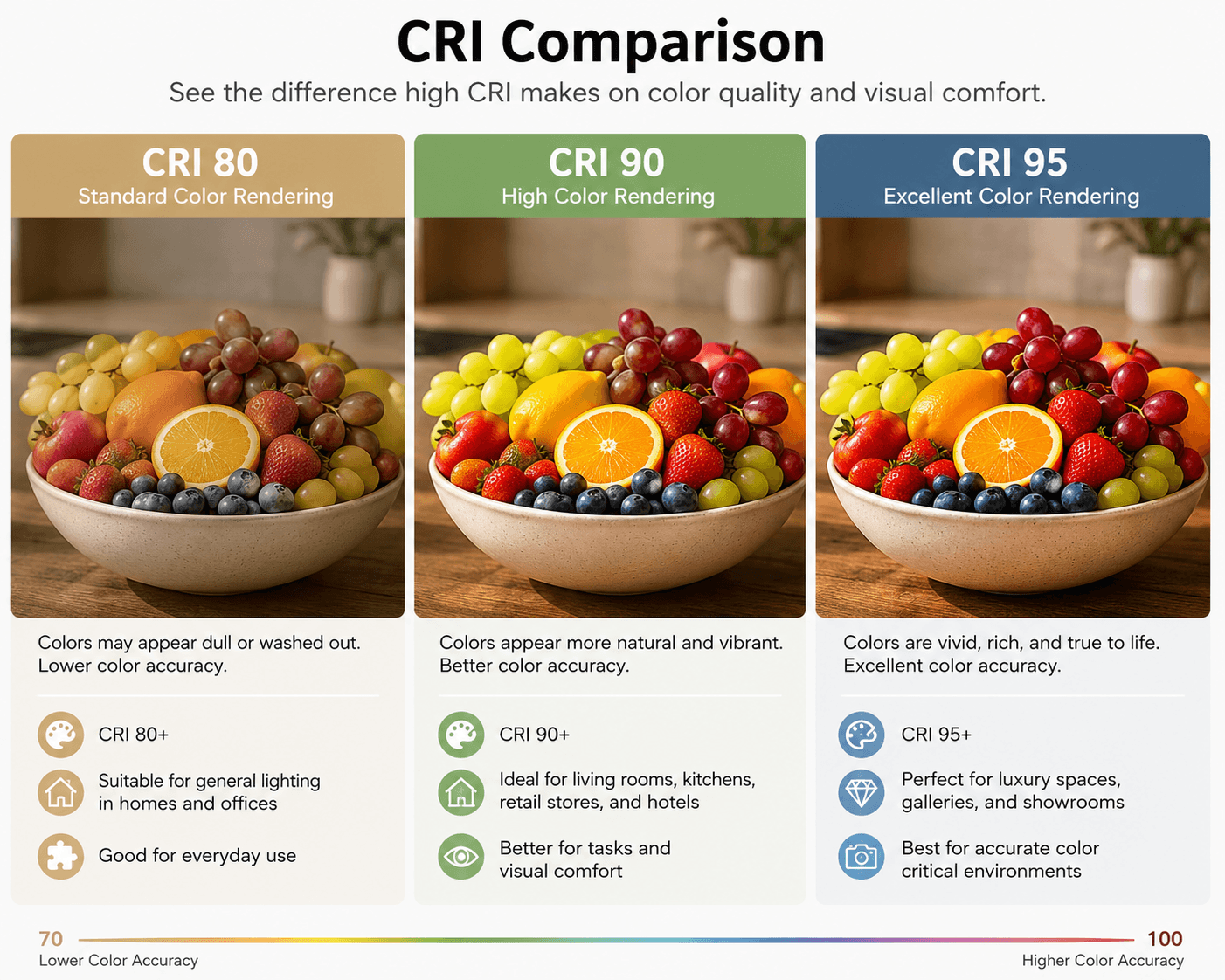
Pour l'éclairage quotidien de la maison, Cri 80+ est généralement acceptable.
Cependant, pour les espaces où l'apparence des couleurs est importante, tel que:
- Restaurants
- Magasins de vêtements
- Galeries d'art
- Hôtels
- Zones de maquillage
Cri 90+ Les ampoules LED sont souvent recommandées.
Un éclairage à IRC élevé peut faire:
- La nourriture paraît plus fraîche
- Les tons chair semblent plus naturels
- Les couleurs intérieures semblent plus riches
- Les produits semblent plus attractifs
Donc, la luminosité à elle seule ne définit pas une ampoule LED de haute qualité.
Technologie de gradation LED: Créer la bonne atmosphère
L'un des avantages de l'éclairage LED moderne est la possibilité de régler la luminosité..
Cependant, Les ampoules LED fonctionnent différemment des ampoules à incandescence traditionnelles.
Les ampoules à incandescence peuvent être atténuées simplement en réduisant la puissance électrique.
Les ampoules LED nécessitent des systèmes de contrôle électroniques spéciaux.
Les technologies de gradation LED courantes incluent:
Gradation de pointe
Une méthode de gradation traditionnelle souvent utilisée avec les systèmes plus anciens.
Gradation du bord de fuite
Une technologie plus récente qui offre généralement une gradation des LED plus douce et plus silencieuse.
Gradation intelligente
Permet aux utilisateurs de contrôler la luminosité via:
- Applications mobiles
- Assistants vocaux
- Systèmes de maison intelligente
Lors de l'installation d'ampoules LED à intensité variable, vérifiez toujours la compatibilité entre l'ampoule et le variateur.
L'utilisation d'un gradateur incompatible peut provoquer:
- Vacillant
- Bourdonnement
- Plage de gradation limitée
- Durée de vie de l'ampoule raccourcie
Comprendre le scintillement des LED
Bien que les ampoules LED soient très efficaces, les produits de mauvaise qualité peuvent présenter un scintillement.
Le scintillement des LED se produit généralement lorsque le pilote ne peut pas fournir un courant électrique stable..
Les causes courantes incluent:
- Pilotes de mauvaise qualité
- Compatibilité incorrecte des variateurs
- Mauvaise conception du circuit
Un scintillement visible peut entraîner:
- Inconfort oculaire
- Maux de tête
- Problèmes d'enregistrement de la caméra
- Confort visuel réduit
Heureusement, des ampoules LED de haute qualité avec des pilotes fiables peuvent réduire ou éliminer considérablement les problèmes de scintillement.
Pour les zones où les gens passent de nombreuses heures, comme les bureaux, chambres à coucher, et espaces commerciaux, choisir un éclairage LED sans scintillement est particulièrement important.
Pourquoi les ampoules LED durent si longtemps
L'un des avantages les plus impressionnants de la technologie LED est sa durée de vie extrêmement longue..
Contrairement aux ampoules à incandescence, qui échouent généralement soudainement lorsque le filament brûle, Les ampoules LED fonctionnent d'une manière complètement différente.
Au lieu de s'arrêter brusquement, Les LED perdent progressivement de leur luminosité avec le temps. Ce processus est appelé dépréciation du lumen.
Autrement dit, une ampoule LED de haute qualité ne « grille » généralement pas comme les ampoules traditionnelles. Plutôt, son rendement lumineux diminue lentement jusqu'à ce qu'il atteigne la fin de sa durée de vie utile.
La plupart des ampoules LED de qualité sont conçues pour:
- 15,000 heures
- 25,000 heures
- 35,000 heures
- 50,000+ heures
Pour un ménage moyen, une ampoule LED de 25 000 heures peut durer plus de 10 années, en fonction de l'utilisation quotidienne.
Cependant, la durée de vie réelle d'une ampoule LED dépend de plusieurs facteurs importants:
Gestion de la chaleur
Une bonne conception thermique aide à protéger la puce LED et les composants électroniques de la surchauffe.
Qualité du pilote
Un pilote fiable assure une fourniture de puissance stable et réduit le stress sur les pièces internes.
Stabilité électrique
Une tension stable aide à prévenir les dommages prématurés.
Ventilation des luminaires
Une bonne circulation de l'air permet à la chaleur de s'échapper et améliore les performances à long terme.
Donc, tandis que la technologie LED elle-même est conçue pour durer de nombreuses années, la qualité des produits et le design interne jouent toujours un rôle majeur.
Applications courantes de l'éclairage LED
Parce que la technologie LED est efficace, durable, et très flexible, il est maintenant utilisé dans presque tous les types d'applications d'éclairage.
Des simples ampoules domestiques aux systèmes d’éclairage intelligents avancés, Les LED sont devenues un élément essentiel de la conception d'éclairage moderne.
Éclairage LED résidentiel
Dans les maisons, Les ampoules LED sont couramment utilisées pour:
- Plafonniers
- Lampes suspendues
- Lustres
- Lampes de table
- Lampadaires
- Spots encastrés
- Luminaires extérieurs
Par exemple, les ampoules à filament LED décoratives sont populaires dans les salons, salles à manger, et les restaurants car ils combinent l'efficacité énergétique avec une apparence vintage classique.
Entre-temps, Les downlights et plafonniers LED offrent une luminosité, éclairage propre pour les cuisines, salles de bains, et zones de travail.
Éclairage LED décoratif
La technologie LED a également changé l'éclairage décoratif.
Les produits LED décoratifs populaires incluent:
- Ampoules LED Edison
- Ampoules LED bougies
- Ampoules à filament vintage
- Ampoules globes
- Ampoules RVB intelligentes
Ces produits permettent aux designers et aux propriétaires de créer des ambiances différentes tout en conservant une faible consommation d'énergie..
Par exemple:
- Les ampoules de bougies blanc chaud créent un effet lustre élégant
- Les ampoules Edison ajoutent un style industriel vintage
- Les ampoules intelligentes RVB créent des couleurs et des ambiances personnalisables
Éclairage LED commercial
Les entreprises choisissent de plus en plus l'éclairage LED car il réduit les coûts d'exploitation et améliore l'expérience client..
Les applications courantes incluent:
- Hôtels
- Restaurants
- Magasins de détail
- Bureaux
- Entrepôts
- Centres commerciaux
Dans les environnements commerciaux, la qualité de l'éclairage est particulièrement importante car elle affecte:
- Confort du client
- Apparence du produit
- Ambiance de marque
- Productivité des employés
Par conséquent, de nombreux projets commerciaux utilisent désormais des systèmes LED de haute qualité au lieu des solutions d'éclairage traditionnelles.
Applications LED spécialisées
Au-delà de l'éclairage quotidien, Les LED sont également utilisées dans des domaines spécialisés tels que:
- Éclairage public
- Éclairage architectural
- Éclairage paysager
- Éclairage horticole
- Applications UV
- Éclairage automobile
Parce que les LED sont petites, efficace, et facile à contrôler, ils continuent de créer de nouvelles possibilités dans différentes industries.
Comment choisir la meilleure ampoule LED
Après avoir appris le fonctionnement de l'éclairage LED, choisir la bonne ampoule LED devient beaucoup plus facile.
Cependant, de nombreux acheteurs se concentrent encore uniquement sur la puissance ou le prix. En réalité, plusieurs facteurs déterminent si une ampoule LED fournira la bonne luminosité, confort, et durée de vie.
Avant d'acheter, considérer les points suivants.
1. Vérifier la luminosité (Lumens)
La première étape consiste à choisir la bonne luminosité.
Souviens-toi:
Watts = Consommation d'énergie
Lumens = puissance lumineuse
Par exemple:
- 400–500 lumens → Petites lampes et éclairage d'accentuation
- 800 lumens → Remplacement d'une ampoule traditionnelle de 60W
- 1,100+ lumens → Pièces plus grandes ou espaces plus lumineux
Choisir le bon flux lumineux évite que les pièces soient trop sombres ou inutilement lumineuses.
2. Sélectionnez la bonne température de couleur
La meilleure température de couleur dépend de l'ambiance que vous souhaitez créer.
Pour des espaces de détente:
Choisir:
- 2700K
- 3000K
Convient pour:
- Chambres
- Salons
- Restaurants
- Hôtels
Pour les environnements de travail:
Choisir:
- 4000K
- 5000K
Convient pour:
- Bureaux
- Cuisines
- Ateliers
La bonne température de couleur peut améliorer considérablement le confort et l’expérience visuelle.
3. Considérez le CRI pour une meilleure qualité des couleurs
Si la précision des couleurs compte, choisissez une ampoule LED à CRI plus élevé.
Pour l'éclairage général:
- Cri 80+ est acceptable
Pour les applications premium:
- Cri 90+ est recommandé
Un éclairage à IRC élevé est particulièrement utile pour:
- Coins repas
- Présentoirs de vente au détail
- Oeuvre
- Espaces de maquillage
- Projets d'accueil
4. Confirmez le type de culot d'ampoule
Vérifiez toujours si le culot de l'ampoule correspond à votre luminaire.
Les options courantes incluent:
- E26
- E27
- E12
- E14
- GU10
- MR16
- B22
Par exemple:
Culots à vis E26 et E27 sont couramment utilisés dans les appareils ménagers.
E12 et E14 sont souvent utilisés pour les lustres décoratifs et ampoules de type bougie.
Choisir la bonne base garantit une installation facile et un fonctionnement sûr.
5. Vérifier la compatibilité de gradation
Si vous souhaitez une luminosité réglable, assurez-vous que l'ampoule est étiquetée comme dimmable.
Vérifiez également que:
- Le variateur prend en charge la technologie LED
- La plage de puissance est compatible
- L'ampoule et le variateur sont conçus pour fonctionner ensemble
Sinon, vous pouvez rencontrer un scintillement ou de mauvaises performances de gradation.
6. Considérez l’environnement du luminaire
Toutes les ampoules LED ne conviennent pas à tous les luminaires.
Par exemple:
- Les luminaires fermés nécessitent des ampoules conçues pour contrôler la chaleur
- Les luminaires extérieurs nécessitent des conceptions résistantes aux intempéries
- Les environnements à haute température nécessitent une gestion thermique plus stricte
La sélection de l'ampoule LED adaptée à l'environnement permet de maximiser la durée de vie et les performances. Vérifiez ici pour plus d'ampoules LED de haute qualité sur Huiyeetech.
Foire aux questions sur l’éclairage LED
Comment fonctionnent les lumières LED en termes simples?
Les lumières LED créent un éclairage lorsque l'électricité traverse une puce semi-conductrice. Le mouvement des électrons libère de l'énergie sous forme de photons, que nous voyons comme la lumière visible.
Contrairement aux ampoules traditionnelles, Les LED ne chauffent pas un filament, donc ils gaspillent beaucoup moins d'énergie.
Puis-je remplacer n'importe quelle ampoule par une ampoule LED?
Dans la plupart des cas, Oui.
Cependant, tu devrais vérifier:
- Type de culot d'ampoule
- Tension
- Exigences de luminosité
- Compatibilité de gradation
- Limites des luminaires
Le choix d'une ampoule LED compatible garantit une installation sûre et des performances fiables.
Pourquoi les ampoules LED sont-elles plus chères que les ampoules traditionnelles?
Les ampoules LED coûtent généralement plus cher au départ car elles contiennent des composants avancés tels que:
- Puces semi-conductrices
- Pilotes de LED
- Systèmes de gestion de la chaleur
- Composants optiques
Cependant, le coût initial plus élevé est généralement compensé par:
- Consommation d’électricité réduite
- Durée de vie plus longue
- Moins de remplacements
Au fil du temps, Les LED deviennent souvent le choix le plus économique.
Les lumières LED consomment-elles beaucoup d'électricité?
Non.
Les lumières LED font partie des technologies d'éclairage les plus économes en énergie disponibles aujourd'hui..
Elles offrent une luminosité similaire tout en consommant beaucoup moins d'électricité que les ampoules à incandescence et CFL..
Les ampoules LED sont-elles meilleures que les ampoules à incandescence?
Pour la plupart des applications, Oui.
Offre d'ampoules LED:
- Consommation d’énergie réduite
- Durée de vie plus longue
- Moins de chaleur
- Meilleure durabilité
- Plus d'options de conception
C'est pourquoi les LED sont devenues le remplacement standard de l'éclairage traditionnel..
Pensées finales: Pourquoi l'éclairage LED est l'avenir
L'éclairage LED a complètement changé la façon dont nous utilisons et comprenons la lumière.
En convertissant l'électricité directement en lumière visible, Les LED offrent une efficacité énergétique exceptionnelle, durée de vie plus longue, coûts d'entretien réduits, et de meilleures performances d'éclairage.
En outre, améliorations continues de la technologie des semi-conducteurs, Pilotes de LED, gestion thermique, qualité des couleurs, et les commandes intelligentes continuent de rendre l'éclairage LED encore plus puissant et polyvalent.
Que vous remplaciez une seule ampoule domestique, moderniser un espace commercial, ou concevoir un projet d'éclairage complet, comprendre le fonctionnement de l'éclairage LED vous permet de prendre de meilleures décisions.
Des économies d’énergie à un confort amélioré, La technologie LED offre une solution plus intelligente, nettoyeur, et une manière plus durable d'éclairer le monde.
L’avenir de l’éclairage est celui des LED, et cet avenir est déjà là.