 English
 العربية
 Français
 Deutsch
 Italiano
 Polski
 Português
 Русский
 Español
 Українська


Temperatura de color: ¿qué significa??
Al comprar una bombilla, A menudo te encontrarás con términos como temperatura de color, blanco cálido, blanco frio, y luz. Si no estás seguro de lo que significan, ciertamente no estás solo.
En el pasado, Elegir una bombilla fue simple porque la mayoría de los hogares usaban bombillas incandescentes tradicionales que producían un brillo cálido similar.. Hoy, sin embargo, CONDUJO, halógeno, y las bombillas CFL están disponibles en una amplia gama de temperaturas de color. Como resultado, Seleccionar el color de luz correcto es tan importante como elegir la base de bombilla o el brillo correctos..
Comprender la temperatura del color le ayuda a crear la atmósfera adecuada, mejorar la visibilidad, y asegúrese de que las bombillas de repuesto coincidan con su iluminación existente.
¿Qué es la temperatura del color??
En términos simples, temperatura de color Describe la apariencia de la luz blanca producida por una fuente de luz.. En lugar de medir el brillo, indica si aparece la luz cálido (amarillo), neutral, o Frío (azul).
La temperatura del color se mide en kélvin (K).
- 2700K–3000K: Blanco cálido
- 3500K: Blanco neutro
- 4000K: Blanco fresco
- 5000K–6500K: Luz
Simplemente recuerda:
- Kelvin inferior = luz más cálida
- Kelvin más alto = luz más fría
Es importante señalar que La temperatura del color no determina el brillo.. El brillo se mide por separado en lúmenes (lm).
¿Por qué es importante la temperatura del color??
La temperatura del color tiene un impacto significativo en la apariencia y la atmósfera de una habitación..
Por ejemplo, Imagina que una de las tres bombillas de tu cocina se funde.. Compras un repuesto con la misma base., forma, potencia, y brillo. Después de instalarlo, sin embargo, la nueva bombilla se ve notablemente diferente de las demás: una parece cálida y amarilla, mientras que el nuevo luce blanco brillante.
La razón es simple: las bombillas tienen diferentes temperaturas de color.
Incluso si las bombillas producen la misma cantidad de lúmenes, Las clasificaciones Kelvin no coincidentes pueden hacer que una habitación parezca inconsistente y menos atractiva visualmente.. Por lo tanto, haciendo coincidir el kélvin (K) La calificación es una de las formas más fáciles de lograr una iluminación uniforme en toda su casa..
Tabla de temperatura de color (Escala Kelvin)
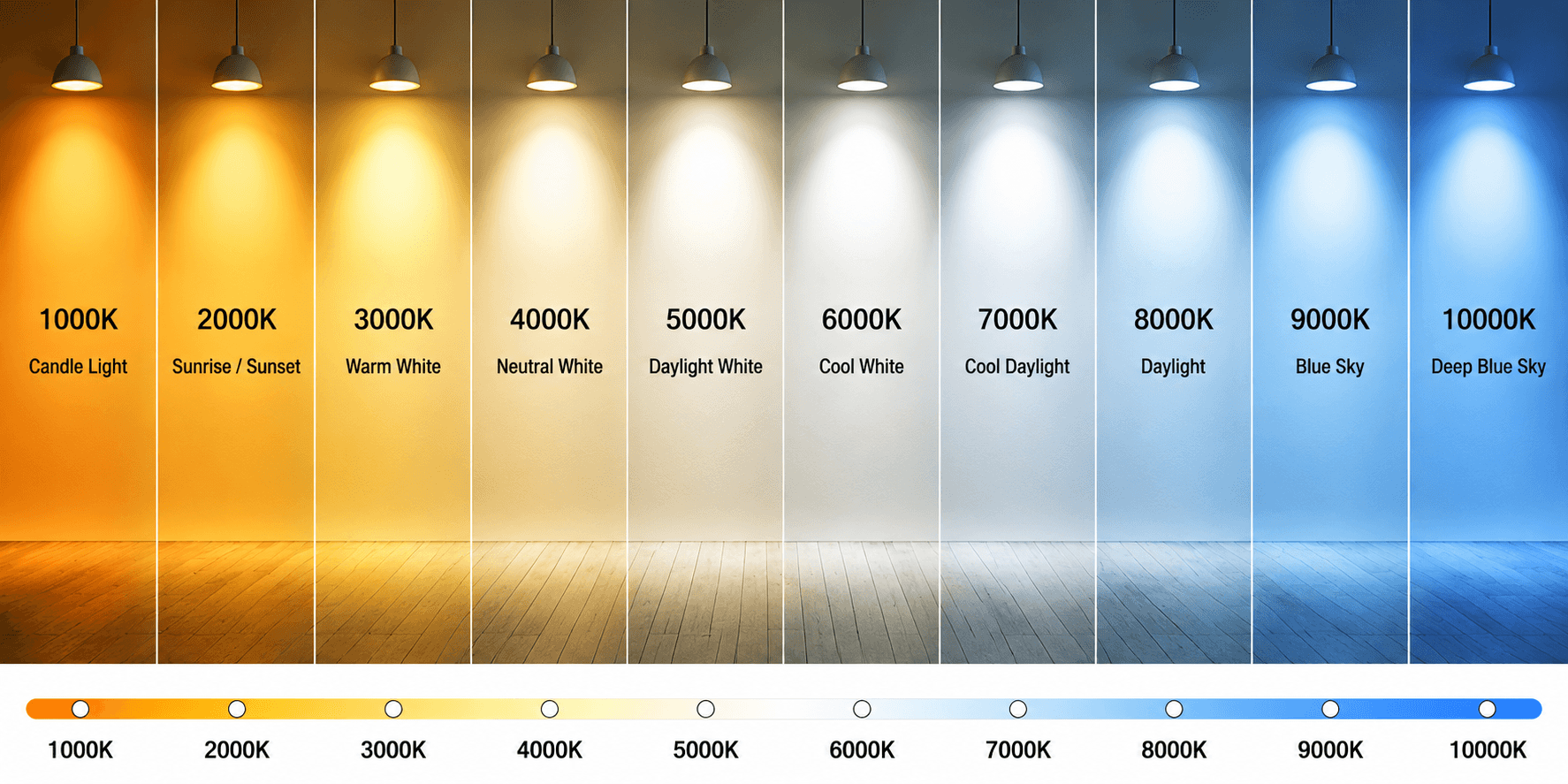
Afortunadamente, comparar colores claros es fácil. El kélvin (K) escala muestra qué tan cálida o fría aparecerá una fuente de luz.
| Temperatura de color | Apariencia | Uso típico |
|---|---|---|
| 1000K | Luz de una vela | Ambiente decorativo |
| 2700K–3000K | Blanco cálido | Viviendas, hoteles, restaurantes |
| 3500K | Blanco neutro | Oficinas, escuelas |
| 4000K | Blanco fresco | Cocinas, baños |
| 5000K–6500K | Luz | Talleres, minorista, oficinas |
| 9000K | Cielo azul claro | Referencia natural |
La mayoría de los fabricantes imprimen claramente el Clasificación Kelvin tanto en el embalaje como en las especificaciones del producto, facilitando la elección de la bombilla de repuesto correcta.
¿Qué pasa si no sé la temperatura de color de mis bombillas existentes??
Si su bombilla actual no muestra su clasificación Kelvin, no te preocupes.
La mayoría de la iluminación residencial cae en una de estas temperaturas de color comunes.:
- 2700K–3000K – Blanco cálido
- 3500K - Blanco
- 4000K – Blanco frío
- 6500K – Luz del día
Comparando su iluminación actual con estas gamas estándar, normalmente puedes encontrar la coincidencia más cercana.
Afortunadamente, al comprar en línea, La clasificación Kelvin casi siempre aparece en las especificaciones del producto., haciendo el reemplazo mucho más fácil.
2700K–3000K – Blanco cálido
Entre todas las temperaturas de color, Blanco cálido es la opción más popular para iluminación residencial. Se parece mucho al suave brillo de las bombillas incandescentes tradicionales y crea un ambiente acogedor., ambiente relajante.
Lo mejor para
- salas de estar
- Dormitorios
- Comedores
- Hoteles
- Restaurantes
- Iluminación decorativa
Ventajas
- Crea un cálido, ambiente acogedor
- Cómodo para uso nocturno
- Ideal para bombillas de filamento LED estilo Edison y vintage.
- Realza los muebles de madera y los colores cálidos del interior.
En general, Warm White es la mejor opción donde la comodidad y la relajación son la prioridad.
3500K – Blanco neutro
Si buscas un equilibrio entre iluminación cálida y fría, 3500Blanco neutro es una excelente elección. Proporciona limpieza, Iluminación de apariencia natural sin parecer demasiado amarilla o azul..
Lo mejor para
- Oficinas
- Escuelas
- Áreas de recepción
- Salas de espera
- Espacios comerciales
- Pasillos
Ventajas
- Cómodo para el uso diario
- Aspecto de color natural
- Adecuado tanto para espacios residenciales como comerciales.
- Ayuda a reducir la fatiga visual durante el uso prolongado.
Como resultado, 3500K es una opción popular para espacios que sirven para múltiples propósitos.
4000K – Blanco frío
Para una iluminación diaria más brillante, 4000K blanco frío es una de las opciones más versátiles disponibles. Produce crujiente, Iluminación limpia con muy poco tinte amarillo., hacer que los detalles sean más fáciles de ver.
Lo mejor para
- Cocinas
- Baños
- cuartos de lavado
- Talleres
- Garajes
- Iluminación de seguridad exterior
Ventajas
- Brillante, apariencia limpia
- Excelente precisión del color
- Ideal para cocinar, limpieza, y aseo
- Popular tanto en hogares como en edificios comerciales.
Como consecuencia, 4000K es una de las temperaturas de color más comúnmente recomendadas para la iluminación de tareas..
6500K – Luz del día
Cuando se requiere el máximo brillo y visibilidad, 6500K luz del día suele ser la opción preferida. Se parece mucho a la luz natural y produce una luz blanca brillante con un notable tinte azul..
Lo mejor para
- Oficinas
- Talleres
- Exhibidores minoristas
- Estudios de fotografía
- Almacenes
- Iluminación exterior
Ventajas
- Visibilidad máxima
- Excelente reproducción cromática
- Ayuda a mejorar la concentración.
- Ideal donde el reconocimiento preciso del color es esencial
Consejo: Evite el uso de bombillas de 6500K en dormitorios o salones si prefiere un ambiente cálido y relajante..
Bombillas de luz diurna frente a bombillas de luz diurna de espectro completo
Aunque estos términos suelen usarse indistintamente, Bombillas LED de luz diurna y Bombillas de luz diurna de espectro completo no son lo mismo.
A 6500K bombilla de luz diurna simplemente imita el color de la luz natural.
A Bombilla de espectro completo, sin embargo, está diseñado para producir una gama más amplia de longitudes de onda visibles que se parecen más a la luz solar natural. Estas lámparas especializadas se utilizan comúnmente para fotografía., crecimiento de las plantas, y terapia de luz, incluidas aplicaciones que pueden ayudar a las personas afectadas por Trastorno afectivo estacional (TRISTE).
Cómo elegir la temperatura de color adecuada
La temperatura de color ideal depende de cómo se utilice la habitación.. Como guía general, Las siguientes recomendaciones funcionan bien para la mayoría de las aplicaciones..
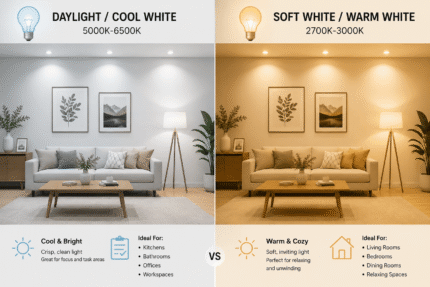
| Habitación | Temperatura de color recomendada |
|---|---|
| Dormitorio | 2700K–3000K |
| Sala de estar | 2700K–3000K |
| Comedor | 2700K–3000K |
| Cocina | 4000K |
| Baño | 4000K |
| Oficina en casa | 4000K–5000K |
| Taller | 5000K–6500K |
| Exhibición al por menor | 5000K–6500K |
| Seguridad al aire libre | 4000K–6500K |
Preguntas frecuentes
¿Un Kelvin más alto significa una bombilla más brillante??
No. Kelvin mide la color de la luz, mientras que el brillo se mide en lúmenes (lm). Dos bombillas con la misma potencia lumínica pueden tener temperaturas de color completamente diferentes.
¿Es mejor 3000K o 4000K??
Ninguno de los dos es universalmente mejor. 3000K Crea una atmósfera cálida y relajante que es ideal para espacios habitables., mientras 4000K proporciona más brillo, Iluminación más limpia que se adapta mejor a las cocinas., baños, y áreas de trabajo.
¿2700K es lo mismo que blanco suave??
Sí. La mayoría de los fabricantes utilizan Blanco suave y Blanco cálido indistintamente para bombillas alrededor 2700K. Aunque la redacción puede variar ligeramente entre marcas., generalmente producen el mismo calor, luz confortable.
¿Qué temperatura de color es mejor para las bombillas LED??
No existe una única mejor opción. La temperatura de color ideal depende de dónde se utilizará la bombilla.. Blanco cálido (2700K–3000K) funciona mejor para espacios relajantes, mientras que el blanco frío (4000K) y luz del día (5000K–6500K) son mejores para la iluminación de tareas y entornos de trabajo.
¿Qué temperatura de color es mejor para un dormitorio??
La mayoría de los expertos en iluminación recomiendan 2700K–3000K, ya que la luz cálida crea una atmósfera acogedora y ayuda a promover la relajación.
¿Puedo mezclar diferentes temperaturas de color??
Puede, pero generalmente es mejor mantener la misma temperatura de color en una sola habitación. La iluminación constante crea un ambiente más limpio., apariencia más profesional.
¿Qué temperatura de color es la más cercana a la luz natural??
6500K Se parece más a la luz natural y se utiliza ampliamente en talleres., oficinas, exhibidores minoristas, y otras áreas donde se requiere máxima visibilidad.
Pensamientos finales
Elegir lo correcto temperatura de color Es tan importante como seleccionar la base de bombilla o el brillo correctos.. Si prefieres el cálido resplandor de 2700K, la apariencia equilibrada de 3500K, la nítida claridad de 4000K, o la brillante iluminación de 6500K luz del día, entendiendo el escala kelvin hace que sea más fácil crear la iluminación perfecta para cada habitación.
Antes de comprar bombillas de repuesto, siempre revisa el kélvin (K) calificación junto con la tipo básico y salida de lúmenes. Hacer coincidir las tres especificaciones ayudará a garantizar la coherencia, Iluminación cómoda en toda su casa o lugar de trabajo..
Huiyee Lighting ha estado en este campo por más de 10 años. haga clic aquí para más opciones sobre la temperatura de color de las bombillas LED.