 English
 العربية
 Français
 Deutsch
 Italiano
 Polski
 Português
 Русский
 Español
 Українська


Bombilla LED E26: Todo lo que necesitas saber antes de comprar
Comprar una bombilla LED debería ser sencillo. Sin embargo, una vez que comienzas a comparar diferentes productos, las etiquetas pueden volverse confusas rápidamente. Una bombilla dice E26, otro dice A19, mientras otros muestran 800 lúmenes, 9 vatios, 60equivalente en W, o 2700K. Pronto, encontrar la bombilla de repuesto adecuada parece mucho más complicado de lo que debería.
Bombilla LED E26
En primer lugar, es importante entender que E26 se refiere sólo a la tipo de base de tornillo en la bombilla. lo hace no describir la forma de la bombilla, brillo, o color.
El Base media E26 es la base de tornillo estándar utilizada en todo Estados Unidos, Canadá, y otros países que operan con sistemas eléctricos de 120 V. Como resultado, Se adapta a la gran mayoría de accesorios de iluminación residencial., incluyendo luces de techo, lámparas de mesa, lámparas de pie, luces colgantes, apliques de pared, luces de tocador, y muchos accesorios al aire libre.
Para entender mejor el nombre, veamos su origen.
la designación E26 viene del famoso Tornillo Edison, inventado por Tomás Edison hace más de un siglo. A pesar del rápido desarrollo de la tecnología LED, Esta base roscada sigue siendo el estándar de la industria debido a su simplicidad., fiabilidad, y compatibilidad.
Esto es lo que significa el código:
- mi = Tornillo Edison
- 26 = La base del tornillo mide 26 milímetros de diámetro
Porque el estándar base se ha mantenido sin cambios., Las modernas bombillas LED E26 pueden reemplazar fácilmente a las incandescentes tradicionales., halógeno, o bombillas CFL sin cambiar los accesorios existentes.
Por qué elegir una bombilla LED E26?
En comparación con las bombillas incandescentes tradicionales, Las bombillas LED E26 ofrecen una amplia gama de ventajas.
Ellos:
- Consumir hasta 80–90% menos electricidad
- último entre 15,000 y 50,000 horas
- Genera significativamente menos calor
- Se enciende instantáneamente sin tiempo de calentamiento
- Están disponibles en varios niveles de brillo y temperaturas de color.
- Puede ser regulable cuando se combina con reguladores de intensidad compatibles
En breve, Proporcionan facturas de energía más bajas., vida útil más larga, y mejor rendimiento de iluminación general, convirtiéndolos en la opción preferida para los hogares modernos.
Dimensiones de base media E26
Ahora que ya sabes qué es una base E26, echemos un vistazo más de cerca a sus dimensiones..
Aunque las bombillas LED vienen en muchas formas y tamaños diferentes, Cada bombilla E26 comparte la misma base de tornillo estandarizada..
Las especificaciones típicas incluyen:
| Especificación | Dimensión |
|---|---|
| Diámetro de la base | 26 milímetros (1.02 pulgadas) |
| Tipo de hilo | Tornillo Edison |
| Voltaje estándar | 120V y |
| Regiones comunes | Estados Unidos, Canadá, México |
Estos hilos proporcionan tanto una conexión mecánica segura como el contacto eléctrico necesario para alimentar la bombilla de forma segura..
E26 frente a. E27
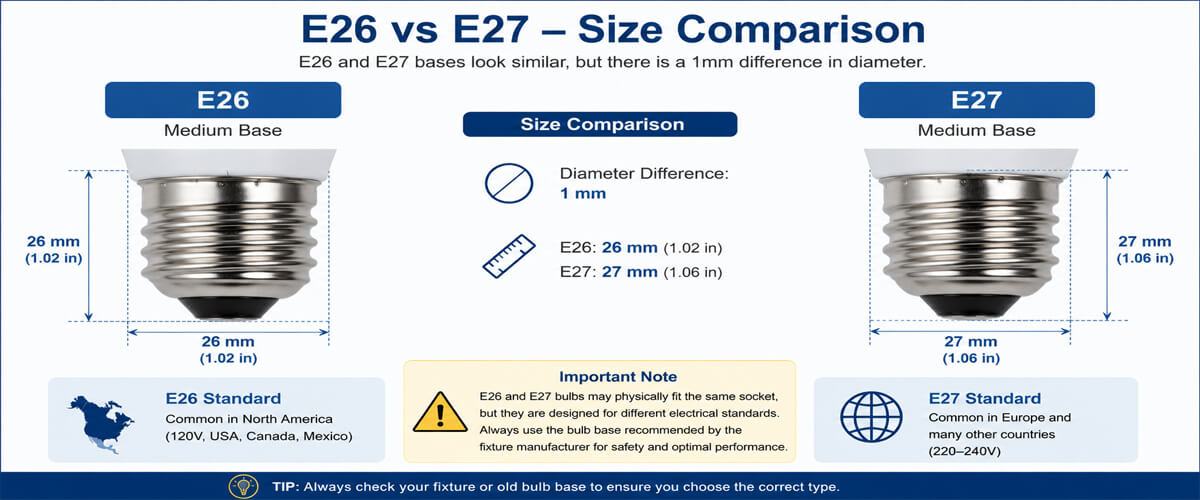
A primera vista, E26 y E27 Las bombillas parecen casi idénticas.. De hecho, el diámetro de la base difiere sólo por 1 milímetros, por lo que a menudo pueden encajar en el mismo enchufe.
Sin embargo, Están diseñados para diferentes estándares eléctricos..
- E26 — Estándar norteamericano (120V)
- E27 — Norma europea (220–240V)
Aunque son físicamente compatibles en muchas situaciones, Siempre es mejor utilizar la base de la bombilla recomendada por el fabricante del dispositivo para garantizar una seguridad y un rendimiento óptimos..
Códigos de forma de bombilla
Mientras que E26 te indica el tipo de base, no te dice cómo se ve realmente la bombilla. Ahí es donde códigos de forma de bulbo Adelante.
Los códigos de forma de bombilla son un sistema estándar de la industria que se utiliza para identificar la forma y el tamaño de una bombilla.. Hacen que reemplazar una bombilla existente sea mucho más fácil porque puedes encontrar rápidamente una con la misma apariencia y dimensiones..
Típicamente, cada código consta de:
- Una o más letras que indican la forma del bulbo.
- Un número que representa el diámetro máximo del bulbo en octavos de pulgada
Algunos de los ejemplos más comunes incluyen:
| Código de bombilla | Forma | Aplicaciones típicas |
|---|---|---|
| A19 | Bombilla doméstica estándar | Iluminación general del hogar. |
| ST19 / ST64 | bombilla edison vintage | Accesorios decorativos |
| G25 | bombilla globo | Iluminación de tocador de baño |
| G40 | Bombilla globo grande | Luces colgantes decorativas |
| B11 | bombilla de vela | Candelabros y apliques de pared |
| BR30 | bombilla de inundación | Iluminación empotrada en el techo |
| PAR38 | Destacar | Iluminación de seguridad exterior |
Por ejemplo, un A19 la bombilla mide aproximadamente 19/8 pulgadas (2.375 pulgadas) de diámetro.
Simplemente recuerda:
- E26 = Tamaño básico
- A19, G25, ST19, B11 = Forma del bulbo
Juntos, Estas especificaciones describen completamente el diseño físico de la bombilla..
Vatios frente a. Vatios equivalentes
Después de identificar la forma correcta de la base y la bombilla, La siguiente especificación que notarás es la potencia..
Mucha gente todavía asocia una mayor potencia con una luz más brillante.. Si bien esto era cierto en general para las bombillas incandescentes tradicionales, ya no se aplica a los LED modernos.
Potencia real
El vataje impreso en una bombilla LED indica ¿Cuánta electricidad consume la bombilla?, no lo brillante que es.
Los ejemplos incluyen:
- 4LED
- 6LED
- 9LED
- 12LED
Dado que los LED son altamente eficientes, Requieren mucha menos energía para producir la misma cantidad de luz.. Para mayor potencia, Podemos personalizar para el cliente según lo solicitado.. Si es necesario, por favor contáctanos directamente.
Vatios equivalentes
Para facilitar la actualización, Los fabricantes también enumeran un vatios equivalentes.
Esto les indica a los consumidores qué bombilla incandescente está diseñada para reemplazar el LED..
| Potencia LED | Equivalente incandescente |
|---|---|
| 4W | 40W |
| 6W | 60W |
| 9W | 75W |
| 12W | 100W |
| 15W | 150W |
Por ejemplo, a 9LED Puede producir aproximadamente el mismo brillo que un tradicional. 75bombilla incandescente, mientras consume sólo una fracción de la electricidad.
Por lo tanto, al comparar bombillas LED, no te centres solo en la potencia.
Lúmenes
En cambio, prestar mucha atención a la clasificación lumínica.
Lúmenes (lm) medir la cantidad total de luz visible emitida por una bombilla. En términos simples:
Cuanto mayor sea el valor del lumen, cuanto más brillante es la luz.
A diferencia de los vatios, Los lúmenes miden directamente el brillo., convirtiéndolas en la mejor manera de comparar bombillas LED.
Aquí hay algunos niveles de brillo comunes.:
| Brillo | Lúmenes |
|---|---|
| Iluminación decorativa | 250–450 lúmenes |
| Lámparas de mesa | 450–800 lúmenes |
| Iluminación general de la habitación | 800–1.100 lm |
| Iluminación de tareas | 1,100–1.600 lúmenes |
| Espacios muy luminosos | 1,600+ lm |
Porque diferentes bombillas LED pueden producir diferentes lúmenes mientras consumen la misma cantidad de electricidad., Los lúmenes son el indicador más confiable de brillo..
Temperatura del color
Una vez que haya seleccionado el brillo correcto, es hora de considerar la apariencia de la luz misma.
La temperatura del color describe si la luz parece cálida., neutral, o genial. Se mide en kélvin (K).
En términos generales:
- Los valores Kelvin más bajos crean temperaturas más cálidas., luz en tonos amarillos.
- Los valores Kelvin más altos producen temperaturas más frías., luz más blanca.
Las temperaturas de color residenciales más comunes incluyen:
| Temperatura del color | Apariencia | Mejor para |
|---|---|---|
| 2200K | Luz de una vela | iluminación de época, restaurantes |
| 2700K | Blanco cálido | Dormitorios, sala de estar |
| 3000K | Blanco suave | Comedores, pasillos |
| 4000K | Blanco neutro | Cocinas, baños |
| 5000K | Luz | Oficinas, garajes, talleres |
| 6500K | Luz del día fresca | Espacios comerciales e industriales. |
¿Qué temperatura de color es mejor??
Al final, la temperatura de color adecuada depende de la atmósfera que desee crear.
- 2700K–3000K crea un ambiente acogedor y relajante.
- 4000K Proporciona una iluminación equilibrada para las actividades cotidianas..
- 5000K ofrece crujiente, Iluminación de alta visibilidad para áreas de trabajo y tareas detalladas..
Como resultado, Elegir la temperatura de color adecuada puede mejorar drásticamente tanto la comodidad como la funcionalidad de su espacio..
Cómo elegir la bombilla LED E26 adecuada
Ahora que comprende las especificaciones básicas, elegir la bombilla adecuada se vuelve mucho más fácil.
Antes de realizar tu compra, considere estos cinco factores:
- Confirma que tu dispositivo utiliza un Base media E26.
- Elija la forma de bombilla correcta, como A19, ST19, G25, o B11.
- Comparar lúmenes para determinar el brillo que necesita.
- Seleccione un temperatura de color que coincida con su habitación y preferencia personal.
- Compruebe si hay características adicionales como compatibilidad de atenuación, IRC alto, o funciones de iluminación inteligente.
Siguiendo estos sencillos pasos, No tendrá problemas para seleccionar la bombilla LED ideal para su aplicación..
Conclusión
En resumen, elegir la bombilla LED adecuada no tiene por qué ser abrumador.
Una vez que entiendas lo que E26, códigos de forma de bulbo, vatios, vatios equivalentes, lúmenes, y temperatura de color realmente significa, comparar productos se vuelve mucho más sencillo.
Recordar, un bombilla LED E26 simplemente se refiere al estándar 26 mm base de tornillo Edison utilizado en la mayoría de los hogares norteamericanos. Las especificaciones restantes le indican cómo funcionará la bombilla: qué tan brillante es, cuanta energía usa, y que tipo de luz produce.
Finalmente, No juzgues una bombilla LED solo por su potencia. Para la mejor experiencia de iluminación, Elija una bombilla con el adecuado salida de lúmenes, el derecho temperatura de color, y un Índice de reproducción cromática (CRI) de 90 o superior. Una bombilla LED con alto CRI muestra los colores con mayor precisión, crea un ambiente de apariencia más natural, y mejora el confort visual en toda tu casa.
Con un conocimiento básico de estas especificaciones, Podrás elegir con confianza la bombilla LED E26 perfecta para cualquier habitación mientras disfrutas de una eficiencia energética, de larga duración, e iluminación de alta calidad para los años venideros. haga clic aquí para más bombillas LED E26.