English
 العربية
 Français
 Deutsch
 Italiano
 Polski
 Português
 Русский
 Español
 Українська


Iluminando sua casa: Luz branca quente ou branca fria – qual você deve escolher?
Escolher a iluminação certa para sua casa nem sempre é tão simples quanto selecionar uma lâmpada com maior brilho. Embora muitos proprietários se concentrem nos lúmens e na temperatura da cor, eles muitas vezes ignoram outro fator crítico que afeta diretamente a aparência e a sensação de uma sala: Índice de reprodução de cores (Cri).
Na verdade, duas lâmpadas LED podem ter o mesmo brilho e temperatura de cor, ainda produzem experiências visuais completamente diferentes. Isso ocorre porque o CRI determina a precisão com que as cores aparecem sob luz artificial.
Portanto, antes de decidir entre iluminação branca quente e branca fria, é importante entender ambos temperatura de cor (Kelvin) e Cri (Índice de reprodução de cores). Junto, esses dois fatores irão ajudá-lo a criar uma casa confortável, funcional, e visualmente atraente.
Antes de comprar novas lâmpadas LED, pergunte a si mesmo duas perguntas importantes:
- Quais salas você deseja iluminar?
- Como você pode iluminar esses espaços da maneira mais eficaz?
Felizmente, depois de entender como a temperatura da cor e o CRI funcionam juntos, escolher a iluminação certa fica muito mais fácil.
Diferentes espaços domésticos precisam de iluminação diferente
Em primeiro lugar, a iluminação deve apoiar as atividades que ocorrem dentro de uma sala. Como cada espaço tem um propósito diferente, cada área da sua casa requer uma abordagem de iluminação ligeiramente diferente.
Por exemplo, a iluminação que ajuda você a relaxar em um quarto pode não fornecer visibilidade suficiente para preparar refeições em uma cozinha. De forma similar, a iluminação que funciona bem para leitura e estudo pode parecer muito clara e clínica em uma sala de estar.
Como resultado, avaliar cada cômodo individualmente é uma das maneiras mais eficazes de criar um design de iluminação equilibrado em toda a sua casa..
De um modo geral, os proprietários escolhem entre duas temperaturas de cor primária:
- Luz Branca Quente
- Luz Branca Fria
No entanto, antes de comparar essas opções, vamos primeiro ver por que o CRI é tão importante quanto a temperatura da cor.
O que é CRI e por que é importante?
Cri, ou Índice de reprodução de cores, mede a precisão com que uma fonte de luz revela cores em comparação com a luz solar natural.
A escala CRI varia de 0 para 100:
| Classificação CRI | Desempenho de cores |
|---|---|
| Cri 80 | Bom para iluminação básica |
| Cri 90 | Excelente precisão de cores |
| Cri 95+ | Reprodução de cores quase natural |
Um CRI mais alto permite que as cores pareçam mais ricas, mais vibrante, e mais fiel à vida.
Por exemplo:
- Armários brancos parecem mais limpos.

- Móveis de madeira exibem seu grão natural e calor.
- A comida parece mais fresca e apetitosa.
- Os tons de pele parecem mais naturais.
- Acabamentos decorativos revelam suas verdadeiras cores.
- A reprodução de cores mais nítida ajuda a reduzir o cansaço visual durante a leitura, trabalhando, e tarefas diárias.
- Os quartos ficam mais claros, mais acolhedor, e mais premium com reprodução de cores precisa.
- Armários brancos parecem mais limpos.
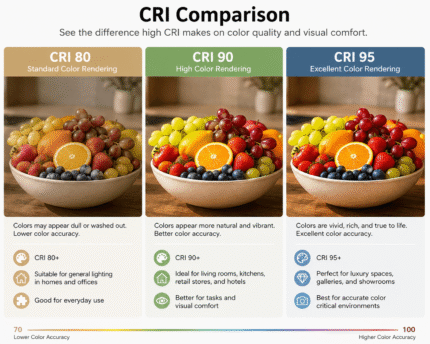
Em contraste, iluminação de baixo CRI pode fazer com que as cores pareçam opacas, desbotado, ou ligeiramente distorcido. Devido a esta, muitos profissionais de iluminação agora recomendam a escolha de lâmpadas LED com IRC de 90 ou superior, especialmente para aplicações residenciais.
Quer você escolha iluminação branca quente ou branca fria, um CRI alto garantirá que sua casa tenha a melhor aparência.
Branco quente vs luz branca fria: Qual é a diferença?
Agora que cobrimos o CRI, vamos explorar a diferença entre iluminação branca quente e branca fria.
A principal distinção é a sua temperatura de cor, medido em Kelvin (K). A temperatura da cor descreve a aparência da luz e não o calor real produzido pela lâmpada.
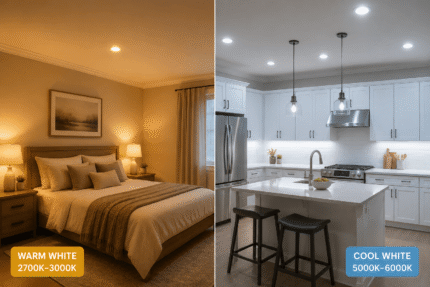
Luz Branca Quente (2700K–3000K)
A luz branca quente produz um brilho suave amarelo ou âmbar semelhante às lâmpadas incandescentes tradicionais.
Embora as lâmpadas incandescentes tenham desaparecido em grande parte devido à sua ineficiência, muitas pessoas ainda amam o ambiente aconchegante que criam. Felizmente, a moderna tecnologia LED pode replicar a mesma aparência convidativa enquanto consome significativamente menos energia.
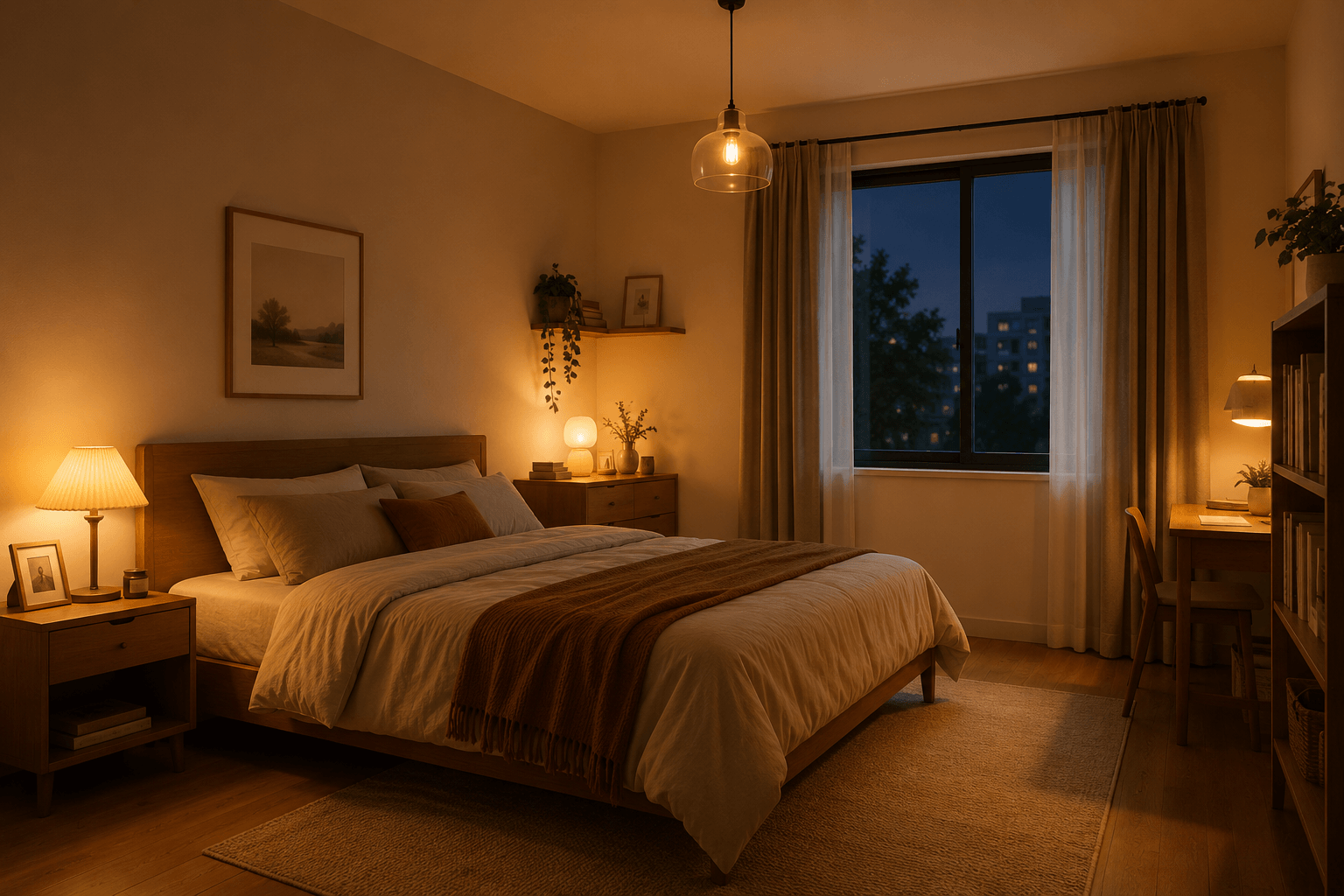
Como resultado, a iluminação branca quente é ideal para criar um ambiente relaxante e confortável.
A luz branca quente funciona particularmente bem em:
- Quartos
- Salas de estar
- Salas de jantar
- Quartos familiares
- Hotéis e espaços de hospitalidade
Além disso, quando emparelhado com uma lâmpada LED de alto CRI, a iluminação branca quente pode melhorar lindamente:
- Móveis de madeira
- Acentos decorativos
- Arte
- Têxteis
- Detalhes arquitetônicos
Consequentemente, os quartos ficam mais quentes, mais convidativo, e mais luxuoso.
Luz Branca Fria (4000K–6500K)
Em comparação, a luz branca fria parece mais brilhante, limpador, e um pouco azulado.
Porque melhora a visibilidade e o contraste, a iluminação branca fria é frequentemente usada em áreas onde a concentração e a precisão são importantes.
As aplicações típicas incluem:
- Cozinhas
- Escritórios domésticos
- Salas de estudo
- Garagens
- Oficinas
- Banheiros
- Lavanderias
Adicionalmente, a luz branca fria pode fazer com que os espaços pareçam mais limpos e espaçosos.
Quando combinado com um CRI de 90+, a iluminação branca fria não só melhora a visibilidade, mas também garante que as cores permaneçam precisas e naturais. Isto é especialmente importante em cozinhas, onde a preparação dos alimentos beneficia de clareza, renderização de cores realista.
Você pode usar branco quente e branco frio juntos?
Absolutamente.
Na verdade, O design de iluminação moderno combina frequentemente múltiplas temperaturas de cor para criar um ambiente mais flexível e funcional.
Em vez de escolher uma única temperatura de cor para toda a casa, muitos designers recomendam camadas de iluminação branca quente e fria para se adequar à finalidade de cada área.
Por exemplo:
Cozinha
- Luzes pendentes brancas quentes acima da ilha
- Iluminação branca fria acima das bancadas
Banheiro
- Iluminação ambiente branca quente
- Iluminação de espelho branco legal
Espaços de convivência em plano aberto
- Iluminação branca quente para áreas de estar e relaxamento
- Iluminação branca fria para zonas de leitura ou de trabalho
Combinando ambas as temperaturas de cor, proprietários podem:
- Reduza sombras fortes
- Melhorar o conforto visual
- Melhore a estética do ambiente
- Aumente a funcionalidade
- Crie cenas de iluminação adaptáveis ao longo do dia
Como resultado, a casa parece mais confortável e ao mesmo tempo altamente prática.
Conclusão: Como escolher a melhor lâmpada LED
Em última análise, a melhor solução de iluminação depende da finalidade da sala e da qualidade da própria lâmpada.
Se você estiver criando um ambiente relaxante, escolher lâmpadas LED brancas quentes (2700K–3000K) para quartos, salas de estar, e áreas de jantar.
Se você precisa de brilho, iluminação focada para tarefas, escolher lâmpadas LED brancas frias (4000K–6500K) para cozinhas, escritórios domésticos, garagens, e banheiros.
No entanto, a temperatura da cor é apenas parte da equação.
Para alcançar o mais natural, vibrante, e experiência de iluminação confortável, recomendamos fortemente a seleção de lâmpadas LED com um IRC de 90 ou superior. A iluminação de alto CRI permite que as cores pareçam mais realistas, melhora o conforto visual, e melhora a aparência geral da sua casa.
Na iluminação Huiyee, todas as nossas lâmpadas LED padrão são fabricadas com Cri 90+ para garantir excelente precisão de cores e desempenho de iluminação premium.
Se você prefere iluminação branca quente ou branca fria, escolher uma lâmpada de alto CRI fará uma diferença notável na aparência e sensação do seu espaço.
Procurando CRI premium 90+ Lâmpadas LED? Clique aqui para explorar nossa linha completa de lâmpadas de filamento LED de alta qualidade, Lâmpadas Edison, lâmpadas globo, e soluções de iluminação decorativa.
Perguntas frequentes
A luz branca é boa para um quarto?
Sim, desde que você escolha a temperatura de cor certa.
Para a maioria dos quartos, luz branca quente entre 2700K e 3000K cria uma atmosfera relaxante e confortável que apoia o descanso e o relaxamento.
Para um conforto visual ainda melhor, escolha uma lâmpada com IRC de 90 ou superior para garantir cores naturais e um ambiente mais agradável.
Você pode misturar iluminação branca quente e branca fria?
Absolutamente.
Muitas casas modernas combinam com sucesso iluminação branca quente e branca fria para equilibrar conforto e funcionalidade.
Por exemplo, uma cozinha pode usar iluminação ambiente branca quente para uma atmosfera acolhedora, ao mesmo tempo que incorpora iluminação branca fria para preparação e limpeza de alimentos.
O segredo é manter um design consistente enquanto usa cada temperatura de cor onde ela apresenta melhor desempenho.
Qual cor de luz está mais próxima da luz solar natural?
A luz natural normalmente varia entre 5000K e 6500K, tornando as lâmpadas LED diurnas ou brancas frias a combinação mais próxima em termos de temperatura de cor.
No entanto, a temperatura da cor por si só não determina o quão natural a luz parece.
Para o efeito de luz do dia mais realista, escolha lâmpadas LED que combinem:
- 5000Temperatura de cor K–6500K
- Cri 90 ou superior
Esta combinação proporciona excelente precisão de cores e uma experiência de iluminação que se assemelha muito à luz solar natural.
Artigos relacionados