 English
 العربية
 Français
 Deutsch
 Italiano
 Polski
 Português
 Русский
 Español
 Українська


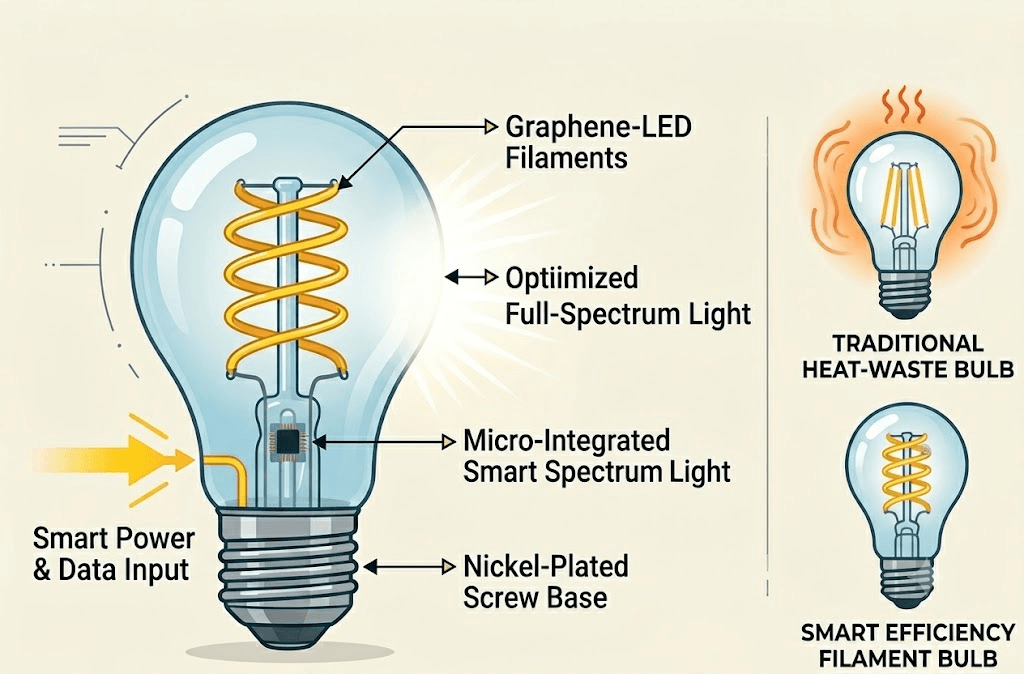
Como funciona a iluminação LED: A ciência por trás das lâmpadas modernas com baixo consumo de energia
A iluminação LED transformou completamente a forma como iluminamos as nossas casas, escritórios, hotéis, restaurantes, e espaços comerciais. Comparado com lâmpadas incandescentes tradicionais e lâmpadas CFL, Luzes LED proporcionam melhor eficiência energética, vida útil mais longa, melhor qualidade de iluminação, e menores custos de manutenção.
No entanto, muitas pessoas usam lâmpadas LED todos os dias sem saber o que realmente acontece dentro delas. Quando você acende uma luz LED, como a eletricidade se torna brilhante, iluminação confortável?
A resposta está em um componente minúsculo, mas poderoso, dentro da lâmpada: o chip semicondutor.
Quando a corrente elétrica passa por este chip, produz luz visível através de um processo chamado eletroluminescência. Ao contrário das lâmpadas incandescentes, que aquecem um filamento até que ele brilhe, A tecnologia LED converte eletricidade diretamente em luz. Como resultado, muito menos energia é desperdiçada como calor.
Devido a esta conversão eficiente de energia, As lâmpadas LED podem reduzir o consumo de eletricidade em até 80% em comparação com a iluminação tradicional. Além disso, sua longa vida útil ajuda a reduzir a frequência de substituição e os custos de manutenção.
Hoje, A tecnologia LED é usada em todos os lugares - desde lâmpadas Edison decorativas e lâmpadas de vela em lustres até luminárias embutidas, sistemas de iluminação inteligentes, e soluções de iluminação comercial.
Neste guia completo, nós vamos explicar como funciona a iluminação LED, quais componentes estão dentro de uma lâmpada LED, por que os LEDs são mais eficientes em termos energéticos do que as lâmpadas tradicionais, e como fatores como brilho, temperatura de cor, e CRI afetam sua experiência de iluminação. A imagem abaixo pode ajudá-lo a entender melhor como a lâmpada funciona.
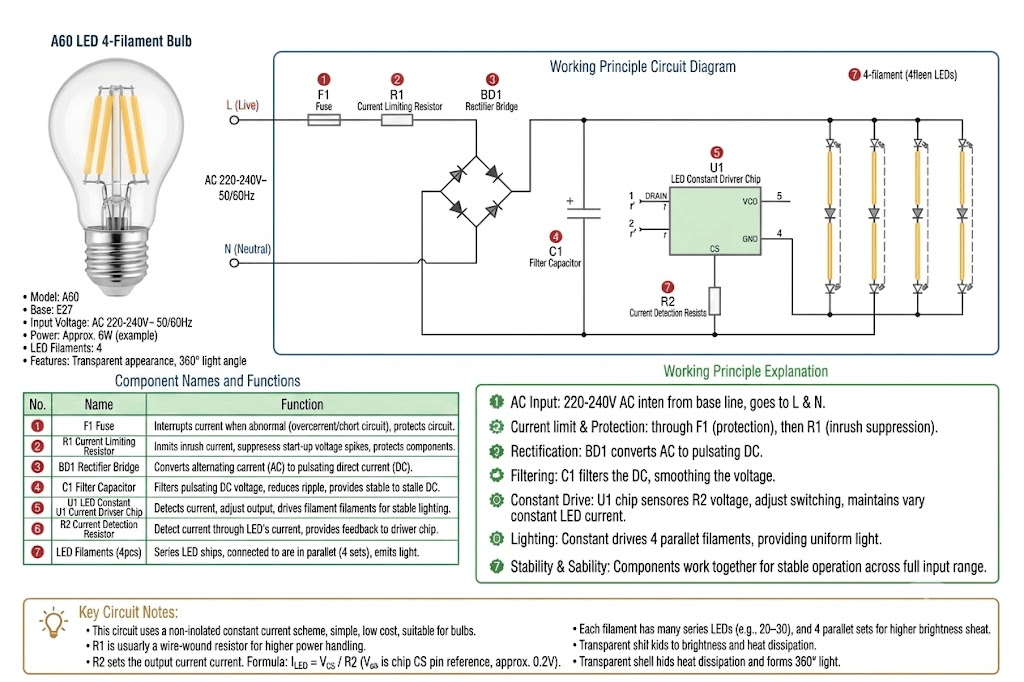
Quer você esteja substituindo uma única lâmpada, atualizando a iluminação da sua casa, ou planejando um projeto de iluminação comercial, compreender a tecnologia LED irá ajudá-lo a escolher a solução de iluminação certa.
O que é um LED?
Antes de explorar como funciona a iluminação LED, é importante entender o que significa o termo “LED”.
LED significa Diodo emissor de luz. É um dispositivo semicondutor que converte energia elétrica em luz visível.
Ao contrário das lâmpadas incandescentes, que criam luz aquecendo um filamento de tungstênio, Os LEDs produzem luz através de um processo chamado eletroluminescência.
Simplesmente explicado:
A eletricidade entra → Os elétrons se movem dentro do semicondutor → A energia é liberada na forma de luz
Porque os LEDs não precisam aquecer um filamento, eles usam energia com muito mais eficiência e geram significativamente menos calor.
Esta tecnologia simples mas avançada é a razão pela qual as lâmpadas LED são:
- Mais eficiente em termos energéticos
- Mais duradouro
- Resfriador durante a operação
- Mais flexível no design
- Disponível em muitas cores e estilos de iluminação
À medida que a tecnologia LED continua a melhorar, os fabricantes agora podem criar lâmpadas com melhor brilho, maior precisão de cores, e recursos de controle mais inteligentes.
Uma breve história da tecnologia LED
Embora a iluminação LED seja considerada uma tecnologia moderna, seu desenvolvimento levou muitos anos.
Os primeiros LEDs não foram projetados para iluminação doméstica. Em vez de, eles eram usados principalmente como pequenas luzes indicadoras em dispositivos eletrônicos.
Ao longo do tempo, melhorias nos materiais semicondutores transformaram os LEDs nas soluções de iluminação avançadas atuais.
1962 – O primeiro LED prático
Nick Holonyak Jr.. desenvolveu o primeiro LED vermelho visível prático, criando a base para a futura tecnologia LED.
1970Década de 1980 - Mais cores de LED foram desenvolvidas
Durante esse período, fabricantes introduziram amarelo, laranja, e LEDs verdes, expandindo as aplicações de LED além de simples indicadores.
1990s – O LED azul mudou a indústria da iluminação
O desenvolvimento de LEDs azuis de alto brilho foi um avanço. Combinando chips LED azuis com materiais de fósforo, os fabricantes poderiam finalmente criar iluminação LED branca eficiente.
2000s – Lâmpadas LED entraram nas casas
À medida que os custos de produção diminuíram e o desempenho melhorou, As lâmpadas LED tornaram-se um substituto prático para lâmpadas incandescentes e CFL.
Hoje – A iluminação LED domina o mercado
Os LEDs modernos são agora amplamente utilizados em:
- Iluminação residencial
- Edifícios comerciais
- Hotéis e restaurantes
- Iluminação externa
- Sistemas de iluminação inteligentes
- Aplicações industriais
Mais importante ainda, a invenção da tecnologia LED azul tornou possível a moderna iluminação LED branca e mudou completamente a indústria de iluminação global.
Lâmpadas LED vs Incandescentes vs CFL: Qual é melhor?
Para entender melhor por que os LEDs se tornaram tão populares, ajuda compará-los com tecnologias de iluminação mais antigas.
| Recurso | Incandescente | LFC | LIDERADO |
|---|---|---|---|
| Fonte de luz | Filamento aquecido | Gás mercúrio | Chip semicondutor |
| Eficiência Energética | Baixo | Médio | Alto |
| Eficiência Típica | Em volta 15 lm/W | Em volta 60 lm/W | 80–120lm/W |
| Vida útil | Sobre 1,000 horas | Sobre 8,000 horas | 25,000–50.000+ horas |
| Saída de calor | Muito alto | Moderado | Baixo |
| Conteúdo de Mercúrio | Não | Sim | Não |
| Consumo de energia | Mais alto | Médio | Mais baixo |
Como mostra a comparação, As lâmpadas LED oferecem vantagens em quase todas as categorias.
Por exemplo, substituir uma lâmpada incandescente tradicional de 60 W por uma lâmpada LED de 9 W pode fornecer brilho semelhante e usar muito menos eletricidade.
Portanto, Os LEDs são agora a escolha preferida dos proprietários, negócios, e profissionais de iluminação em todo o mundo.
Anatomia de uma lâmpada LED moderna
Embora uma lâmpada LED possa parecer semelhante a uma lâmpada tradicional vista de fora, sua estrutura interna é muito mais avançada.
Dentro de cada lâmpada LED, vários componentes principais trabalham juntos para criar, eficiente, e iluminação de alta qualidade.
A compreensão dessas partes também explica por que algumas lâmpadas LED têm um desempenho muito melhor do que outras., mesmo quando eles têm a mesma potência.
Chip LED: O coração da lâmpada
O chip LED é a parte mais importante de todo o sistema de iluminação.
É o componente que produz luz quando a eletricidade passa por ele.
Os chips LED modernos são geralmente feitos de materiais semicondutores, como:
- Nitreto de gálio (GaN)
- Nitreto de índio e gálio (InGaN)
Esses materiais convertem eficientemente energia elétrica em luz visível.
Hoje, Os chips LED estão comumente disponíveis em três tipos principais:
LEDSMD (Dispositivo montado em superfície)
LEDs SMD são amplamente utilizados em produtos de iluminação doméstica.
Vantagens:
- Alta eficiência
- Distribuição uniforme de luz
- Desempenho confiável
- Produção econômica
Eles são comumente encontrados em lâmpadas LED, painéis, e luminárias embutidas.
LED COB (Chip a bordo)
Os LEDs COB combinam vários chips de LED em uma placa.
Os benefícios incluem:
- Maior brilho
- Melhor gerenciamento térmico
- Saída de luz mais forte
Eles são frequentemente usados em iluminação comercial e aplicações de alta potência.
Chip de filamento LED
A tecnologia de filamento LED foi projetada para imitar a aparência dos filamentos incandescentes tradicionais.
Estas lâmpadas são especialmente populares para:
- Lâmpadas Edison
- Iluminação vintage
- Lustres decorativos
- Luzes pendentes
À medida que a tecnologia de chips LED continua a melhorar, os fabricantes podem produzir soluções de iluminação mais brilhantes com menor consumo de energia.
Driver de LED: O cérebro de uma lâmpada LED
Embora o chip LED seja a parte que cria luz, não pode funcionar diretamente com a eletricidade da sua casa.
É aqui que Driver de LED torna-se essencial.
O driver de LED funciona como um pequeno sistema de gerenciamento de energia dentro da lâmpada. Sua principal função é converter a corrente alternada de alta tensão (AC) do seu sistema elétrico para a corrente contínua de baixa tensão (CC) que o chip LED precisa.
Em termos simples:
Eletricidade doméstica → driver de LED → Energia estável → chip de LED produz luz
Além de converter energia, um driver de LED de alta qualidade também controla o fluxo de corrente e protege a lâmpada contra flutuações elétricas.
Um bom driver de LED oferece várias funções importantes:
- Conversão de energia CA para CC
- Regulamentação atual constante
- Proteção de tensão
- Proteção contra surtos
- Redução de cintilação
- Compatibilidade de escurecimento
Portanto, a qualidade do driver LED tem impacto direto no desempenho da lâmpada, estabilidade de brilho, e vida útil.
Por outro lado, drivers de LED de baixa qualidade podem causar problemas comuns, como:
- Cintilação visível
- Sons de zumbido
- Brilho reduzido
- Vida útil mais curta
- Baixo desempenho de escurecimento
Por esta razão, escolher lâmpadas LED de fabricantes confiáveis é importante, especialmente para aplicações onde a qualidade da iluminação é importante, como casas, hotéis, restaurantes, e lojas de varejo.
Dissipador de calor: Mantendo as lâmpadas LED frescas e confiáveis
Embora as lâmpadas LED produzam muito menos calor do que as lâmpadas incandescentes, eles não são completamente livres de calor.
Durante a operação, o chip LED ainda gera uma pequena quantidade de calor. Se este calor não puder escapar adequadamente, pode danificar componentes internos e reduzir a vida útil da lâmpada.
Para resolver este problema, os fabricantes adicionam um dissipador de calor para projetos de lâmpadas LED.
O dissipador de calor funciona absorvendo o calor do chip LED e transferindo-o para o ambiente circundante.
Os materiais comuns do dissipador de calor incluem:
- Alumínio
- Cerâmica
- Materiais compósitos de grafite
Entre esses materiais, o alumínio é amplamente utilizado porque fornece excelente dissipação de calor, ao mesmo tempo que permanece leve e acessível.
Como resultado, gerenciamento térmico eficaz ajuda lâmpadas LED:
- Mantenha o brilho estável
- Evite o superaquecimento
- Melhore a confiabilidade
- Alcançar sua vida útil nominal
É também por isso que duas lâmpadas LED com a mesma potência podem ter vidas úteis muito diferentes. O design interno e o sistema de gerenciamento de calor fazem uma diferença significativa.
Revestimento e Difusor de Fósforo: Criando Luz Branca Confortável
Um fato interessante sobre a tecnologia LED é que a maioria dos chips LED não produz luz branca naturalmente..
Em vez de, muitos chips LED produzem luz azul.
Então, como os fabricantes criam a iluminação branca quente ou branca fria que vemos todos os dias??
A resposta é um material especial chamado revestimento de fósforo.
Uma camada de fósforo é aplicada sobre o chip LED. Quando a luz azul passa através deste revestimento, parte da energia é convertida em outros comprimentos de onda, incluindo amarelo, laranja, e luz vermelha.
A combinação dessas cores cria a aparência de luz branca ao olho humano.
Esta tecnologia permite aos fabricantes produzir diferentes cores de iluminação, incluindo:
| Temperatura de cor | Aparência | Aplicações Comuns |
|---|---|---|
| 2700K | Branco Quente | Quartos, salas de estar |
| 3000K | Branco suave e quente | Hotéis, restaurantes, áreas de jantar |
| 4000K | Branco Neutro | Cozinhas, banheiros, escritórios |
| 5000K | Branco frio | Espaços de trabalho, áreas comerciais |
| 6500K | Luz do dia branca | Garagens, oficinas |
Além disso, As lâmpadas LED geralmente incluem um difusor ou tampa óptica.
O difusor ajuda:
- Espalhe a luz uniformemente
- Reduza o brilho
- Elimine pontos de acesso agressivos
- Crie uma experiência visual mais confortável
Portanto, lâmpadas LED de alta qualidade não se trata apenas de brilho - mas também de produzir iluminação confortável e equilibrada.
Base e alojamento da lâmpada: Tornando as lâmpadas LED fáceis de instalar
Depois que os componentes internos são montados, eles são protegidos dentro da carcaça da lâmpada e conectados a uma base de lâmpada.
A base é a parte que conecta a lâmpada ao aparelho e fornece energia elétrica.
Os tipos comuns de base de lâmpada LED incluem:
- E26
- E27
- E12
- E14
- GU10
- MR16
- B22
Escolher a base correta da lâmpada é essencial porque uma base incompatível pode impedir a instalação ou afetar a segurança.
Por exemplo:
- E26 e E27 são amplamente utilizados em soquetes domésticos
- E12 é comumente usado para lâmpadas decorativas de velas e lustres
- GU10 é frequentemente encontrado em holofotes e iluminação embutida
Ao compreender as bases das lâmpadas, você pode selecionar rapidamente a lâmpada LED de reposição correta para o seu equipamento.
A ciência por trás da iluminação LED: Como a eletricidade se torna leve
Agora que entendemos as principais partes de uma lâmpada LED, vamos nos aprofundar na ciência real por trás de como os LEDs criam luz.
Embora o processo aconteça em um nível microscópico, a ideia básica é surpreendentemente simples.
A junção PN: Onde a luz é gerada
Dentro de cada chip LED existe uma estrutura especial chamada Junção PN.
Ele contém duas camadas semicondutoras:
Semicondutor Tipo N
Esta camada contém elétrons extras.
Semicondutor tipo P
Esta camada contém áreas chamadas “buracos,”que são espaços onde os elétrons podem se mover.
Quando a eletricidade flui através do LED, elétrons se movem da camada tipo N em direção à camada tipo P.
Quando os elétrons se combinam com buracos, energia é liberada.
Este processo é chamado recombinação elétron-buraco.
A energia liberada aparece como pequenas partículas de luz chamadas fótons.
Em termos simples:
Eletricidade → Movimento de elétrons → Liberação de fótons → Luz visível
Ao contrário das lâmpadas incandescentes, Os LEDs não precisam aquecer nada para criar luz.
Devido a esta, muito mais energia elétrica se transforma em iluminação útil em vez de calor desperdiçado.
Por que os LEDs produzem cores diferentes
A cor de um LED depende dos materiais semicondutores usados dentro do chip.
Diferentes materiais têm diferentes níveis de energia, também conhecido como lacunas de banda.
A diferença de energia determina o comprimento de onda da luz produzida.
Por exemplo:
| Cor | Comprimento de onda aproximado |
|---|---|
| Vermelho | 620–750nm |
| Verde | 520–560nm |
| Azul | 460–495nm |
| Violeta | 400–420nm |
Ajustando materiais semicondutores, os fabricantes podem criar diferentes cores de LED para diversas aplicações.
Esta tecnologia é usada em:
- Iluminação decorativa
- Lâmpadas RGB inteligentes
- Telas de exibição
- Iluminação arquitetônica
Como os LEDs brancos criam luz branca
Interessantemente, a maioria das lâmpadas LED brancas não cria luz branca diretamente.
Em vez de, eles usam uma combinação de:
- Chip LED azul
- Revestimento de fósforo
O LED azul produz luz azul, enquanto o revestimento de fósforo converte parte dessa luz em outras cores.
Quando essas cores se misturam, nossos olhos percebem o resultado como luz branca.
Este método fornece:
- Alta eficiência
- Melhor consistência de cor
- Longa vida útil
- Menor custo de produção
Por causa dessas vantagens, LEDs convertidos em fósforo tornaram-se a tecnologia padrão para iluminação LED branca moderna.
Por que a iluminação LED é tão eficiente em termos energéticos
Uma das principais razões pelas quais as pessoas mudam para a iluminação LED é a economia de energia.
No entanto, a verdadeira vantagem da tecnologia LED não é simplesmente o facto de utilizar menos watts. A principal diferença é com que eficiência os LEDs convertem eletricidade em luz utilizável.
As lâmpadas incandescentes tradicionais funcionam aquecendo um filamento de metal até que fique quente o suficiente para brilhar.. Como resultado, a maior parte da eletricidade é liberada como calor em vez de luz.
Em comparação, As lâmpadas LED usam tecnologia de semicondutores para converter eletricidade diretamente em luz.
Isso significa:
Menos energia desperdiçada → Mais energia convertida em luz → Menores custos de eletricidade
Devido a este design eficiente, As lâmpadas LED podem fornecer o mesmo brilho que as lâmpadas tradicionais, consumindo significativamente menos energia.
Para proprietários, isso significa contas mensais de eletricidade mais baixas.
Para empresas, como hotéis, restaurantes, escritórios, e lojas de varejo, A iluminação LED pode reduzir significativamente os custos operacionais a longo prazo.
Lúmens x Watts: Compreendendo o brilho do LED
Ao comprar lâmpadas tradicionais, muitas pessoas usaram watts para estimar o brilho.
No entanto, com tecnologia LED, este método não é mais preciso.
A razão é simples:
Watts medem o consumo de energia, não brilho.
Os lúmens medem a saída de luz real.
Por exemplo:
| Bulbo Tradicional | Brilho | Equivalente a LED |
|---|---|---|
| 25W Incandescente | Em volta 250 lúmens | 2–LED de 3W |
| 40W Incandescente | Em volta 450 lúmens | 4–LED de 6W |
| 60W Incandescente | Em volta 800 lúmens | 7–LED de 10W |
| 75W Incandescente | Em volta 1,100 lúmens | 10–LED de 13W |
| 100W Incandescente | Em volta 1,600 lúmens | 14–LED de 18W |
Portanto, ao escolher uma lâmpada LED, é melhor focar em lúmens em vez de watts.
Por exemplo, se você deseja o mesmo brilho de uma lâmpada incandescente antiga de 60 W, procure uma lâmpada LED com cerca 800 lúmens.
Esta simples mudança nos hábitos de compra pode ajudá-lo a selecionar a lâmpada LED certa com mais facilidade.
Menos calor significa mais benefícios
Outra vantagem importante da iluminação LED é a redução da produção de calor.
As lâmpadas incandescentes tradicionais liberam uma grande quantidade de energia na forma de calor. Na verdade, aproximadamente 90% da sua energia pode ser perdida como calor em vez de luz útil.
As lâmpadas LED funcionam de maneira diferente.
Porque convertem eletricidade de forma mais eficiente, eles produzem muito menos calor.
Como resultado:
- Os quartos ficam mais frescos
- Sistemas de ar condicionado funcionam menos
- Os equipamentos permanecem mais seguros
- As lâmpadas duram mais
- O desperdício de energia é reduzido
Isto é especialmente valioso em climas quentes, edifícios comerciais, e luminárias fechadas onde o calor excessivo pode afetar o desempenho.
Além disso, menor consumo de energia ajuda a reduzir as emissões de carbono, tornando a iluminação LED uma escolha mais ecológica.
Qualidade de cor: Por que uma boa iluminação é mais do que brilho
Embora o brilho seja importante, não é o único fator que determina a qualidade da iluminação.
Um ambiente de iluminação confortável também depende:
- Temperatura da cor
- Índice de reprodução de cores (Cri)
- Desempenho de escurecimento
- Controle de oscilação
Esses fatores influenciam a aparência e a sensação de um espaço.
Por exemplo, um restaurante pode precisar de calor, luz convidativa, enquanto um escritório pode exigir mais brilho, iluminação mais fria para melhorar a concentração.
Compreender estes detalhes ajuda-o a escolher lâmpadas LED que correspondam à finalidade de cada espaço.
Compreendendo a temperatura da cor (CCT)
A temperatura da cor descreve como a luz aparece ao olho humano.
É medido em Kelvin (K).
Valores mais baixos de Kelvin criam mais calor, mais luz amarela, enquanto valores Kelvin mais altos criam temperaturas mais frias, mais luz em tons de azul.
| Temperatura de cor | Aparência | Uso recomendado |
|---|---|---|
| 2700K | Branco Quente | Quartos, salas de estar |
| 3000K | Branco Suave | Salas de jantar, hotéis, restaurantes |
| 4000K | Branco Neutro | Cozinhas, banheiros, escritórios |
| 5000K | Branco frio | Espaços de trabalho, áreas comerciais |
| 6500K | Luz do dia | Garagens, oficinas |
Por exemplo:
Uma lâmpada LED de 2700K cria um ambiente aconchegante, tornando-o ideal para áreas de relaxamento.
Enquanto isso, uma lâmpada de 4.000 K ou 5.000 K fornece uma iluminação mais clara e energética, que funciona melhor para ambientes de trabalho.
Portanto, selecionar a temperatura de cor correta é tão importante quanto escolher o brilho certo.
Por que o CRI é importante na iluminação LED
Outro fator importante que afeta a qualidade da iluminação é Cri, ou índice de reprodução de cores.
O CRI mede a precisão com que uma fonte de luz mostra as cores verdadeiras dos objetos em comparação com a luz solar natural.
Quanto maior o valor do CRI, mais cores naturais aparecem. Você pode ver a diferença entre as diferentes classificações do CRI de acordo com a imagem abaixo.
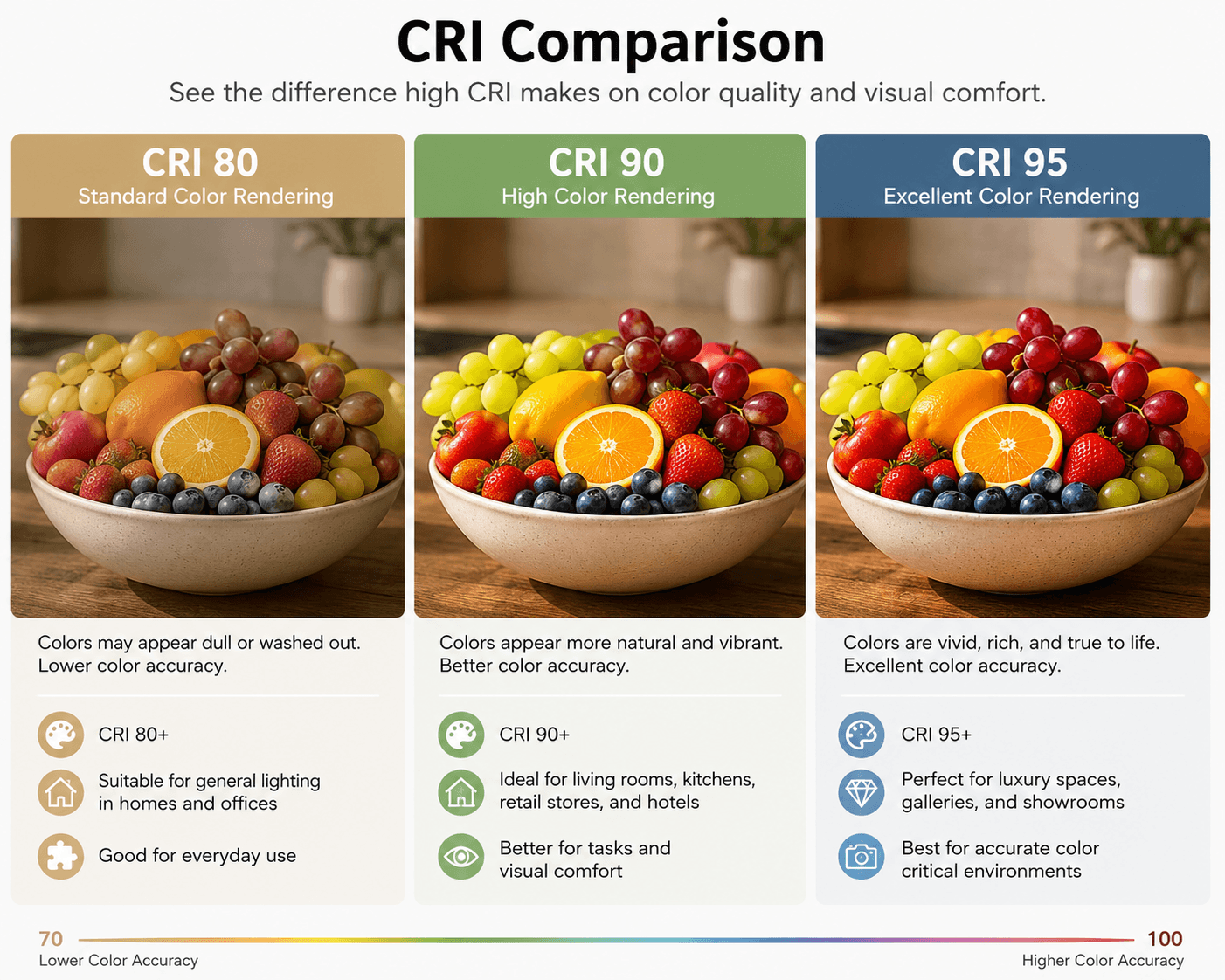
Para iluminação doméstica diária, Cri 80+ geralmente é aceitável.
No entanto, para espaços onde a aparência da cor é importante, como:
- Restaurantes
- Lojas de roupas
- Galerias de arte
- Hotéis
- Áreas de maquiagem
Cri 90+ Lâmpadas LED são frequentemente recomendadas.
A iluminação de alto CRI pode fazer:
- A comida parece mais fresca
- Os tons de pele parecem mais naturais
- As cores interiores parecem mais ricas
- Os produtos parecem mais atraentes
Portanto, o brilho por si só não define uma lâmpada LED de alta qualidade.
Tecnologia de escurecimento LED: Criando a atmosfera certa
Uma das vantagens da iluminação LED moderna é a capacidade de ajustar o brilho.
No entanto, As lâmpadas LED funcionam de forma diferente das lâmpadas incandescentes tradicionais.
As lâmpadas incandescentes podem ser reguladas simplesmente reduzindo a energia elétrica.
As lâmpadas LED requerem sistemas de controle eletrônico especiais.
As tecnologias comuns de dimerização de LED incluem:
Escurecimento de ponta
Um método de dimerização tradicional que é frequentemente usado em sistemas mais antigos.
Escurecimento da borda final
Uma tecnologia mais recente que geralmente fornece dimerização de LED mais suave e silenciosa.
Escurecimento inteligente
Permite que os usuários controlem o brilho através:
- Aplicativos móveis
- Assistentes de voz
- Sistemas domésticos inteligentes
Ao instalar lâmpadas LED reguláveis, verifique sempre a compatibilidade entre a lâmpada e o interruptor dimmer.
Usar um dimmer incompatível pode causar:
- Cintilante
- Zumbido
- Faixa de escurecimento limitada
- Vida útil da lâmpada reduzida
Compreendendo a cintilação do LED
Embora as lâmpadas LED sejam altamente eficientes, produtos de baixa qualidade podem apresentar cintilação.
A cintilação do LED geralmente acontece quando o driver não consegue fornecer uma corrente elétrica estável.
As causas comuns incluem:
- Drivers de baixa qualidade
- Compatibilidade incorreta do dimmer
- Projeto de circuito ruim
A cintilação visível pode causar:
- Desconforto ocular
- Dores de cabeça
- Problemas de gravação da câmera
- Conforto visual reduzido
Felizmente, lâmpadas LED de alta qualidade com drivers confiáveis podem reduzir ou eliminar significativamente problemas de cintilação.
Para áreas onde as pessoas passam muitas horas, como escritórios, quartos, e espaços comerciais, escolher iluminação LED sem cintilação é especialmente importante.
Por que as lâmpadas LED duram tanto
Uma das vantagens mais impressionantes da tecnologia LED é a sua vida útil extremamente longa.
Ao contrário das lâmpadas incandescentes, que geralmente falham repentinamente quando o filamento queima, As lâmpadas LED funcionam de uma maneira completamente diferente.
Em vez de parar de repente, Os LEDs perdem brilho gradualmente com o tempo. Este processo é chamado depreciação do lúmen.
Em outras palavras, uma lâmpada LED de alta qualidade geralmente não “queima” como as lâmpadas tradicionais. Em vez de, sua emissão de luz diminui lentamente até atingir o fim de sua vida útil.
A maioria das lâmpadas LED de qualidade são classificadas para:
- 15,000 horas
- 25,000 horas
- 35,000 horas
- 50,000+ horas
Para uma família média, uma lâmpada LED de 25.000 horas pode durar mais de 10 anos, dependendo do uso diário.
No entanto, a vida útil real de uma lâmpada LED depende de vários fatores importantes:
Gerenciamento de calor
Um bom design térmico ajuda a proteger o chip LED e os componentes eletrônicos contra superaquecimento.
Qualidade do motorista
Um driver confiável garante fornecimento de energia estável e reduz o estresse nas peças internas.
Estabilidade Elétrica
Tensão estável ajuda a prevenir danos prematuros.
Ventilação de luminária
O fluxo de ar adequado permite que o calor escape e melhora o desempenho a longo prazo.
Portanto, enquanto a própria tecnologia LED foi projetada para durar muitos anos, a qualidade do produto e o design interno ainda desempenham um papel importante.
Aplicações comuns de iluminação LED
Porque a tecnologia LED é eficiente, durável, e altamente flexível, agora é usado em quase todos os tipos de aplicação de iluminação.
Desde simples lâmpadas domésticas até sistemas avançados de iluminação inteligente, Os LEDs tornaram-se uma parte essencial do design de iluminação moderno.
Iluminação LED residencial
Nas casas, As lâmpadas LED são comumente usadas para:
- Luzes de teto
- Luzes pendentes
- Lustres
- Candeeiros de mesa
- Candeeiros de pé
- Downlights embutidos
- Luminárias externas
Por exemplo, lâmpadas decorativas de filamento de LED são populares em salas de estar, áreas de jantar, e restaurantes porque combinam eficiência energética com uma aparência vintage clássica.
Enquanto isso, Downlights LED e luzes de teto fornecem brilho, iluminação limpa para cozinhas, banheiros, e áreas de trabalho.
Iluminação LED decorativa
A tecnologia LED também mudou a iluminação decorativa.
Os produtos LED decorativos populares incluem:
- Lâmpadas LED Edison
- Lâmpadas LED de vela
- Lâmpadas de filamento vintage
- Lâmpadas globo
- Lâmpadas RGB inteligentes
Esses produtos permitem que designers e proprietários criem ambientes diferentes, mantendo o baixo consumo de energia..
Por exemplo:
- Lâmpadas de velas brancas quentes criam um efeito de lustre elegante
- As lâmpadas Edison adicionam um estilo industrial vintage
- As lâmpadas inteligentes RGB criam cores e ambientes personalizáveis
Iluminação LED Comercial
As empresas escolhem cada vez mais a iluminação LED porque reduz os custos operacionais e melhora a experiência do cliente.
Aplicações comuns incluem:
- Hotéis
- Restaurantes
- Lojas de varejo
- Escritórios
- Armazéns
- Centros comerciais
Em ambientes comerciais, a qualidade da iluminação é especialmente importante porque afeta:
- Conforto do cliente
- Aparência do produto
- Atmosfera da marca
- Produtividade dos funcionários
Como resultado, muitos projetos comerciais agora usam sistemas LED de alta qualidade em vez de soluções de iluminação tradicionais.
Aplicações especiais de LED
Além da iluminação cotidiana, Os LEDs também são usados em campos especializados, como:
- Iluminação pública
- Iluminação arquitetônica
- Iluminação paisagística
- Iluminação hortícola
- Aplicações UV
- Iluminação automotiva
Porque os LEDs são pequenos, eficiente, e fácil de controlar, eles continuam a criar novas possibilidades em diferentes setores.
Como escolher a melhor lâmpada LED
Depois de aprender como funciona a iluminação LED, escolher a lâmpada LED certa fica muito mais fácil.
No entanto, muitos compradores ainda se concentram apenas na potência ou no preço. Na realidade, vários fatores determinam se uma lâmpada LED fornecerá o brilho certo, conforto, e vida útil.
Antes de comprar, considere os seguintes pontos.
1. Verifique o brilho (Lúmens)
O primeiro passo é escolher o brilho correto.
Lembrar:
Watts = Consumo de energia
Lúmens = saída de luz
Por exemplo:
- 400–500 lúmens → Lâmpadas pequenas e iluminação de realce
- 800 lumens → Substituição de uma lâmpada tradicional de 60W
- 1,100+ lumens → Salas maiores ou espaços mais claros
Escolher a saída de lúmen correta evita que as salas fiquem muito escuras ou desnecessariamente claras.
2. Selecione a temperatura de cor correta
A melhor temperatura de cor depende da atmosfera que você deseja criar.
Para espaços relaxantes:
Escolher:
- 2700K
- 3000K
Adequado para:
- Quartos
- Salas de estar
- Restaurantes
- Hotéis
Para ambientes de trabalho:
Escolher:
- 4000K
- 5000K
Adequado para:
- Escritórios
- Cozinhas
- Oficinas
A temperatura de cor certa pode melhorar significativamente o conforto e a experiência visual.
3. Considere CRI para melhor qualidade de cor
Se cores precisas são importantes, escolha uma lâmpada LED CRI mais alta.
Para iluminação geral:
- Cri 80+ é aceitável
Para aplicativos premium:
- Cri 90+ é recomendado
A iluminação de alto CRI é especialmente útil para:
- Áreas de jantar
- Expositores de varejo
- Arte
- Espaços de maquiagem
- Projetos de hotelaria
4. Confirme o tipo de base da lâmpada
Verifique sempre se a base da lâmpada corresponde ao seu equipamento.
As opções comuns incluem:
- E26
- E27
- E12
- E14
- GU10
- MR16
- B22
Por exemplo:
Bases de parafuso E26 e E27 são comumente usados em utensílios domésticos.
E12 e E14 são frequentemente usados para lustres decorativos e lâmpadas estilo vela.
A escolha da base correta garante fácil instalação e operação segura.
5. Verifique a compatibilidade de escurecimento
Se você quiser brilho ajustável, certifique-se de que a lâmpada esteja rotulada como regulável.
Verifique também isso:
- O interruptor dimmer suporta tecnologia LED
- A faixa de potência é compatível
- A lâmpada e o dimmer foram projetados para funcionar juntos
De outra forma, você pode experimentar oscilações ou baixo desempenho de escurecimento.
6. Considere o ambiente do dispositivo
Nem todas as lâmpadas LED são adequadas para todos os equipamentos.
Por exemplo:
- Luminárias fechadas precisam de lâmpadas projetadas para controle de calor
- As luminárias externas exigem designs resistentes às intempéries
- Ambientes de alta temperatura precisam de um gerenciamento térmico mais forte
Selecionar a lâmpada LED correta para o ambiente ajuda a maximizar a vida útil e o desempenho. Verifique aqui mais lâmpadas LED de alta qualidade em Huiyeetech.
Perguntas frequentes sobre iluminação LED
Como funcionam as luzes LED em termos simples?
Luzes LED criam iluminação quando a eletricidade passa por um chip semicondutor. O movimento dos elétrons libera energia na forma de fótons, que vemos como luz visível.
Ao contrário das lâmpadas tradicionais, LEDs não aquecem um filamento, então eles desperdiçam muito menos energia.
Posso substituir qualquer lâmpada por uma lâmpada LED?
Na maioria dos casos, sim.
No entanto, você deve verificar:
- Tipo de base de lâmpada
- Tensão
- Requisitos de brilho
- Compatibilidade de escurecimento
- Limitações de luminária
A escolha de uma lâmpada LED compatível garante uma instalação segura e um desempenho confiável.
Por que as lâmpadas LED são mais caras que as lâmpadas tradicionais?
As lâmpadas LED geralmente custam mais antecipadamente porque contêm componentes avançados, como:
- Chips semicondutores
- Drivers de LED
- Sistemas de gerenciamento de calor
- Componentes ópticos
No entanto, o custo inicial mais alto é geralmente compensado por:
- Menor consumo de eletricidade
- Vida útil mais longa
- Menos substituições
Ao longo do tempo, Os LEDs muitas vezes se tornam a escolha mais econômica.
As luzes LED consomem muita eletricidade?
Não.
As luzes LED estão entre as tecnologias de iluminação com maior eficiência energética disponíveis atualmente.
Eles fornecem brilho semelhante enquanto usam muito menos eletricidade em comparação com lâmpadas incandescentes e CFL.
As lâmpadas LED são melhores do que as lâmpadas incandescentes?
Para a maioria das aplicações, sim.
Oferta de lâmpadas LED:
- Menor consumo de energia
- Vida útil mais longa
- Menos calor
- Melhor durabilidade
- Mais opções de design
É por isso que os LEDs se tornaram o substituto padrão da iluminação tradicional.
Considerações Finais: Por que a iluminação LED é o futuro
A iluminação LED mudou completamente a forma como usamos e entendemos a luz.
Ao converter eletricidade diretamente em luz visível, LEDs proporcionam excelente eficiência energética, vida útil mais longa, menores custos de manutenção, e melhor desempenho de iluminação.
Além disso, melhorias contínuas na tecnologia de semicondutores, Drivers de LED, gerenciamento térmico, qualidade da cor, e os controles inteligentes continuam a tornar a iluminação LED ainda mais poderosa e versátil.
Quer você esteja substituindo uma única lâmpada doméstica, modernização de um espaço comercial, ou projetando um projeto de iluminação completo, entender como funciona a iluminação LED permite que você tome melhores decisões.
Da poupança de energia ao maior conforto, A tecnologia LED oferece um ambiente mais inteligente, limpador, e mais sustentável de iluminar o mundo.
O futuro da iluminação é LED – e esse futuro já está aqui.