 English
 العربية
 Français
 Deutsch
 Italiano
 Polski
 Português
 Русский
 Español
 Українська


Why Choosing the Right Bulb Socket Matters
When replacing a light bulb, many people focus on brightness, wattage, or color temperature. However, before considering any of those factors, it is essential to ensure that the bulb socket (lamp base) matches your fixture.
After all, even the most efficient LED bulb will not work if it cannot physically connect to the lamp holder. Therefore, identifying the correct socket type should always be your first step.
Important: Always check your existing bulb or fixture before purchasing a replacement. An E27 bulb will not fit into an E14 socket, and a GU10 spotlight cannot replace a G9 capsule bulb without an appropriate adapter.
Fortunately, once you know your socket type, finding a suitable LED replacement becomes much easier.
Tip: Always match the socket type first.
Check the existing bulb or the fixture label. An E27 bulb will not fit an E14 socket, and a GU10 bulb will not fit a G9 socket, even though both may be LED bulbs.
Understanding the Two Main Bulb Socket Families
Generally speaking, most residential and commercial lighting fixtures use one of two socket categories: Edison screw sockets or pin-based sockets.
| Socket Family | Common Types | Installation Method | Typical Applications |
|---|---|---|---|
| Edison Screw (E) | E27, E26, E14, E12 | Screw-in | Ceiling lights, table lamps, pendant lights, chandeliers |
| Pin-Based (G/GU) | GU10, G9, G4, G5.3 | Push-in or twist-lock | Spotlights, accent lighting, and under-cabinet lighting |
As a result, identifying which family your fixture belongs to will immediately narrow down your options.
Edison Screw Sockets
Without a doubt, Edison screw sockets are the most widely used bulb bases around the world. The letter “E” stands for Edison, named after Thomas Edison, while the number indicates the diameter of the screw thread in millimeters.
Common Edison Socket Types
| Socket | Diameter | Common Applications |
|---|---|---|
| E27 | 27 mm | Standard household lighting |
| E14 | 14 mm | Decorative fixtures and chandeliers |
| E26 | 26 mm | North American household lighting |
| E12 | 12 mm | Candelabra and chandelier bulbs |
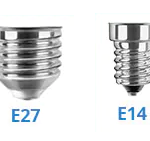
For example, if you have a decorative chandelier, there is a good chance it uses E14 or E12 candle bulbs. On the other hand, most pendant lights and table lamps utilize E27 or E26 sockets.
Why Socket Size Matters
Although some socket sizes appear similar, they are not interchangeable. Therefore, you should never assume that an E26 bulb will automatically fit an E27 fixture or that an E12 bulb can replace an E14 bulb.
In addition, voltage requirements may differ depending on your region, making proper identification even more important.
Bayonet Sockets
While Edison sockets dominate many markets, Bayonet sockets remain extremely popular in the United Kingdom, Australia, and several Commonwealth countries.
Unlike screw bases, Bayonet bulbs feature two side pins that lock into place with a short twist.
Common Bayonet Socket Types
| Socket | Common Name | Typical Use |
|---|---|---|
| B22 | Bayonet Cap (BC) | General household lighting |
| B15 | Small Bayonet Cap (SBC) | Decorative fixtures |
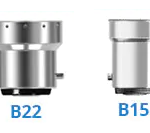
To install a Bayonet bulb, simply insert the pins into the socket, push gently, and rotate approximately 180 degrees until it locks securely.
Consequently, Bayonet sockets offer a reliable connection while allowing quick bulb replacement.
Pin Sockets
Meanwhile, many modern lighting fixtures use pin-based sockets instead of screw or Bayonet bases.
These socket types are particularly common in:
- Recessed spotlights
- Kitchen lighting
- Display lighting
- Under-cabinet lighting
- Decorative wall fixtures
Most Common Pin Socket Types
| Socket | Installation Method | Common Applications |
|---|---|---|
| GU10 | Push and twist | Ceiling spotlights |
| G9 | Push-in | Decorative fixtures |
| G4 | Push-in | Cabinet lighting |
| G5.3 / MR16 | Push-in | Low-voltage spotlights |
Furthermore, the number following the “G” typically refers to the distance between the pins measured in millimeters.
For instance:
- G4 = 4 mm pin spacing
- G5.3 = 5.3 mm pin spacing
- G9 = 9 mm pin spacing
Because of these differences, even small variations in pin spacing can prevent proper installation.
GU10 Sockets
Among all pin-based sockets, GU10 is arguably the most common.
If your kitchen, hallway, bathroom, or living room features recessed spotlights, there is a strong possibility that they use GU10 bulbs.
How GU10 Bulbs Work
Unlike standard pin sockets, GU10 bulbs feature locking pins.
To install:
- Insert the bulb into the socket.
- Push gently upward.
- Rotate clockwise.
- Lock securely into place.
As a result, GU10 bulbs provide a stable connection and are less likely to loosen over time.
Additionally, modern GU10 LED bulbs offer significant energy savings compared to traditional halogen spotlights.
How to Identify Your Bulb Socket in Minutes
If you’re unsure which socket type your fixture uses, don’t worry. The identification process is usually straightforward.
Step 1: Remove the Existing Bulb
First, switch off the power and allow the bulb to cool completely.
Step 2: Examine the Base
Next, look carefully at the bulb base:
✔ Threaded metal base → Edison socket (E27, E14, E26, E12)
✔ Two side pins → Bayonet socket (B22, B15)
✔ Two straight pins → Pin socket (G4, G9, G5.3)
✔ Twist-lock pins → GU10
Step 3: Check for Markings
Most bulbs and fixtures include identification markings such as:
- E27
- E14
- B22
- GU10
- G9
Therefore, checking the label often provides the fastest answer.
Step 4: Measure the Socket
If no markings are visible, measuring the socket can help confirm compatibility.
For example:
- E27 = 27 mm thread diameter
- E14 = 14 mm thread diameter
- G4 = 4 mm pin spacing
Consequently, a simple ruler can often eliminate guesswork.
How to Choose the Right LED Replacement
Once you have identified the socket type, the next step is selecting the appropriate LED bulb.
However, socket compatibility is only part of the equation.
You should also consider:
| Factor | Why It Matters |
|---|---|
| Socket Type | Must physically fit |
| Voltage | Must match fixture requirements |
| Lumens | Determines brightness |
| Color Temperature | Influences ambiance |
| Beam Angle | Affects light distribution |
| Dimmability | Required for dimmer switches |
Therefore, choosing the correct LED involves both mechanical and performance considerations.
Don’t Forget About Dimmer Compatibility
Another critical consideration is dimming performance.
If your fixture uses a dimmer switch, you should always choose a dimmable LED bulb.
Otherwise, you may experience:
- Flickering
- Buzzing noises
- Reduced dimming range
- Premature bulb failure
Moreover, some older dimmer switches are not fully compatible with modern LEDs. Therefore, checking manufacturer compatibility recommendations can save time and frustration.
Can You Use Socket Adapters?
Sometimes you may find the perfect LED bulb, only to discover that the socket type does not match your fixture.
Fortunately, socket adapters can provide a practical solution.
For example:
- E14 to E27 adapter
- E27 to B22 adapter
- E26 to E27 adapter
However, before using an adapter, make sure:
✔ Voltage requirements match
✔ Wattage limits are respected
✔ The bulb fits inside the fixture
✔ Adequate ventilation is maintained
Although adapters are convenient, choosing the correct bulb base is generally the safest and most professional solution. If needed, pls contact us directly, we provide the adapters and other lighting accessories.
Common Mistakes to Avoid
To ensure a successful LED upgrade, avoid these common errors:
❌ Purchasing a bulb based only on appearance
❌ Confusing E27 with E26
❌ Confusing E14 with E12
❌ Installing a non-dimmable bulb on a dimmer circuit
❌ Ignoring voltage requirements
❌ Using oversized bulbs in enclosed fixtures
By avoiding these mistakes, you can improve safety, extend bulb lifespan, and maximize energy efficiency.
Final Thoughts
Ultimately, choosing the right bulb socket is much easier than most people think. First, identify the socket type. Next, confirm voltage compatibility. Then, select the desired brightness, color temperature, and dimming capability.
Whether you need an E27 LED bulb, E14 candle bulb, GU10 spotlight, G9 capsule bulb, or B22 Bayonet bulb, taking a few minutes to verify compatibility can help you avoid costly mistakes and ensure optimal lighting performance.
In short, the correct socket is the foundation of every successful lighting upgrade. Once you get that right, finding the perfect LED replacement becomes a straightforward process.