 English
 العربية
 Français
 Deutsch
 Italiano
 Polski
 Português
 Русский
 Español
 Українська


¿Cuál es la diferencia entre las bombillas E27 y E14??
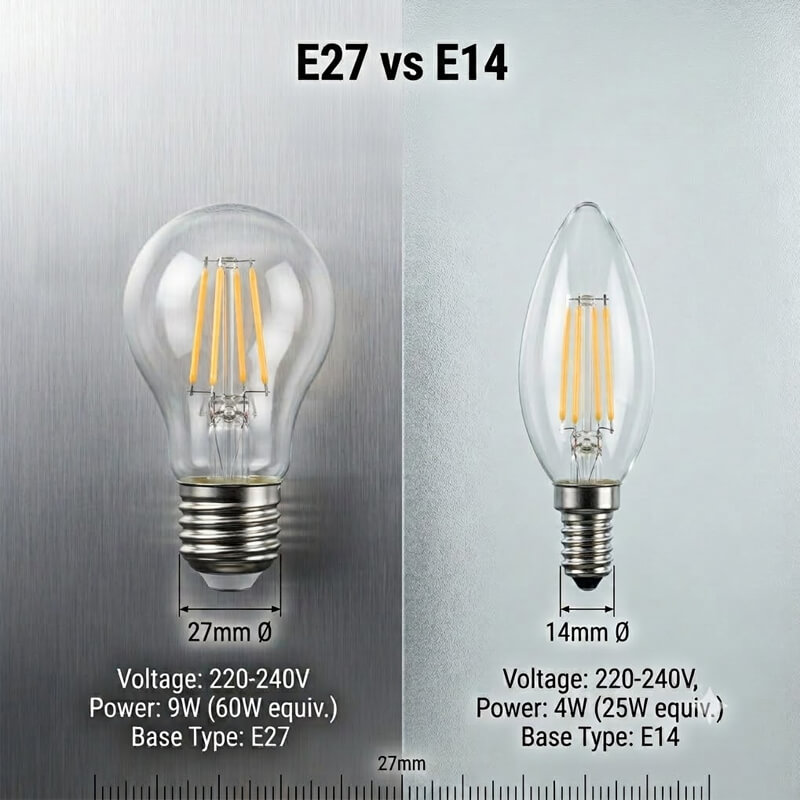
A la hora de comprar bombillas LED para tu hogar, oficina, o proyectos de iluminación, Es posible que a menudo te encuentres con dos tipos de bases de bombillas comunes.: Bombillas E27 y E14. Muchos compradores preguntan: ¿Cuál es la diferencia entre las bombillas E27 y E14?? ¿Se pueden usar en la misma lámpara?? ¿Qué base de bombilla es la elección correcta para mi dispositivo de iluminación??
Aunque ambos Las bombillas E27 y E14 utilizan bases de tornillo Edison., son de diferente tamaño, solicitud, estilos de bombillas compatibles, y capacidad de potencia. Por lo tanto, Elegir la base de bombilla correcta es esencial para garantizar una instalación adecuada., seguridad, y el mejor rendimiento lumínico.
En esta guía, Explicaremos las diferencias clave entre Bombillas E27 frente a E14 desde la perspectiva del comprador, ayudándole a encontrar rápidamente la solución de iluminación adecuada.
1. Diferencia de tamaño entre bombillas E27 y E14
La diferencia más obvia entre Bombillas E27 y E14 es el tamaño de su base de tornillo.
la carta "MI" medio Tornillo Edison, que se refiere al diseño de base de bombilla tipo tornillo. Mientras tanto, el número después de “E” indica el diámetro de la base en milímetros.
En otras palabras:
- E27 = diámetro de la base del tornillo de 27 mm
- E14 = diámetro de la base del tornillo de 14 mm
Debido a esta diferencia de tamaño, Las bombillas E27 y E14 están diseñadas para diferentes tipos de luminarias..
Tamaño de la bombilla E27
Un bombilla E27 tiene una base de tornillo de 27 mm, convirtiéndola en una de las bases de bombillas más utilizadas en todo el mundo..
Debido a su mayor tamaño, la base E27 proporciona:
- Una conexión más fuerte
- Mejor soporte para bombillas más grandes
- Compatibilidad con bombillas LED de mayor potencia
Por esta razón, Las bombillas E27 se utilizan comúnmente para iluminación doméstica y comercial en general..
Las formas comunes de bombillas E27 incluyen:
- Bombillas LED A19
- Bombillas Edison ST64
- bombillas globo g45
- bombillas globo g95
- bombillas decorativas G125
- bombillas de filamento LED
Tamaño de la bombilla E14
En comparación, un bombilla E14 tiene una base de tornillo de 14 mm mucho más pequeña.
Por su diseño compacto, Las bombillas E14 son ideales para luminarias donde el espacio es limitado..
Se utilizan comúnmente con:
- bombillas de vela
- Bombillas de globo pequeñas
- Bombillas decorativas de filamento.
- Bombillas LED compactas
Por lo tanto, Las bombillas E14 a menudo se seleccionan para lámparas decorativas en lugar de aplicaciones de alto brillo..
Comparación rápida del tamaño E27 frente al E14
| Característica | Bombilla E27 | Bombilla E14 |
|---|---|---|
| Diámetro de la base | 27milímetros | 14milímetros |
| tipo básico | tornillo de edison | tornillo de edison |
| Tamaño | Más grande | Menor |
| Uso principal | Iluminación general | Iluminación decorativa |
simplemente hablando:
E27 = base más grande, aplicaciones de iluminación más fuertes
E14 = base más pequeña, aplicaciones decorativas elegantes
2. Diferencia en las regiones de uso entre las bombillas E27 y E14
Aunque tanto las bombillas E27 como E14 son populares en todo el mundo, su uso varía según las preferencias de iluminación regionales.
¿Dónde se utilizan habitualmente las bombillas E27??
Las bombillas E27 se utilizan ampliamente en:
- América del norte
- Europa
- Australia
- Oriente Medio
- Sudeste Asiático
En muchos países, E27 se considera la base de bombilla doméstica estándar..
Por su versatilidad, Las bombillas E27 se instalan con frecuencia en:
- Luces de techo
- Luces colgantes
- Lámparas de mesa
- Lámparas de pie
- Luces de pared
- Accesorios de iluminación exterior
Por ejemplo, Muchas luces colgantes modernas y lámparas de techo decorativas están diseñadas con casquillos E27 porque pueden adaptarse a una amplia gama de formas y estilos de bombillas..
¿Dónde se utilizan habitualmente las bombillas E14??
Por otro lado, Las bombillas E14 son especialmente populares en los países europeos., incluido:
- Alemania
- Francia
- Italia
- España
- el reino unido
A menudo se encuentran en luminarias decorativas y compactas..
Las aplicaciones típicas incluyen:
- Candelabros
- Lámparas de noche
- Luces del gabinete
- Lámparas de pared decorativas
- Lámparas de mesa pequeñas
En particular, Las bombillas tipo vela E14 se utilizan ampliamente en lámparas de araña de estilo europeo porque su forma delgada crea una apariencia elegante y clásica..
3. Diferencia en tipos de bombillas compatibles
Además del tamaño base, Otra diferencia importante entre las bombillas E27 y E14 es la variedad de formas de bombillas disponibles..
Elegir la forma correcta de la bombilla no solo afecta el brillo sino que también influye en la apariencia general de su dispositivo de iluminación..
Tipos de bombillas E27 populares
Dado que E27 tiene una base de tornillo más grande, admite una gama más amplia de diseños de bombillas.
Bombilla LED A19
La bombilla LED A19 es una de las bombillas domésticas más habituales..
Es popular porque ofrece:
- Alto brillo
- Eficiencia energética
- Fácil reemplazo
- Amplia aplicación
Se utiliza comúnmente en dormitorios., sala de estar, cocinas, y oficinas.
Bombilla de filamento LED E27
Para iluminación decorativa, Las bombillas de filamento LED E27 son una opción popular.
Se utilizan comúnmente en:
- Luces colgantes antiguas
- Lámparas industriales
- Iluminación de restaurante
- Candelabros decorativos
Los estilos populares incluyen:
- Bombillas Edison ST64
- bombillas globo g95
- Bombillas de gran tamaño G125
Estas bombillas combinan una apariencia vintage con una moderna tecnología LED de ahorro de energía..
Tipos de bombillas E14 populares
En comparación con las bombillas E27, Las bombillas E14 están más enfocadas a diseños decorativos.
Bombillas LED tipo vela E14
La bombilla de vela es el estilo E14 más popular..
Es ampliamente utilizado en:
- Candelabros
- Lámparas de cristal
- Apliques de pared
- Accesorios decorativos
La forma de la vela crea un ambiente cálido y elegante..
Pequeñas bombillas LED decorativas
Las bombillas E14 también están disponibles en:
- Mini bombillas globo
- bombillas de filamento
- bombillas antiguas
Son ideales para compradores que desean una iluminación elegante y al mismo tiempo ahorrar espacio..
4. Diferencia en potencia de bombilla entre E27 y E14
Otra diferencia clave es el rango de potencia típico.
Generalmente, Las bombillas E27 admiten mayor potencia, mientras Las bombillas E14 están diseñadas para aplicaciones de iluminación más pequeñas..
Rango de potencia de la bombilla E27
Las bombillas LED E27 suelen oscilar entre:
- 4W–10W para iluminación decorativa
- 10W–15W para iluminación del hogar
- 15W–20W+ para aplicaciones de alto brillo
Reemplazos típicos:
- 6W LED ≈ 40W incandescente
- 10LED W ≈ 75W incandescente
- 15W LED ≈ 100W incandescente
Por lo tanto, Las bombillas E27 son una mejor opción cuando necesitas una iluminación más intensa.
Rango de potencia de la bombilla E14
Porque las luminarias E14 suelen ser más pequeñas, su rango de potencia es generalmente menor.
Las potencias comunes de las bombillas LED E14 incluyen:
- 2W–5W para iluminación decorativa
- 5W–8W para habitaciones pequeñas
- 8W–12W para aplicaciones más brillantes
Sin embargo, El brillo no sólo depende de la potencia.. La potencia luminosa real también depende de:
- Lúmenes
- Calidad del chip LED
- Ángulo de haz
- Temperatura de color
Consejo para el comprador:
Antes de comprar cualquier bombilla, siempre revisa:
- El tipo de enchufe
- La potencia máxima del dispositivo.
- El espacio de instalación disponible
Instalar una bombilla de gran tamaño o con demasiada potencia puede reducir la vida útil o crear problemas de sobrecalentamiento.
5. Otras diferencias entre las bombillas E27 y E14
además del tamaño, región, tipos de bombillas, y poder, Hay varias otras diferencias que vale la pena considerar..
1. Diferentes aplicaciones de iluminación
Las bombillas E27 son adecuadas para:
- Iluminación de la habitación principal
- Iluminación de cocina
- Luces colgantes
- Lámparas de exterior
- iluminación comercial
Proporcionan más flexibilidad porque hay muchos estilos de bombillas y opciones de brillo disponibles..
Las bombillas E14 son adecuadas para:
- Candelabros
- Lámparas decorativas
- Iluminación de acento
- Pequeños accesorios
Se prefieren cuando la apariencia y el diseño son importantes..
2. Compatibilidad con diferentes accesorios
Las bombillas E27 y E14 no pueden reemplazarse directamente entre sí.
Por ejemplo:
- Una bombilla E27 no cabe en un casquillo E14.
- Una bombilla E14 no cabe en un casquillo E27.
Aunque existen adaptadores, Usar la base de bombilla correcta es siempre la opción más segura y confiable..
3. Diferentes efectos de apariencia
Porque las bombillas E27 son más grandes, A menudo se convierten en un elemento de diseño visible en los accesorios de iluminación..
Funcionan bien con:
- Lámparas de estilo industrial
- Luces colgantes modernas
- Grandes accesorios decorativos
Mientras tanto, Las bombillas E14 tienen una apariencia más pequeña y delicada.
Son ideales para:
- Candelabros clásicos
- Iluminación de cristal
- Lámparas de pared antiguas
6. Preguntas frecuentes sobre las bombillas E27 y E14
Q1: ¿Son intercambiables las bombillas E27 y E14??
No. Tienen diferentes diámetros de tornillo..
Las bombillas E27 requieren casquillos E27, mientras que las bombillas E14 requieren casquillos E14.
Q2: cual es mas brillante, E27 o E14?
Generalmente, Las bombillas E27 pueden proporcionar un mayor brillo porque generalmente admiten opciones LED de mayor potencia..
Sin embargo, El brillo depende de la salida real de lúmenes y no solo del tamaño de la base de la bombilla..
Q3: ¿Es E27 una base de bombilla estándar??
Sí. E27 es una de las bases de bombillas estándar más comunes utilizadas en la iluminación doméstica en todo el mundo..
Q4: ¿Puedo utilizar una bombilla E14 en una lámpara E27??
No, son de diferentes tamaños.
Debes utilizar la base de la bombilla que coincida con el portalámparas..
Q5: ¿Qué bombilla es mejor para las luces colgantes??
Depende del diseño de la lámpara colgante..
- Las lámparas colgantes grandes suelen utilizar bombillas E27..
- Las pequeñas luces colgantes decorativas pueden utilizar bombillas E14..
Para iluminación colgante de estilo vintage, Las bombillas de filamento LED E27 son especialmente populares.
Q6: ¿Qué bombilla debo elegir para una lámpara de araña??
La mayoría de las lámparas de araña tradicionales utilizan bombillas de vela E14 porque proporcionan un efecto decorativo elegante..
Sin embargo, Algunas lámparas de araña modernas utilizan bombillas E27 para un rendimiento de iluminación más potente..
Siempre verifique las especificaciones del dispositivo antes de comprar..
7. Conclusión: Bombillas E27 frente a E14, ¿Cuál deberías elegir??
La principal diferencia entre Bombillas E27 y E14 es el tamaño de la base del tornillo. Sin embargo, las diferencias también afectan el estilo de la bombilla, brillo, compatibilidad de accesorios, y aplicación.
para resumir:
- bombillas e27 Cuentan con una base de 27 mm y son ideales para iluminación general., luces colgantes, y aplicaciones que requieren mayor brillo.
- bombillas e14 Tienen una base de 14 mm y son perfectos para lámparas de araña., lámparas decorativas, y luminarias compactas.
Al elegir entre Bombillas E27 frente a E14, siempre considere:
✔ Su tipo de portalámparas
✔ Nivel de brillo requerido
✔ Tamaño del accesorio
✔ Aspecto del bulbo
✔ Potencia nominal máxima
Para la mayoría de los proyectos de iluminación cotidianos, Las bombillas LED E27 ofrecen mayor versatilidad, mientras Las bombillas LED E14 son la mejor opción para una iluminación decorativa elegante.
Comprender la diferencia entre Bombillas E27 y E14 te ayudará a evitar errores de compra, mejorar el rendimiento de la iluminación, y crea la atmósfera ideal para tu espacio. Haga clic aquí para Bombillas E27 y E14