 English
 العربية
 Français
 Deutsch
 Italiano
 Polski
 Português
 Русский
 Español
 Українська


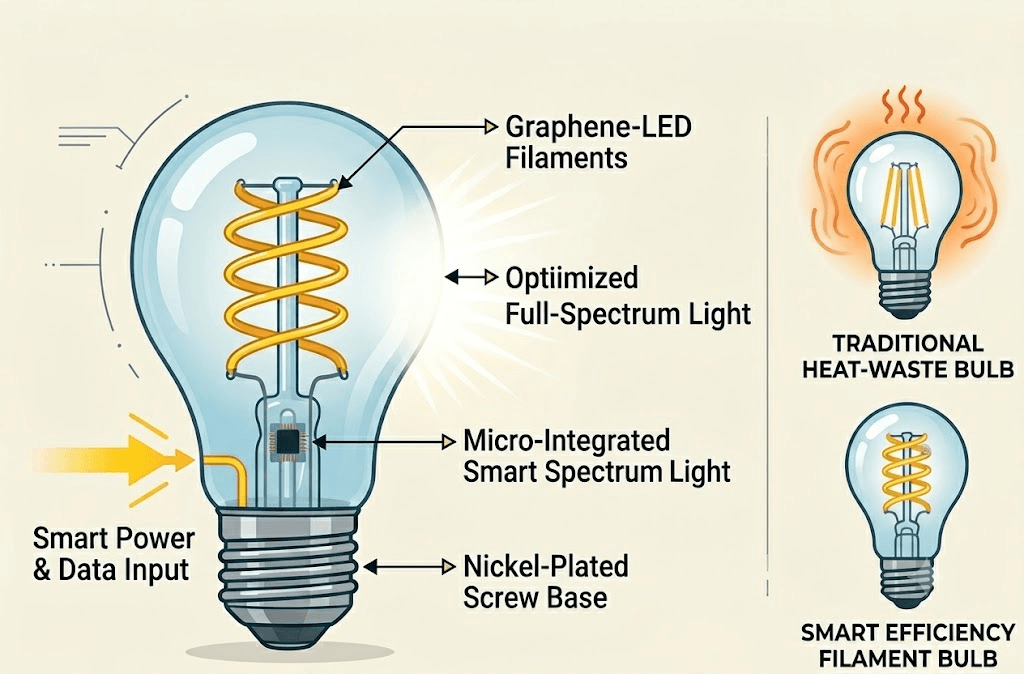
Як працює світлодіодне освітлення: The Science Behind Modern Energy-Efficient Light Bulbs
LED lighting has completely transformed the way we illuminate our homes, офіси, готелі, ресторани, та комерційні площі. Compared with traditional incandescent bulbs and CFL bulbs, LED lights provide better energy efficiency, довший термін служби, improved lighting quality, і нижчі витрати на технічне обслуговування.
Проте, many people use LED bulbs every day without knowing what actually happens inside them. When you turn on an LED light, how does electricity become bright, комфортне освітлення?
The answer lies in a tiny but powerful component inside the bulb: the semiconductor chip.
When electrical current passes through this chip, it produces visible light through a process called electroluminescence. Unlike incandescent bulbs, which heat a filament until it glows, LED technology converts electricity directly into light. В результаті, much less energy is wasted as heat.
Because of this efficient energy conversion, LED bulbs can reduce electricity consumption by up to 80% compared with traditional lighting. Крім того, their long service life helps reduce replacement frequency and maintenance costs.
Сьогодні, LED technology is used everywhere—from decorative Edison bulbs and candle bulbs in chandeliers to recessed downlights, розумні системи освітлення, and commercial lighting solutions.
У цьому повному посібнику, ми пояснимо how LED lighting works, what components are inside an LED bulb, why LEDs are more energy-efficient than traditional bulbs, and how factors such as brightness, колірна температура, and CRI affect your lighting experience. The picture below may help you have a better understanding of how the bulb works.
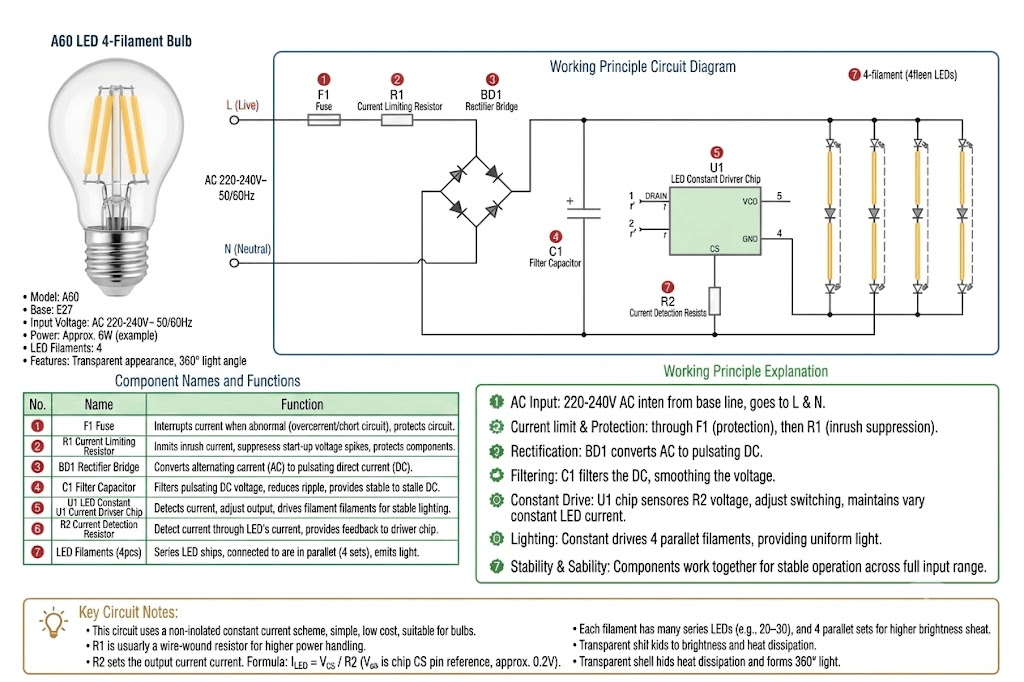
Whether you are replacing a single bulb, upgrading your home lighting, or planning a commercial lighting project, understanding LED technology will help you choose the right lighting solution.
What Is an LED?
Before exploring how LED lighting works, it is important to understand what the term “LED” means.
Світлодіод означає Світлодіод. It is a semiconductor device that converts electrical energy into visible light.
Unlike incandescent bulbs, which create light by heating a tungsten filament, LEDs produce light through a process called electroluminescence.
Simply explained:
Electricity enters → Electrons move inside the semiconductor → Energy is released as light
Because LEDs do not need to heat a filament, they use energy much more efficiently and generate significantly less heat.
This simple but advanced technology is the reason LED bulbs are:
- More energy-efficient
- Longer-lasting
- Cooler during operation
- More flexible in design
- Available in many colors and lighting styles
As LED technology continues to improve, manufacturers can now create bulbs with better brightness, higher color accuracy, and smarter control features.
A Brief History of LED Technology
Although LED lighting is considered a modern technology, its development has taken many years.
The first LEDs were not designed for home lighting. Натомість, they were mainly used as small indicator lights in electronic devices.
З часом, improvements in semiconductor materials transformed LEDs into today’s advanced lighting solutions.
1962 – The First Practical LED
Nick Holonyak Jr. developed the first practical visible red LED, creating the foundation for future LED technology.
1970s–1980s – More LED Colors Were Developed
У цей період, manufacturers introduced yellow, orange, and green LEDs, expanding LED applications beyond simple indicators.
1990s – Blue LED Changed the Lighting Industry
The development of high-brightness blue LEDs was a breakthrough. By combining blue LED chips with phosphor materials, manufacturers could finally create efficient white LED lighting.
2000s – LED Bulbs Entered Homes
As production costs decreased and performance improved, LED bulbs became a practical replacement for incandescent and CFL bulbs.
Today – LED Lighting Dominates the Market
Modern LEDs are now widely used in:
- Житлове освітлення
- Комерційні будівлі
- Готелі та ресторани
- Зовнішнє освітлення
- Розумні системи освітлення
- Industrial applications
Найголовніше, the invention of blue LED technology made modern white LED lighting possible and completely changed the global lighting industry.
LED vs Incandescent vs CFL Bulbs: Which One Is Better?
To better understand why LEDs have become so popular, it helps to compare them with older lighting technologies.
| Особливість | Лампа розжарювання | CFL | LED |
|---|---|---|---|
| Джерело світла | Heated filament | Mercury gas | Semiconductor chip |
| Енергоефективність | Низький | Середній | Високий |
| Typical Efficiency | Around 15 лм/Вт | Around 60 лм/Вт | 80–120 lm/W |
| Тривалість життя | про 1,000 години | про 8,000 години | 25,000–50,000+ hours |
| Теплова потужність | Дуже високий | Помірний | Низький |
| Mercury Content | немає | так | немає |
| Energy Consumption | Highest | Середній | Lowest |
As the comparison shows, LED bulbs provide advantages in almost every category.
Наприклад, replacing a traditional 60W incandescent bulb with a 9W LED bulb can provide similar brightness while using much less electricity.
тому, LEDs are now the preferred choice for homeowners, підприємства, and lighting professionals around the world.
Anatomy of a Modern LED Bulb
Although an LED bulb may look similar to a traditional light bulb from the outside, its internal structure is much more advanced.
Inside every LED bulb, several key components work together to create stable, ефективний, and high-quality lighting.
Understanding these parts also explains why some LED bulbs perform much better than others, even when they have the same wattage.
LED Chip: The Heart of the Bulb
The LED chip is the most important part of the entire lighting system.
It is the component that produces light when electricity passes through it.
Modern LED chips are usually made from semiconductor materials such as:
- Gallium Nitride (GaN)
- Indium Gallium Nitride (InGaN)
These materials efficiently convert electrical energy into visible light.
Сьогодні, LED chips are commonly available in three main types:
SMD LED (Surface Mounted Device)
SMD LEDs are widely used in household lighting products.
Переваги:
- High efficiency
- Рівномірний розподіл світла
- Reliable performance
- Cost-effective production
They are commonly found in LED bulbs, panels, and downlights.
COB LED (Chip on Board)
COB LEDs combine multiple LED chips on one board.
Benefits include:
- Higher brightness
- Better thermal management
- Stronger light output
They are often used in commercial lighting and high-power applications.
LED Filament Chip
LED filament technology is designed to imitate the appearance of traditional incandescent filaments.
These bulbs are especially popular for:
- Лампочки Едісона
- Vintage lighting
- Decorative chandeliers
- Підвісні світильники
As LED chip technology continues to improve, manufacturers can produce brighter lighting solutions with lower power consumption.
Світлодіодний драйвер: The Brain of an LED Bulb
While the LED chip is the part that creates light, it cannot work directly with the electricity from your home.
This is where the Світлодіодний драйвер becomes essential.
The LED driver works like a small power management system inside the bulb. Its main job is to convert the high-voltage alternating current (AC) from your electrical system into the low-voltage direct current (DC) that the LED chip needs.
Якщо говорити простою мовою:
Home electricity → LED driver → Stable power → LED chip produces light
Besides converting power, a high-quality LED driver also controls current flow and protects the bulb from electrical fluctuations.
A good LED driver provides several important functions:
- AC to DC power conversion
- Constant current regulation
- Voltage protection
- Surge protection
- Flicker reduction
- Dimming compatibility
тому, the quality of the LED driver has a direct impact on the bulb’s performance, brightness stability, and lifespan.
З іншого боку, low-quality LED drivers may cause common problems such as:
- Visible flickering
- Дзижчання
- Reduced brightness
- Shorter lifespan
- Погана продуктивність затемнення
З цієї причини, choosing LED bulbs from reliable manufacturers is important, especially for applications where lighting quality matters, such as homes, готелі, ресторани, and retail stores.
Тепловідвід: Keeping LED Bulbs Cool and Reliable
Although LED bulbs produce much less heat than incandescent bulbs, they are not completely heat-free.
Під час експлуатації, the LED chip still generates a small amount of heat. If this heat cannot escape properly, it may damage internal components and reduce the bulb’s lifespan.
To solve this problem, manufacturers add a heat sink to LED bulb designs.
The heat sink works by absorbing heat from the LED chip and transferring it into the surrounding environment.
Common heat sink materials include:
- Алюміній
- Керамічні
- Graphite composite materials
Among these materials, aluminum is widely used because it provides excellent heat dissipation while remaining lightweight and affordable.
В результаті, effective thermal management helps LED bulbs:
- Maintain stable brightness
- Prevent overheating
- Improve reliability
- Achieve their rated lifespan
This is also why two LED bulbs with the same wattage can have very different lifespans. The internal design and heat management system make a significant difference.
Phosphor Coating and Diffuser: Creating Comfortable White Light
One interesting fact about LED technology is that most LED chips do not naturally produce white light.
Натомість, many LED chips produce blue light.
So how do manufacturers create the warm white or cool white lighting we see every day?
The answer is a special material called phosphor coating.
A phosphor layer is applied over the LED chip. When blue light passes through this coating, part of the energy is converted into other wavelengths, including yellow, orange, and red light.
The combination of these colors creates the appearance of white light to the human eye.
This technology allows manufacturers to produce different lighting colors, в тому числі:
| Колірна температура | Appearance | Common Applications |
|---|---|---|
| 2700К | Теплий білий | спальні, житлові кімнати |
| 3000К | Soft Warm White | Готелі, ресторани, обідні зони |
| 4000К | Нейтральний білий | Кухні, ванні кімнати, офіси |
| 5000К | Холодний білий | Workspaces, commercial areas |
| 6500К | Daylight White | Гаражі, майстерні |
Крім того, LED bulbs usually include a diffuser or optical cover.
The diffuser helps:
- Spread light evenly
- Reduce glare
- Eliminate harsh hotspots
- Create a more comfortable visual experience
тому, high-quality LED bulbs are not only about brightness—they are also about producing comfortable and balanced lighting.
Lamp Base and Housing: Making LED Bulbs Easy to Install
After the internal components are assembled, they are protected inside the bulb housing and connected to a lamp base.
The base is the part that connects the bulb to the fixture and supplies electrical power.
Common LED bulb base types include:
- E26
- E27
- E12
- E14
- GU10
- MR16
- B22
Choosing the correct bulb base is essential because an incompatible base may prevent installation or affect safety.
Наприклад:
- E26 and E27 are widely used in household screw sockets
- E12 is commonly used for decorative candle bulbs and chandeliers
- GU10 is often found in spotlights and recessed lighting
By understanding bulb bases, you can quickly select the correct replacement LED bulb for your fixture.
The Science Behind LED Lighting: How Electricity Becomes Light
Now that we understand the main parts inside an LED bulb, let’s look deeper into the actual science behind how LEDs create light.
Although the process happens at a microscopic level, the basic idea is surprisingly simple.
The P-N Junction: Where Light Is Generated
Inside every LED chip is a special structure called a P-N junction.
It contains two semiconductor layers:
N-Type Semiconductor
This layer contains extra electrons.
P-Type Semiconductor
This layer contains areas called “holes,” which are spaces where electrons can move.
When electricity flows through the LED, electrons move from the N-type layer toward the P-type layer.
When electrons combine with holes, energy is released.
This process is called electron-hole recombination.
The released energy appears as tiny particles of light called photons.
Якщо говорити простою мовою:
Electricity → Electron movement → Photon release → Visible light
Unlike incandescent bulbs, LEDs do not need to heat anything to create light.
Через це, much more electrical energy becomes useful illumination instead of wasted heat.
Why LEDs Produce Different Colors
The color of an LED depends on the semiconductor materials used inside the chip.
Different materials have different energy levels, також відомий як band gaps.
The energy difference determines the wavelength of the light produced.
Наприклад:
| Колір | Approximate Wavelength |
|---|---|
| Червоний | 620–750 nm |
| Зелений | 520–560 nm |
| Синій | 460–495 nm |
| Violet | 400–420 nm |
By adjusting semiconductor materials, manufacturers can create different LED colors for various applications.
This technology is used in:
- Декоративне освітлення
- Smart RGB bulbs
- Display screens
- Architectural lighting
How White LEDs Create White Light
Цікаво, most white LED bulbs do not create white light directly.
Натомість, they use a combination of:
- Blue LED chip
- Phosphor coating
The blue LED produces blue light, while the phosphor coating converts part of that light into other colors.
When these colors mix, our eyes perceive the result as white light.
This method provides:
- High efficiency
- Better color consistency
- Тривалий термін служби
- Lower production cost
Через ці переваги, phosphor-converted LEDs have become the standard technology for modern white LED lighting.
Why LED Lighting Is So Energy Efficient
One of the biggest reasons people switch to LED lighting is energy savings.
Проте, the real advantage of LED technology is not simply that it uses fewer watts. The key difference is how efficiently LEDs convert electricity into usable light.
Traditional incandescent bulbs work by heating a metal filament until it becomes hot enough to glow. В результаті, most of the electricity is released as heat instead of light.
У порівнянні, LED bulbs use semiconductor technology to convert electricity directly into light.
This means:
Less energy wasted → More energy converted into light → Lower electricity costs
Because of this efficient design, LED bulbs can provide the same brightness as traditional bulbs while using significantly less power.
For homeowners, this means lower monthly electricity bills.
For businesses, such as hotels, ресторани, офіси, and retail stores, LED lighting can greatly reduce long-term operating costs.
Lumens vs Watts: Understanding LED Brightness
When buying traditional bulbs, many people used watts to estimate brightness.
Проте, with LED technology, this method is no longer accurate.
Причина проста:
Watts measure energy consumption, not brightness.
Lumens measure actual light output.
Наприклад:
| Traditional Bulb | Яскравість | LED Equivalent |
|---|---|---|
| 25W Incandescent | Around 250 люменів | 2–3W LED |
| 40W Incandescent | Around 450 люменів | 4–6W LED |
| 60W Incandescent | Around 800 люменів | 7–10W LED |
| 75W Incandescent | Around 1,100 люменів | 10–13W LED |
| 100W Incandescent | Around 1,600 люменів | 14–18W LED |
тому, when choosing an LED bulb, it is better to focus on lumens instead of watts.
Наприклад, if you want the same brightness as an old 60W incandescent bulb, look for an LED bulb with around 800 люменів.
This simple change in shopping habits can help you select the right LED bulb more easily.
Less Heat Means More Benefits
Another important advantage of LED lighting is reduced heat production.
Traditional incandescent bulbs release a large amount of energy as heat. Насправді, приблизно 90% of their energy can be lost as heat rather than useful light.
LED bulbs operate differently.
Because they convert electricity more efficiently, they produce much less heat.
В результаті:
- Rooms stay cooler
- Air conditioning systems work less
- Fixtures remain safer
- Bulbs last longer
- Energy waste is reduced
This is especially valuable in warm climates, commercial buildings, and enclosed fixtures where excessive heat can affect performance.
Крім того, lower energy consumption helps reduce carbon emissions, making LED lighting a more environmentally friendly choice.
Color Quality: Why Good Lighting Is More Than Brightness
Although brightness is important, it is not the only factor that determines lighting quality.
A comfortable lighting environment also depends on:
- Колірна температура
- Індекс передачі кольору (CRI)
- Dimming performance
- Flicker control
These factors influence how a space looks and feels.
Наприклад, a restaurant may need warm, inviting light, while an office may require brighter, cooler lighting to improve concentration.
Understanding these details helps you choose LED bulbs that match the purpose of each space.
Розуміння колірної температури (CCT)
Color temperature describes how the light appears to the human eye.
It is measured in Kelvin (К).
Lower Kelvin values create warmer, more yellow light, while higher Kelvin values create cooler, more blue-toned light.
| Колірна температура | Appearance | Recommended Use |
|---|---|---|
| 2700К | Теплий білий | спальні, житлові кімнати |
| 3000К | Soft White | Їдальні, готелі, ресторани |
| 4000К | Нейтральний білий | Кухні, ванні кімнати, офіси |
| 5000К | Холодний білий | Workspaces, commercial areas |
| 6500К | Денне світло | Гаражі, майстерні |
Наприклад:
A 2700K LED bulb creates a cozy atmosphere, making it ideal for relaxing areas.
Тим часом, a 4000K or 5000K bulb provides clearer and more energetic lighting, which works better for working environments.
тому, selecting the correct color temperature is just as important as choosing the right brightness.
Why CRI Matters in LED Lighting
Another important factor affecting lighting quality is CRI, or Color Rendering Index.
CRI measures how accurately a light source shows the true colors of objects compared with natural sunlight.
The higher the CRI value, the more natural colors appear. You can see the difference between different CRI ratings according the picture below.
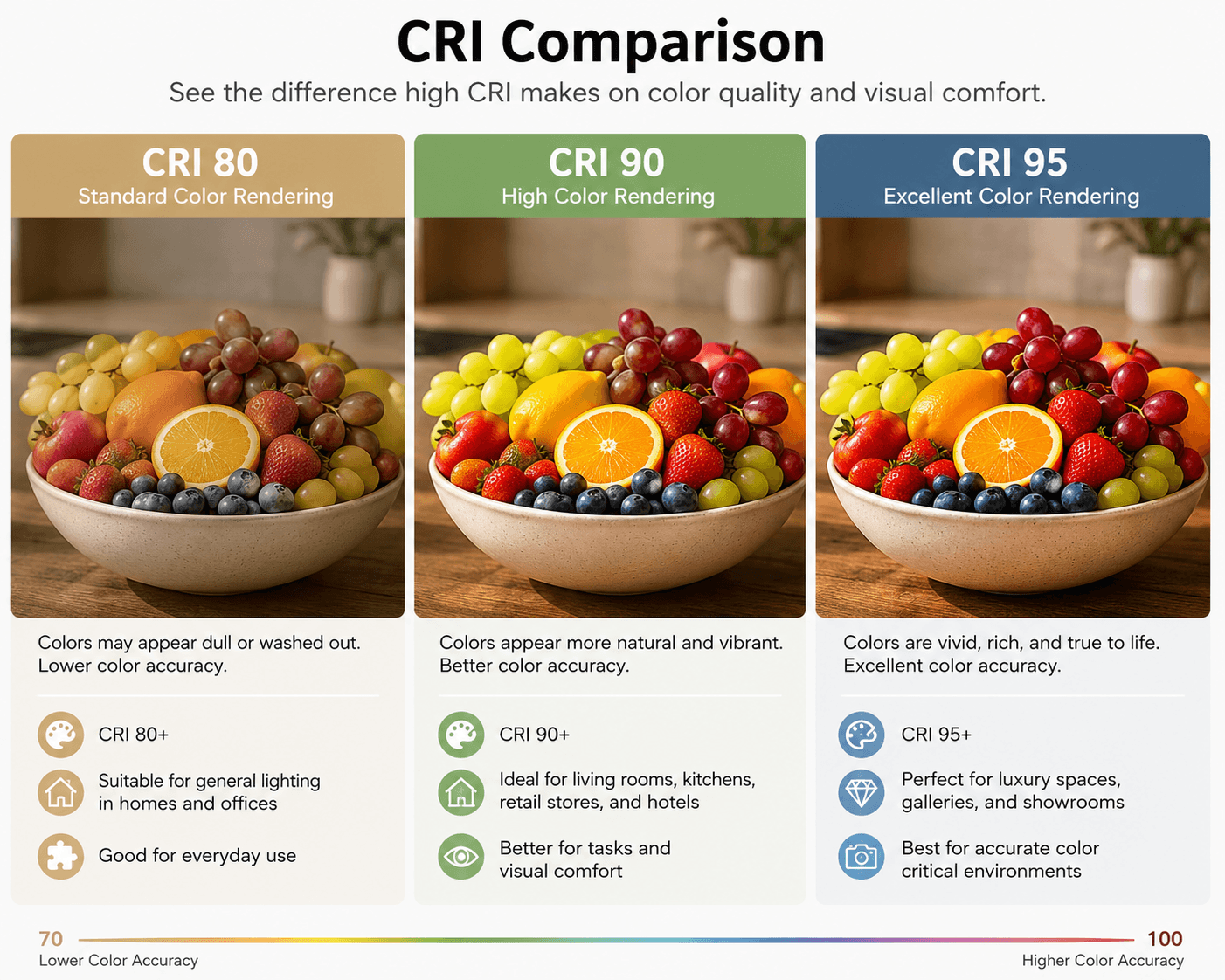
For everyday home lighting, CRI 80+ is usually acceptable.
Проте, for spaces where color appearance matters, такі як:
- Ресторани
- Clothing stores
- Художні галереї
- Готелі
- Makeup areas
CRI 90+ LED bulbs are often recommended.
High-CRI lighting can make:
- Food looks fresher
- Skin tones appear more natural
- Interior colors look richer
- Products appear more attractive
тому, brightness alone does not define a high-quality LED bulb.
LED Dimming Technology: Creating the Right Atmosphere
One of the advantages of modern LED lighting is the ability to adjust brightness.
Проте, LED bulbs work differently from traditional incandescent bulbs.
Incandescent bulbs can be dimmed simply by reducing electrical power.
LED bulbs require special electronic control systems.
Common LED dimming technologies include:
Leading-Edge Dimming
A traditional dimming method that is often used with older systems.
Trailing-Edge Dimming
A newer technology that usually provides smoother and quieter LED dimming.
Smart Dimming
Allows users to control brightness through:
- Mobile apps
- Голосові помічники
- Системи розумного будинку
When installing dimmable LED bulbs, always check compatibility between the bulb and dimmer switch.
Using an incompatible dimmer may cause:
- Мерехтіння
- дзижчання
- Обмежений діапазон затемнення
- Shortened bulb lifespan
Understanding LED Flicker
Although LED bulbs are highly efficient, poor-quality products may experience flickering.
LED flicker usually happens when the driver cannot provide a stable electrical current.
Common causes include:
- Low-quality drivers
- Incorrect dimmer compatibility
- Poor circuit design
Visible flicker may lead to:
- Eye discomfort
- Headaches
- Camera recording issues
- Reduced visual comfort
На щастя, high-quality LED bulbs with reliable drivers can significantly reduce or eliminate flickering problems.
For areas where people spend many hours, such as offices, спальні, та комерційні площі, choosing flicker-free LED lighting is especially important.
Why LED Bulbs Last So Long
One of the most impressive advantages of LED technology is its extremely long lifespan.
Unlike incandescent bulbs, which usually fail suddenly when the filament burns out, LED bulbs work in a completely different way.
Instead of suddenly stopping, LEDs gradually lose brightness over time. This process is called амортизація просвіту.
Іншими словами, a high-quality LED bulb does not usually “burn out” like traditional bulbs. Натомість, its light output slowly decreases until it reaches the end of its useful life.
Most quality LED bulbs are rated for:
- 15,000 години
- 25,000 години
- 35,000 години
- 50,000+ години
For an average household, a 25,000-hour LED bulb can last more than 10 років, depending on daily usage.
Проте, the actual lifespan of an LED bulb depends on several important factors:
Heat Management
Good thermal design helps protect the LED chip and electronic components from overheating.
Driver Quality
A reliable driver ensures stable power delivery and reduces stress on internal parts.
Електрична стабільність
Stable voltage helps prevent premature damage.
Fixture Ventilation
Proper airflow allows heat to escape and improves long-term performance.
тому, while LED technology itself is designed to last for many years, product quality and internal design still play a major role.
Common Applications of LED Lighting
Because LED technology is efficient, durable, and highly flexible, it is now used in almost every type of lighting application.
From simple household bulbs to advanced smart lighting systems, LEDs have become an essential part of modern lighting design.
Residential LED Lighting
In homes, LED bulbs are commonly used for:
- Ceiling lights
- Підвісні світильники
- Люстри
- Настільні лампи
- Торшери
- Вбудовувані світильники
- Outdoor fixtures
Наприклад, decorative LED filament bulbs are popular in living rooms, обідні зони, and restaurants because they combine energy efficiency with a classic vintage appearance.
Тим часом, LED downlights and ceiling lights provide bright, clean illumination for kitchens, ванні кімнати, and work areas.
Decorative LED Lighting
LED technology has also changed decorative lighting.
Popular decorative LED products include:
- Edison LED bulbs
- Candle LED bulbs
- Vintage filament bulbs
- Глобусні цибулини
- Smart RGB bulbs
These products allow designers and homeowners to create different atmospheres while maintaining low energy consumption.
Наприклад:
- Warm white candle bulbs create an elegant chandelier effect
- Edison bulbs add a vintage industrial style
- RGB smart bulbs create customizable colors and moods
Commercial LED Lighting
Businesses increasingly choose LED lighting because it reduces operating costs and improves the customer experience.
Common applications include:
- Готелі
- Ресторани
- Роздрібні магазини
- Офіси
- Склади
- Торгові центри
In commercial environments, lighting quality is especially important because it affects:
- Customer comfort
- Product appearance
- Brand atmosphere
- Employee productivity
В результаті, many commercial projects now use high-quality LED systems instead of traditional lighting solutions.
Specialty LED Applications
Beyond everyday lighting, LEDs are also used in specialized fields such as:
- Street lighting
- Architectural lighting
- Ландшафтне освітлення
- Horticultural lighting
- UV applications
- Automotive lighting
Because LEDs are small, ефективний, and easy to control, they continue to create new possibilities across different industries.
Як вибрати найкращу світлодіодну лампу
After learning how LED lighting works, choosing the right LED bulb becomes much easier.
Проте, many buyers still focus only on wattage or price. У реальності, several factors determine whether an LED bulb will provide the right brightness, комфорт, and lifespan.
Перед покупкою, consider the following points.
1. Check Brightness (Люмен)
The first step is choosing the correct brightness.
Пам'ятайте:
Watts = Energy consumption
Lumens = Light output
Наприклад:
- 400–500 lumens → Small lamps and accent lighting
- 800 lumens → Replacement for a traditional 60W bulb
- 1,100+ lumens → Larger rooms or brighter spaces
Choosing the correct lumen output prevents rooms from being too dark or unnecessarily bright.
2. Select the Right Color Temperature
The best color temperature depends on the atmosphere you want to create.
For relaxing spaces:
Виберіть:
- 2700К
- 3000К
Suitable for:
- спальні
- Житлові кімнати
- Ресторани
- Готелі
For working environments:
Виберіть:
- 4000К
- 5000К
Suitable for:
- Офіси
- Кухні
- Майстер-класи
The right color temperature can significantly improve comfort and visual experience.
3. Consider CRI for Better Color Quality
If accurate colors matter, choose a higher CRI LED bulb.
For general lighting:
- CRI 80+ is acceptable
For premium applications:
- CRI 90+ is recommended
High CRI lighting is especially useful for:
- Обідні зони
- Retail displays
- Мистецтво
- Makeup spaces
- Hospitality projects
4. Confirm the Bulb Base Type
Always check whether the bulb base matches your fixture.
Common options include:
- E26
- E27
- E12
- E14
- GU10
- MR16
- B22
Наприклад:
E26 and E27 screw bases are commonly used in household fixtures.
E12 and E14 are often used for decorative chandeliers and candle-style bulbs.
Choosing the correct base ensures easy installation and safe operation.
5. Check Dimming Compatibility
If you want adjustable brightness, make sure the bulb is labeled as dimmable.
Also check that:
- The dimmer switch supports LED technology
- The wattage range is compatible
- The bulb and dimmer are designed to work together
Інакше, you may experience flickering or poor dimming performance.
6. Consider the Fixture Environment
Not every LED bulb is suitable for every fixture.
Наприклад:
- Enclosed fixtures need bulbs designed for heat control
- Outdoor fixtures require weather-resistant designs
- High-temperature environments need stronger thermal management
Selecting the correct LED bulb for the environment helps maximize lifespan and performance. Check here for more high-quality LED bulbs on Huiyeetech.
Frequently Asked Questions About LED Lighting
How do LED lights work in simple terms?
LED lights create illumination when electricity passes through a semiconductor chip. The movement of electrons releases energy in the form of photons, which we see as visible light.
На відміну від традиційних цибулин, LEDs do not heat a filament, so they waste much less energy.
Can I replace any bulb with an LED bulb?
У більшості випадків, так.
Проте, you should check:
- Bulb base type
- Напруга
- Brightness requirements
- Dimming compatibility
- Fixture limitations
Choosing a compatible LED bulb ensures safe installation and reliable performance.
Why are LED bulbs more expensive than traditional bulbs?
LED bulbs usually cost more upfront because they contain advanced components such as:
- Semiconductor chips
- LED drivers
- Heat management systems
- Optical components
Проте, the higher initial cost is usually balanced by:
- Lower electricity usage
- Довший термін служби
- Fewer replacements
З часом, LEDs often become the more economical choice.
Do LED lights use a lot of electricity?
немає.
LED lights are among the most energy-efficient lighting technologies available today.
They provide similar brightness while using much less electricity compared with incandescent and CFL bulbs.
Are LED bulbs better than incandescent bulbs?
For most applications, так.
LED bulbs offer:
- Менше споживання енергії
- Довший термін служби
- Less heat
- Краща довговічність
- More design options
This is why LEDs have become the standard replacement for traditional lighting.
Заключні думки: Why LED Lighting Is the Future
LED lighting has completely changed the way we use and understand light.
By converting electricity directly into visible light, LEDs provide outstanding energy efficiency, довший термін служби, lower maintenance costs, and better lighting performance.
Крім того, continuous improvements in semiconductor technology, LED drivers, thermal management, color quality, and smart controls continue to make LED lighting even more powerful and versatile.
Whether you are replacing a single household bulb, upgrading a commercial space, or designing a complete lighting project, understanding how LED lighting works allows you to make better decisions.
From energy savings to improved comfort, LED technology offers a smarter, очищувач, and more sustainable way to illuminate the world.
The future of lighting is LED—and that future is already here.